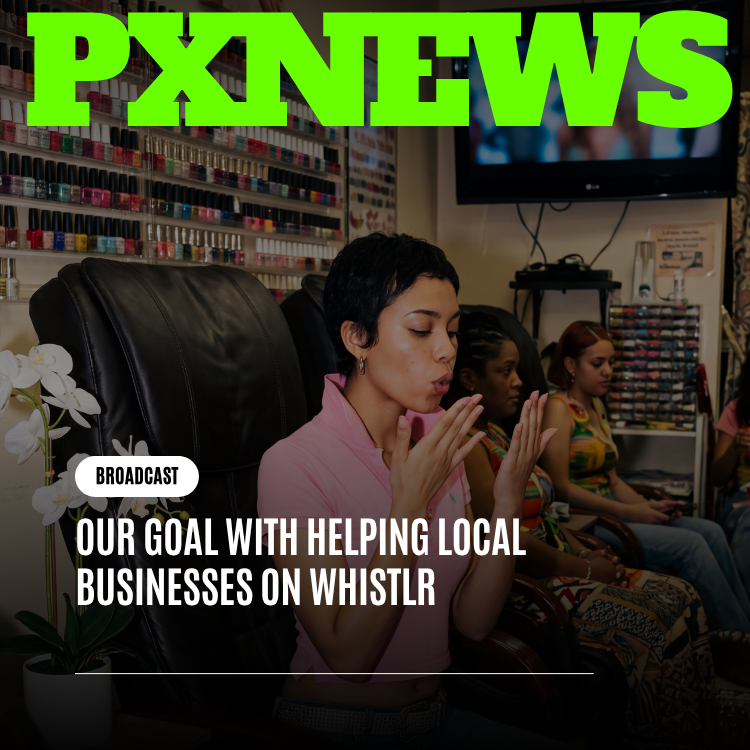
Walk into almost any conversation about social commerce and you'll hear the same handful of names — the same national brands, the same seven-figure creators, the same case studies everyone's already read. That conversation rarely has room for the coffee shop on the corner, the person who sews clothes out of a spare bedroom, or the potter who sells out of a booth at the farmers market twice a month. ETAPX built Storefronts, Live Shopping, and Circuits on Whistlr with those people in mind first, not as an afterthought bolted onto tools designed for someone else. This is the story of why local businesses sit at the center of that thinking, what it actually looks like when a small business grows through Whistlr, and where ETAPX intends to keep taking these tools next.
Why "Local" Isn't a Side Case for ETAPX
Most commerce features get designed around the biggest possible customer first — the brand with a warehouse, a marketing team, and a budget for paid placement — and then get simplified downward until they're technically usable by someone smaller. ETAPX has tried to build Whistlr's commerce tools the other direction. Storefronts, Live Shopping, and the Circuit system were shaped with a one-person operation or a five-person shop in mind from the start, on the theory that if the tools work for someone with no marketing department and no ad budget, they'll work for everyone else too.
That's not just a design philosophy — it's a bet about where real, durable commerce actually happens. A national brand doesn't need a platform to find its customers; it can buy its way into attention almost anywhere. A local business rarely has that option. What it has instead is something a big brand often can't buy at any price: an actual relationship with the people nearby who already know its name, already trust its quality, and would gladly tell a friend about it if telling a friend were easy. ETAPX's commerce tools exist to make that kind of telling easy, and to make sure the business on the other end of that word of mouth has somewhere real to send the sale.
Commerce That Stays Personal on Purpose
There's a version of social commerce that treats every seller as a line in an ad auction — bid the most, reach the most people, win the sale. ETAPX has deliberately tried to build something else. Storefronts on Whistlr sit inside a creator or business's existing profile, inside the Circuits and SubCircuits where their actual community already gathers, rather than floating in an anonymous marketplace optimized purely around ranking algorithms. Live Shopping happens in real time, with real back-and-forth between the seller and the people watching, not as a static product feed. The goal isn't to strip the "local" out of local commerce until it behaves like a generic listing. It's to keep the parts that make a small business worth supporting in the first place — the person behind the counter, the story behind the product, the sense that a purchase is actually reaching someone — intact as it moves online.
AJ, ETAPX's founder and CEO, has talked about this distinction as one of the clearest ways to tell whether a commerce platform is actually built for small business owners or just tolerates them.
"You can tell pretty quickly whether a platform was built with a local business in mind or whether local businesses are just squeezing into something designed for someone bigger. The test isn't whether they can technically list a product. It's whether the person buying it still feels like they're buying from a person. That's the thing we've refused to engineer out of Whistlr's commerce tools, even when it would probably be simpler to just build one big generic marketplace and call it done. A local business's entire advantage is that it isn't generic, and we think the platform underneath it should respect that instead of sanding it down."
— AJ, Founder & CEO, ETAPX
That philosophy shows up in small, deliberate choices across the product — a Storefront that lives inside a business's own Circuit rather than a separate storefront directory nobody browses on its own, a Live Shopping session that looks and feels like a conversation rather than a broadcast, a SubCircuit that lets a business's most engaged regulars talk to each other, not just to the business. None of it is flashy. All of it is aimed at the same outcome: keeping the relationship between a small business and its customers feeling like a relationship.
The Three Tools Doing Most of the Work
Local businesses on Whistlr tend to lean on the same core set of tools, layered together rather than used in isolation. Each one solves a different piece of the problem a small business actually has — being found, being trusted, and being remembered — and the combination is where the real growth tends to show up.
- Storefronts: A dedicated, always-on space attached to a business's profile where products, inventory, and pricing live in one place a customer can browse whenever they want, without needing a live event happening at that exact moment.
- Live Shopping: Real-time sessions where a business can show a product in motion — describe it, answer questions as they come in, take requests — turning a purchase decision into something closer to an actual conversation than a checkout flow.
- Circuits: Topic- and interest-based communities where a business can show up as a genuine participant, not just a seller, building the kind of ongoing visibility that a one-time post never provides.
- SubCircuits: Smaller, more focused spaces nested inside a Circuit, often built around a business's own regulars — the people who show up every week, not just once — where loyalty tends to compound.
- Flow: The everyday feed surface where a business's ordinary posts — a new batch, a restock, a behind-the-scenes moment — reach people who already follow along, keeping the relationship warm between the bigger Live Shopping moments.
None of these tools is meant to work alone. A Storefront gives a business a place to send people. A Live Shopping session gives them a reason to show up. A Circuit and its SubCircuits give them a reason to stay involved even on the weeks there's nothing new to buy. It's the layering — not any single feature — that tends to be what actually changes a small business's trajectory.
A Coffee Shop, One Circuit at a Time
Picture a small coffee shop — the kind with a handful of tables, a regular morning crowd, and an owner who roasts a limited batch every couple of weeks. Before building any real presence on Whistlr, that shop's reach was basically the size of its neighborhood: whoever walked past the window, whoever a regular happened to bring along. A new roast might sell out to the same twenty familiar faces every time, with almost no way for someone three neighborhoods over to ever hear about it.
The shift usually starts small — a Circuit built around the shop itself, where regulars who already loved the place could talk to each other about which roast was coming next, share notes on how to brew it at home, and generally do the kind of enthusiastic talking that used to happen only in line at the counter. From there, a SubCircuit forms naturally around the shop's most devoted customers — the ones who show up for every new batch — giving the owner a direct line to exactly the people most likely to buy immediately and tell someone else about it.
Live Shopping is where the actual sales tend to show up. A short session announcing a new limited roast — the owner talking through where the beans came from, answering questions about roast level in real time, watching the batch sell out while people are still watching — does something a static product post never quite manages: it makes buying coffee beans feel like being let in on something, not just completing a transaction. A shop that used to sell out to the same twenty regulars can end up selling out to people who found the Circuit through a friend's share, tried the coffee because they'd watched someone else ask good questions about it during a live session, and became regulars themselves without ever having set foot in the actual building.
A Small Clothing Brand Finding Its Actual Customers
A one-person clothing brand faces a different version of the same problem. The clothes might be genuinely good — well made, distinctive, worth the price — but "genuinely good" doesn't matter if the only people who ever see them are the same forty followers scrolling past a static photo post. Whistlr's Storefront gives that kind of brand a real home base: every piece, every size run, every restock in one place a customer can actually shop, rather than scattered across old posts nobody can find again.
Live Shopping tends to be where a small clothing brand finds its actual voice, though. A live session trying on a new piece, talking through the fabric, taking questions about fit from people watching in real time — that's the kind of detail a static listing can never really answer, and it's exactly the detail that turns a hesitant browser into a buyer. Circuits built around the brand's particular aesthetic — a specific style, a specific vibe — let the brand find the people who were always going to love what it makes, instead of hoping the right person happens to scroll past at the right moment. A brand that started with forty followers and no real sense of who its customer even was can end up with a Circuit full of people who found each other because of the brand, compare outfits with each other, and show up early to every new drop because they've come to expect that showing up early is worth it.
"I make clothes by myself, out of my apartment, and for the first year almost nobody outside my existing friends ever saw them. What changed things wasn't one big viral moment — it was building a Circuit around what I actually make and doing small Live Shopping sessions where people could ask real questions while I was making something. People started showing up who I'd never met, telling other people, and eventually a SubCircuit formed around my most regular customers who now basically plan their week around when I'm going live. I still make everything myself. I just finally have a way for the right people to actually find it."
— Marisol Vance, independent clothing designer and Whistlr seller
The Local Artist Whose Studio Became a Circuit
Independent makers and artists face perhaps the hardest version of the discovery problem, because their work is often genuinely one-of-a-kind — there's no restock, no next size, just whatever comes off the wheel or out of the studio this month. A local potter selling mostly through a monthly market table has a natural ceiling: however many people happen to walk by that table on that particular Saturday.
What tends to change that ceiling isn't a single viral post — it's the accumulation of small, consistent presence. Posting a piece coming together in Flow, hosting an occasional Live Shopping session where a handful of finished pieces go up for sale in real time while the maker talks through how each one was made, and building a Circuit where people interested in handmade ceramics can find each other and find the artist at the same time. A SubCircuit made up of repeat buyers gives an artist something a monthly market table structurally can't: an actual list of people who've bought before, want to know the moment new work drops, and are genuinely disappointed if they miss it.
None of this requires the artist to become a different kind of person — a marketer, a brand, a full-time online presence. It requires a place where the same small, honest act of showing your work and talking about it can reach further than the walking distance of a market table, without asking the artist to change what they actually make or how they actually work.
What ETAPX Actually Learns From Watching This Happen
Renata Osei, VP of Product at ETAPX, spends a meaningful amount of her time looking at exactly this category of business — not the biggest sellers on the platform, but the smallest ones with the most room to grow — because they tend to surface the clearest signal about whether a feature is actually working the way it was intended to.
Her team pays close attention to a specific set of signals that tend to separate a tool that's genuinely helping a small business from one that just looks good in a demo.
- Repeat buyers inside a SubCircuit: A growing base of people who keep coming back to the same small seller is a far stronger signal than a single spike in one-time sales.
- Questions asked during Live Shopping: A session full of genuine back-and-forth — real questions, real answers — tends to predict a healthier long-term relationship between a business and its customers than a session with high viewership but no conversation.
- Circuits that outlive any single sale: A Circuit that stays active between drops or restocks, purely because people enjoy being part of it, is doing something a transaction-only tool never manages.
- Word of mouth inside the Circuit itself: Existing members bringing friends into a business's Circuit unprompted is one of the clearest signs that a small business's community is doing real work on its own.
Renata has described this as the difference between building tools that move a number and building tools that actually help someone keep a business alive.
"When we look at how a Storefront or a Live Shopping session is performing for a small business, we're genuinely less interested in one big sales number than we are in whether the same people are coming back next month. A single great weekend can happen to anyone once. A SubCircuit full of regulars who keep showing up is the thing that tells us we actually built something useful, not just something that looked good for a quarter. That's the metric that keeps us honest about who these tools are really for."
— Renata Osei, VP of Product, ETAPX
Keeping Commerce From Turning Into Just Another Ad Feed
It would be easy, over time, to let a commerce feature drift toward whatever maximizes short-term transaction volume — surface the biggest sellers more, bury the smallest ones, let algorithmic ranking quietly decide which businesses ever get seen. ETAPX has tried to hold a different line, on the theory that a platform that optimizes purely for transaction volume ends up looking identical to every other marketplace, and a local business has no real chance of standing out inside that kind of system.
Circuits and SubCircuits exist partly as a structural answer to that problem. A small coffee shop's Circuit isn't competing for attention against every other seller on the platform in one undifferentiated feed — it's a space that belongs to that shop and the people who already chose to be there. Discovery still matters, and Whistlr surfaces businesses to people likely to be genuinely interested in what they make. But the core relationship a business builds with its regulars doesn't have to keep winning an algorithmic auction every single day just to stay visible to the people who already chose to follow along.
Why This Matters More as Whistlr Grows
The risk of losing this balance only grows as a platform gets bigger. A small, early community can keep things personal almost by accident, because there simply aren't that many businesses competing for attention yet. That advantage disappears on its own as more sellers join unless a platform deliberately protects it. ETAPX's approach to that risk hasn't been to avoid growth — Whistlr's commerce side is meant to keep expanding — but to keep building the structural pieces, like Circuits and SubCircuits, that let a small business hold onto a direct relationship with its customers regardless of how many other sellers are also on the platform.
Practical Ways Small Businesses Actually Get Started
Businesses new to Whistlr's commerce tools tend to ask a similar set of questions in their first few weeks, and the answers tend to point toward the same handful of starting moves rather than anything complicated.
- Start with a Storefront before anything else: Getting products listed in one place gives a business something to point people toward the moment they're ready to buy, even before a single Live Shopping session or Circuit exists.
- Post consistently in Flow, even when there's nothing new to sell: The businesses that grow fastest tend to show up regularly, not just when there's a product to push — behind-the-scenes moments and small updates keep a following genuinely engaged.
- Try a small Live Shopping session before a big one: A short, low-pressure session focused on answering questions tends to build more trust early on than a heavily produced event nobody feels comfortable interrupting.
- Let a SubCircuit form around actual regulars, not everyone at once: The most engaged SubCircuits tend to grow out of a business's real repeat customers rather than being built top-down before there's a community to fill it.
None of these steps require much beyond consistency and a willingness to actually talk to the people showing up. That's largely the point — the tools are meant to reward the same instincts that made a local business worth supporting in person in the first place.
Where ETAPX Wants to Take This Next
The company's stated intent isn't to eventually graduate small businesses onto some other, more "serious" set of tools once they get big enough. It's to keep investing in the tools built for them specifically, on the theory that a healthy platform needs its smallest sellers thriving just as much as it needs its largest ones — arguably more, since it's the local businesses and independent makers who give Whistlr's commerce side a texture and a trustworthiness that a feed made up entirely of large brands never quite manages.
That means continuing to build with the same one-person-shop, five-person-shop mindset that shaped Storefronts and Live Shopping in the first place, rather than letting the product's center of gravity drift toward whichever sellers happen to move the most volume. It means keeping Circuits and SubCircuits as genuine community spaces rather than letting them flatten into just another discovery feed. And it means continuing to measure success, at least in part, by whether the coffee shop, the clothing brand, and the local artist are still there next year, still building the same kind of direct relationship with their customers that made them worth supporting in the first place.
Frequently Asked Questions
What commerce tools does Whistlr offer local businesses?
The core set is Storefronts, for an always-on place to list products; Live Shopping, for real-time sessions where a business can show products and answer questions directly; and Circuits and SubCircuits, for building an ongoing community around the business rather than relying on one-off posts. Flow rounds these out as the everyday feed surface that keeps a business visible between bigger moments.
Why does ETAPX focus on local and small businesses specifically?
Small and local businesses tend to have a genuine, trusted relationship with the people around them but limited ways to extend that relationship beyond their immediate neighborhood or existing customer base. ETAPX built Whistlr's commerce tools to solve exactly that problem, on the belief that a platform built to work for the smallest sellers first tends to work well for everyone else too.
How is Live Shopping different from just posting a product photo?
Live Shopping happens in real time, with the seller able to answer questions, show a product from different angles, and respond to what people watching actually want to know — closer to an in-person conversation than a static listing. That back-and-forth tends to build the kind of trust a single photo post rarely manages on its own.
What's the difference between a Circuit and a SubCircuit for a business?
A Circuit is generally the broader community space built around a topic, interest, or business, where anyone interested can gather and talk. A SubCircuit is a smaller, more focused space nested inside it — often made up of a business's most engaged regulars — where deeper loyalty and repeat engagement tend to build over time.
Does a small business need a large following before using these tools?
No. Storefronts and Live Shopping are built to work for a business starting from a small, even tiny, existing audience. The businesses that tend to grow fastest usually start with consistent, honest engagement — showing up regularly, answering questions directly — rather than a large following on day one.
The coffee shop still roasts its own beans. The clothing brand still cuts and sews every piece by hand. The artist still throws every piece on the same wheel in the same small studio. What's changed is who gets to find them, and how easily the people who already love what they make can bring someone else along. That's the goal ETAPX keeps building toward — not replacing what makes a local business worth supporting, but giving it room to reach further.