
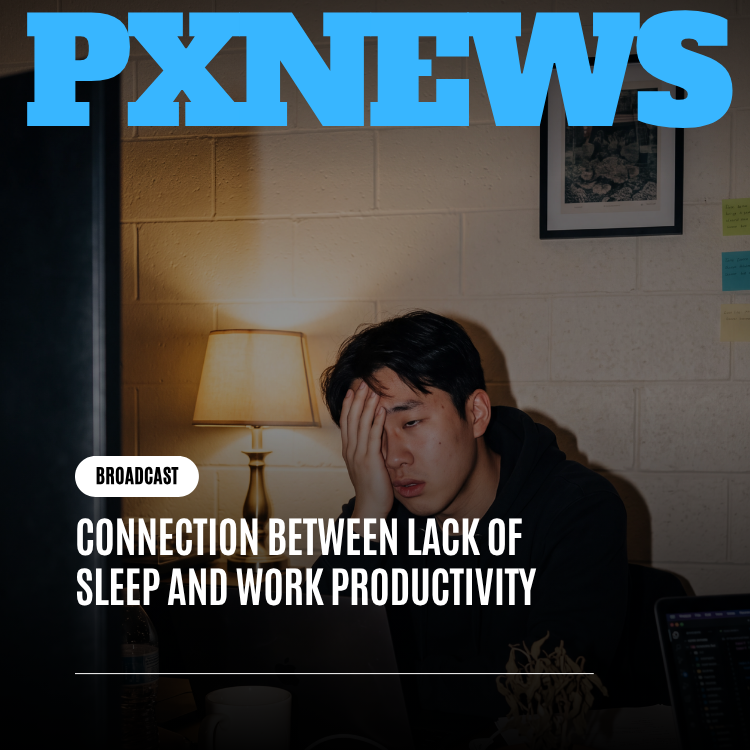
Most people don't need a research paper to tell them that a bad night's sleep makes for a worse day at work. Anyone who has sat through a 9 a.m. meeting after four hours of tossing and turning already knows the feeling: the extra beat it takes to follow a simple question, the patience that runs out an hour earlier than usual, the sense that your own brain is working through fog instead of clear air. It's one of the most widely understood, least controversial ideas in everyday wellness — sleep and daytime performance are connected, and when one slips, the other tends to slip with it. This piece is about that plain, common-knowledge connection: how poor sleep tends to show up in focus, mood, and productivity, why racing thoughts at bedtime are such a familiar obstacle to getting good rest in the first place, and how ETAPX's in.between was built around helping with exactly that last part — giving those thoughts somewhere to go before the lights go off.
The Quiet Cost of a Bad Night's Sleep
Sleep rarely gets the credit it deserves for how much it shapes an ordinary day. It doesn't announce itself the way a missed meal or a skipped workout does. Instead, a short or restless night tends to show up sideways — in small frictions that are easy to blame on other things. The inbox feels more overwhelming than usual. A decision that should take thirty seconds stretches into five minutes of second-guessing. A comment from a coworker that would normally roll off your back suddenly lands wrong. None of these moments individually seem like a sleep problem, which is exactly why the connection is so easy to miss in the moment and so obvious in hindsight.
It's widely understood that the brain and body use sleep to recover, and that when that recovery gets cut short, the effects tend to surface during the parts of the day that ask the most of you — sustained attention, careful judgment, and emotional steadiness. None of this requires a clinical framework to grasp. Most adults can point to a specific week in their own life — a new baby, a stretch of travel, a demanding project, a string of late nights for no particular reason — when they noticed themselves slower to think, quicker to snap, and generally running on a thinner margin than usual. That lived experience is the whole foundation of this article: sleep and daytime functioning are connected in ways that are common knowledge, not a hidden secret waiting to be unlocked by a specific study.
What's worth pausing on is how much of modern work depends on exactly the faculties that a short night tends to dull first. Knowledge work, in particular, runs on sustained focus, working memory, and the ability to weigh several considerations before speaking or deciding. Those are precisely the muscles that feel weakest after a bad night, which is part of why the sleep-productivity connection lands so intuitively for so many people — it isn't an abstract idea, it's a Tuesday they've already lived through.
Why Focus Is Usually the First Casualty
Ask people what they notice first after a rough night, and concentration usually tops the list — well ahead of anything as dramatic as falling asleep at a desk. It shows up as a kind of mental static: reading the same paragraph of an email twice, losing the thread of a conversation mid-sentence, or realizing twenty minutes into a task that you've been staring at it without actually making progress. None of this is exotic or rare. It's one of the most commonly reported, least surprising effects of not sleeping well, and it tends to be the first thing people notice precisely because it interferes with things they're trying to actively do, rather than things happening passively in the background.
Part of why focus takes the earliest hit is that sustained attention is effortful in a way that a lot of other daily functioning isn't. You can get through routine, familiar tasks on autopilot even when you're running low, but the moment something requires genuinely fresh thinking — writing from a blank page, untangling a disagreement, learning something new — the lack of reserve becomes obvious fast. Many people describe this as feeling like they're pushing through mud: the thinking still happens, but everything about it takes more visible effort than it should.
There's also a well-known pattern around decision-making specifically. Small decisions that would normally be quick and almost automatic start to feel heavier after a bad night — what to prioritize first, how to phrase a message, whether to speak up in a meeting or hold back. It's a common, relatable experience that under-rested people tend to lean on shortcuts and defaults rather than carefully weighing options, simply because careful weighing takes energy that isn't fully there. None of this is meant as a diagnosis of anyone's brain chemistry — it's simply the ordinary, widely recognized shape of what an under-slept day tends to feel like for most people.
The Sleep-Mood Connection at Work
If focus is the first thing to slip, mood is usually close behind, and the two tend to feed each other in ways that are easy to recognize once you're looking for them. A short fuse, a lower tolerance for small annoyances, a tendency to read neutral comments as slightly more negative than intended — these are common, everyday observations about how a bad night tends to color the day that follows. Most people have snapped at someone over something trivial and later realized, in a calmer moment, that the real culprit wasn't the trivial thing at all. It was exhaustion wearing the trivial thing as a disguise.
This matters for work specifically because so much of a job — especially any job involving other people — runs on emotional regulation as much as raw skill. Giving feedback well, sitting through a tense meeting, staying patient with a frustrating client, or simply being pleasant to a coworker on a hard day all draw on the same reserve that a good night's sleep tends to replenish. When that reserve is running low, people commonly report feeling more reactive, less resilient to small setbacks, and more likely to take things personally that they'd otherwise shrug off. Again, none of this is a controversial or specialized claim — it's the kind of thing most people would nod along to immediately, because they've felt it themselves.
The relationship also tends to run in both directions, which is part of what makes it so persistent. A stressful, emotionally draining day can make it harder to wind down and sleep well that night, and a poor night's sleep can make the next day feel more stressful and emotionally draining than it might have otherwise — even if nothing about the actual workload changed. Breaking into that loop anywhere helps, which is one of the reasons a calmer bedtime routine is worth taking seriously: it's not just about getting to sleep faster, it's about interrupting a cycle that can otherwise keep feeding itself.
"None of what we built in.between around is exotic or hard to explain. Everyone already knows that a bad night makes for a harder day — shorter temper, foggier focus, less patience for the small stuff. What people don't always have is somewhere to put the thoughts that are keeping them up in the first place. That's the gap we wanted to close: not a sleep hack, just a quiet place to think it through before it becomes 2 a.m. static."
— Maya Lindqvist, Head of in.between, ETAPX
Racing Thoughts: The Most Common Barrier to Falling Asleep
Ask almost anyone why they struggle to fall asleep on a given night, and the answer rarely involves anything exotic. It's usually some version of "my mind wouldn't turn off." The lights go out, the day's distractions disappear, and suddenly there's nothing left competing for attention except the running list of everything left unresolved — the email that needs a careful reply, the conversation that didn't go the way you wanted, the thing you forgot to do, the thing you're worried about tomorrow. This is one of the most universally recognized barriers to good sleep, and it doesn't require any special vulnerability to experience. It happens to focused people, relaxed people, organized people, and scattered people alike, usually on exactly the nights when the day gave the mind the most to chew on.
There's a reasonably intuitive explanation for why this happens so reliably at bedtime specifically. During the day, there's almost always something actively demanding attention — a task, a conversation, a screen, a deadline — which crowds out the quieter, more diffuse worries simmering underneath. At night, once the external noise falls away, those quieter thoughts finally get the floor, and they tend to take it all at once rather than one at a time. It's a familiar, almost universal pattern:
- Unfinished business: Tasks left undone or decisions left unmade tend to surface right as the lights go out, since bedtime is often the first quiet moment all day.
- Replaying the day: A tense conversation or an awkward moment gets rehashed on a loop, long after there's anything useful left to do about it.
- Tomorrow's preview: The mind jumps ahead to what's coming — a meeting, a deadline, a hard conversation — and starts rehearsing it before it needs to.
- General background worry: Money, relationships, health, or just a vague sense of being behind can surface with no clear trigger, simply because there's finally room for it to.
- Screen-driven wind-up: Scrolling right up until the moment of trying to sleep tends to leave the mind more stimulated, not less, making the transition to rest even harder.
None of this is a medical condition — it's just what a busy, engaged mind tends to do the moment it's finally given quiet space to think. The trouble is that bedtime is a strange place for that thinking to happen, since it's also the moment the body is trying to wind down and drift off. Racing thoughts and the effort of falling asleep end up competing for the same narrow window, and thoughts usually win, at least for a while.
Building a Wind-Down Routine That Actually Helps
One of the more broadly accepted, common-sense ideas in everyday wellness is that a consistent wind-down routine tends to make falling asleep easier. This isn't a secret or a specialized technique — it's closer to something most people already sense intuitively, even if they don't always practice it. The basic logic is simple: bodies and minds tend to respond well to predictable cues, and a routine that signals "the day is ending" gives both something to settle into rather than asking them to switch off instantly and without warning.
What that routine looks like varies enormously from person to person, and there's no single right formula — it's less about following a strict checklist and more about consistently creating some separation between the busyness of the day and the moment you actually try to sleep. A few of the most commonly cited habits include:
- A consistent bedtime window: Going to sleep and waking up around the same time most days helps the body settle into a predictable rhythm rather than constantly recalibrating.
- A buffer before bed: Giving yourself even fifteen or twenty minutes of calmer activity before trying to sleep — reading, stretching, a warm shower — rather than going straight from a screen to the pillow.
- Dimmer, calmer surroundings: Lowering lights and reducing noise and stimulation in the hour before bed is a widely recommended, low-effort way to signal to the body that it's time to slow down.
- Limiting late scrolling: Cutting back on feeds and notifications right before bed tends to help, since an engaged, reactive mind is a harder one to quiet down.
- Getting thoughts out of your head: Writing down or talking through what's on your mind — a to-do list, a worry, a replay of the day — gives those thoughts somewhere to land besides the inside of your skull at midnight.
That last point tends to get less attention than the others, but plenty of people who journal, or who simply talk something through with a friend or partner before bed, will say it's the single habit that makes the biggest difference. There's something to the basic act of externalizing a thought — putting it into words, out loud or on a page — that seems to loosen its grip, even without solving whatever the thought was about. The problem isn't unsolved, but it stops occupying quite so much room.
How in.between Fits Into the Evening Wind-Down
This is the specific gap ETAPX built in.between to sit inside. It's an AI-powered sleep and reflection journal: each night, you spend a few minutes talking — by voice or by text — with Nalani, an AI companion designed to listen more than it talks. The idea isn't complicated, and it isn't meant to be. It's the same basic principle behind any wind-down journaling habit — getting the day's loose threads out of your head before you try to sleep — built into a format that's easy to actually stick with, night after night, instead of something that quietly falls off after a week or two like so many journaling habits do.
The reason a conversational format tends to work better for a lot of people than a blank page is fairly intuitive. A blank page doesn't ask a follow-up question. It doesn't notice when you've mentioned the same worry three nights running. Nalani does — gently, and without turning it into a big deal. If the day's racing thoughts are the problem, having somewhere responsive to put them, rather than just a silent page waiting to be filled, seems to make the habit easier to keep. Over time, in.between also reflects small patterns back — a stretch of harder weeks, a recurring theme — the same way a genuinely attentive friend might notice something you hadn't quite put into words yourself.
None of this is framed as a productivity hack or a performance tool, and that's deliberate. The goal isn't to squeeze more output out of anyone's day. It's simply to give the mind somewhere to put its unfinished business before trying to sleep, on the theory — a common-sense one, not a clinical one — that a calmer mind at bedtime tends to make for an easier time falling asleep, and a better-rested morning tends to make for a clearer, steadier day.
"I used to lie there running through my whole day on a loop — every awkward thing I said, every email I still owed someone. Now I just talk it out with Nalani for a few minutes before bed instead of doing it silently in the dark. I fall asleep faster, and honestly I show up to work the next morning a lot less frazzled. It's a small thing every night, but it's added up."
— in.between user
A Companion for Reflection, Not a Cure for Insomnia
It's worth being direct about what in.between is and isn't, because the distinction matters. in.between is a wellness and reflection companion — a place to talk through your day and quiet a racing mind before bed. It is not a licensed therapist, not a medical device, and not a treatment for insomnia, anxiety, or any other sleep or mental health condition. Nalani doesn't diagnose anything, doesn't prescribe anything, and isn't built to replace the judgment of a doctor or a licensed mental health professional.
For most people, the connection between sleep and daytime functioning described throughout this piece is a matter of everyday experience, not a medical issue — the ordinary ebb and flow of good nights and rough ones that everyone deals with. But for some people, trouble sleeping is persistent, severe, or tied to something that genuinely needs professional attention — a sleep disorder, chronic insomnia, or an underlying health condition. A journaling habit, however helpful, is not a substitute for that kind of care. If sleep trouble is a regular, ongoing struggle rather than an occasional rough patch, the right next step is a conversation with a doctor, not just a new nightly routine. in.between is built to sit comfortably alongside that kind of professional care, as a companion for the everyday wind-down, never as a replacement for it.
Frequently Asked Questions
Does poor sleep really affect focus and productivity at work?
It's widely understood and broadly agreed upon that sleep and daytime functioning are connected — most people can point to their own experience of a foggier, less focused day after a rough night. This isn't a specialized or controversial claim; it lines up with what most people already notice about themselves.
Why do racing thoughts tend to show up right at bedtime?
Bedtime is often the first genuinely quiet moment of the day, once the distractions and demands of daily life fall away. That quiet gives background worries, unfinished tasks, and replayed conversations room to surface all at once, which is why racing thoughts are such a common, familiar barrier to falling asleep.
What is in.between, and how is it supposed to help with this?
in.between is ETAPX's AI-powered sleep and reflection journal. Each night, you talk — by voice or text — with Nalani, an AI companion built to listen and gently reflect patterns back over time. The idea is to give racing thoughts somewhere to go before bed, rather than carrying them silently into the night.
Is a wind-down routine actually necessary, or is that overstated?
A calmer, more consistent wind-down before bed is one of the most commonly recommended, common-sense habits for easier sleep — dimming lights, stepping away from screens, and giving your mind something calmer to do before trying to sleep. It doesn't have to be elaborate to help; consistency tends to matter more than complexity.
Can in.between replace seeing a doctor if I have ongoing sleep problems?
No. in.between is a wellness and reflection companion, not a medical device or a licensed therapist, and it isn't designed to treat insomnia or any other condition. If sleep trouble is persistent, severe, or ongoing rather than an occasional rough night, that's worth bringing to a doctor — in.between is meant to complement that kind of care, not substitute for it.
None of this is a secret formula — it's the same plain, familiar connection between rest and daytime life that most people already sense in their own routines. What changes is having somewhere real to put the thoughts that keep that connection from working the way it should, which is the small, quiet job in.between was built to do, one night at a time.