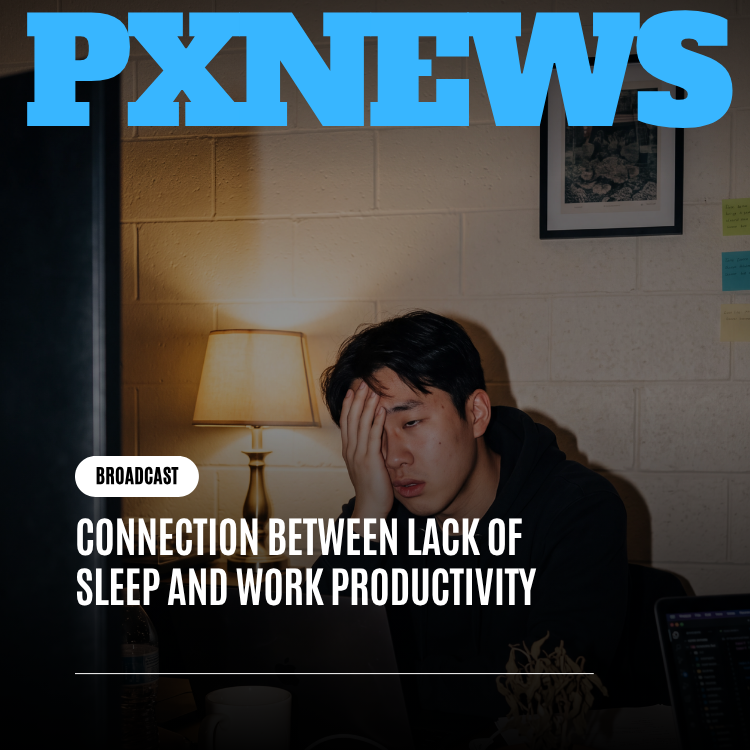

There's a specific, familiar feeling most people can recognize without needing it explained: the moment a perfectly ordinary question from someone you love — "did you remember to call the plumber," "what do you want for dinner," "can you grab that for me" — lands wrong. Not because the question was unreasonable. Because you were running on four hours of sleep and a day that didn't let up, and by 7 p.m. there was nothing left in the tank to meet an ordinary moment with an ordinary response. Most people have been on both sides of that exchange — the person who snapped, and the person who got snapped at for something that wasn't really about them at all. It's one of the most common, least talked-about ways that how we sleep quietly shapes how we love the people around us. This isn't a piece about sleep science or a list of statistics. It's a piece about something simpler and more widely understood: that a tired version of a person and a rested version of the same person can show up very differently in the same relationship, and that the gap between those two versions is worth paying attention to — not just for how you feel, but for how the people closest to you experience being around you.
The Two People You Can Be by Dinnertime
Picture the same evening playing out two different ways. In the first version, someone gets home after a long, grinding day — too many meetings, a commute that took twice as long as it should have, a body that's been asking for rest since roughly 3 p.m. Their partner mentions, gently, that the dishwasher still needs unloading. In this version, that sentence doesn't land as information. It lands as an accusation, or at least it feels that way for a second, and the response comes out sharper than it needed to — "I know, I'll get to it" — with an edge that wasn't really about the dishwasher at all. The partner, reasonably, gets a little defensive back. A ten-second exchange about a kitchen appliance turns into twenty minutes of low-grade tension that neither person particularly wanted.
Now picture the second version of that same evening, same dishwasher, same sentence, but a person who slept well the night before and actually feels like themselves. The comment about the dishwasher just registers as a comment. Maybe there's a light "on it" and a small laugh, maybe there's a quick hug on the way to go do it. Nothing about the day was necessarily easier in this version — the meetings were just as long, the commute just as slow — but there was enough left in reserve to meet an ordinary moment with an ordinary response instead of a defensive one. The dishwasher was never really the story in either version. The story was how much patience a person had left to bring to it, and that reserve is one of the most ordinary, least dramatic things that a good or bad night's sleep seems to affect.
Most people, if they're honest, can sort a good chunk of their memorable relationship friction — with partners, with roommates, with siblings, with their own kids — into moments that had less to do with what was actually said and more to do with how depleted they already were when it was said. That doesn't excuse snapping at someone you love. But it does explain why the same words, on a different night, might not have caused a fight at all.
Why Tiredness Makes Small Things Feel Bigger
There's a common-sense idea most people already carry around, even if they've never put words to it: being exhausted doesn't just make you sleepy, it makes everything feel a little more urgent, a little more personal, and a little harder to let go of. A mildly annoying comment that would normally roll off your back instead sits there, working its way under your skin. A minor inconvenience — a delayed reply, a forgotten errand, a slightly short tone in a text message — gets read as a bigger deal than it probably is. None of this requires a clinical explanation to make sense. Anyone who has tried to have a calm, reasonable conversation while running on fumes knows that "calm and reasonable" is often the first casualty of a bad night's sleep.
What tends to shrink first, for most people, isn't kindness exactly — it's slack. The buffer between "I noticed that" and "I said something about it." When that buffer is healthy, plenty of small friction just passes through unremarked: the towel left on the floor, the interrupted sentence, the joke that landed a little flat. When the buffer is thin, because the night before gave a person almost nothing to work with, that same small friction doesn't pass through. It gets caught, and it gets said out loud, usually in a tone that's sharper than the moment actually called for. The person on the receiving end usually isn't dealing with a person who's angry at them specifically. They're dealing with a person who has run out of slack.
This is also, for most people, entirely reversible on a night-to-night basis — which is part of what makes it so easy to overlook. Nobody thinks of themselves as a short-tempered person just because one exhausted Tuesday went sideways. But stack up enough exhausted Tuesdays in a row, without ever really processing what built up on any of them, and that occasional short fuse can start to feel less like a bad night and more like a personality. The people closest to a person are often the ones who notice that shift first, long before the person noticing it in themselves.
What a Good Night Actually Buys You
It's worth being specific about what "well-rested" tends to add back, because it's rarely dramatic. Nobody wakes up from a great night's sleep as a fundamentally different person. What tends to come back, in small and practical ways, is the stuff that makes ordinary togetherness easier: a longer fuse before irritation shows up on your face, a bit more patience for a rambling story that doesn't have a point yet, the ability to actually listen to what someone is saying instead of just waiting for your turn to respond. None of that is glamorous. All of it is the difference between a good evening with the people you live with and a tense one.
Presence is probably the most underrated piece of this. A tired mind doesn't just get short-tempered — it also tends to drift. Someone can be sitting across the table, phone down, apparently listening, and still be somewhere else entirely: replaying a work problem, running through tomorrow's to-do list, simply too depleted to track a conversation that requires any real attention. The person talking to them can usually tell. Being physically present and being actually present aren't the same thing, and the gap between them tends to widen exactly when someone is running low on rest — which is often, unfortunately, exactly when the people around them most want to be heard.
"My husband and I went through a stretch a while back where we were both just tired all the time — new baby, both working, barely sleeping. We weren't fighting about anything real. We were fighting about whose turn it was to load the car, or a text that got read the wrong way at 11 p.m. Looking back, none of it was actually about us. It was about two exhausted people with nothing left to give each other by the end of the day. The nights we both slept okay, we were fine. It took me embarrassingly long to connect those dots."
— Dana Whitfield, in.between user
None of this means sleep is a magic fix for relationship problems, and it would be irresponsible to suggest that it is. Real disagreements, real incompatibilities, and real hurt don't dissolve because someone got eight hours instead of five. But a lot of what gets mistaken for a relationship problem is really just two tired people with nothing left in reserve, colliding over something small. Being rested doesn't manufacture patience out of nowhere — it just tends to leave more of the patience that was already there intact by the time it's needed.
Where the Friction Actually Goes
Here's the part that's easy to miss: a rough day doesn't just evaporate at bedtime. If it isn't processed somehow — talked through, written down, even just acknowledged — it tends to travel. It shows up the next morning as a shorter fuse before coffee. It shows up as an unusually strong reaction to something small and unrelated, days later, because the original frustration never actually got resolved, just buried under the next thing and the thing after that. Most people have had the experience of snapping at someone over something minor and realizing, a beat too late, that the real target was a boss, a bill, a bad conversation from three days ago that never got fully put down.
This is where the connection to rest and relationships gets a little more specific than "get more sleep." It's not just about hours in bed. It's about whether the day gets any kind of closure before the next one starts. A day that ends with the mental equivalent of shoving everything into a closet and slamming the door doesn't actually go away — it just waits, half-processed, for the next moment of low patience to come spilling back out, usually onto someone who had nothing to do with it in the first place. A day that gets even a little bit of honest reflection before sleep tends to travel lighter into tomorrow.
- The short fuse the next morning: Unprocessed frustration from one day often shows up as irritability the following morning, aimed at whoever happens to be nearby — not because they did anything, but because nothing from the day before was ever actually put down.
- The overreaction to something small: A disproportionately strong response to a minor comment is frequently a sign that an older, unrelated frustration is still sitting there unresolved, waiting for any excuse to surface.
- The distracted conversation: A mind still quietly replaying an unprocessed day struggles to be fully present in a new conversation, even when the person is trying their best to listen.
- The slow accumulation: A single unprocessed rough day is rarely a big deal on its own. A pattern of them, stacked up without ever being worked through, is often what turns an occasional short temper into something that starts to feel like a person's default mode.
- The apology that comes later: Many people can recall snapping at someone they love and apologizing for it an hour or a day later, recognizing in hindsight that the reaction was bigger than the moment warranted — a fairly reliable sign that something else was actually being carried.
None of this is a mystery once it's laid out, but it's easy to live inside without ever naming it. Most people don't sit down at the end of a hard day and consciously decide to carry it into tomorrow. It just happens by default, because there was no moment set aside to do anything else with it.
A Few Minutes Before Sleep, Instead of Carrying It Forward
This is the gap in.between was built to sit in — not as a fix for relationship problems, and not as a replacement for the harder, necessary conversations people sometimes need to have with each other, but as a small, nightly space to actually put a day down before it gets carried into the next one. in.between is ETAPX's AI-powered sleep and reflection journal, guided by an AI companion named Nalani, and its entire premise rests on something pretty ordinary: most people don't lack the ability to process a hard day, they just rarely make time to actually do it before exhaustion and the next morning's obligations take over.
A few minutes of honest reflection before sleep — talking or typing through what actually happened, what actually bothered you, what you're actually still holding onto — doesn't erase a hard day. It does something more modest and, for most people, more useful: it gives the day somewhere to land besides tomorrow's first conversation with someone you care about. Saying out loud, even just to a journal, "today was rough because of this specific thing" tends to loosen that thing's grip in a way that letting it simmer silently never quite manages. It's the difference between a thought that gets acknowledged and a thought that gets shoved into a closet to deal with later — except later usually means "onto whoever's closest tomorrow morning."
"We hear a version of the same story constantly from people who use in.between: it's not that one bad night at home caused some huge blowup. It's smaller and quieter than that. Somebody notices they were short with their partner over nothing, and when they actually sit with it that night, they realize the short temper had nothing to do with their partner at all — it was still leftover from a meeting six hours earlier that never got resolved. Just naming that, out loud or in writing, tends to take the edge off before it has a chance to show up again tomorrow. We didn't build in.between to fix anyone's relationships. We built it because most people are carrying more than they realize into the people they love, simply because nobody ever gave the day a proper place to end."
— Maya Lindqvist, Head of in.between, ETAPX
What makes this work, when it works, isn't any single clever feature. It's the habit of the pause itself — a nightly moment where the day gets acknowledged instead of just absorbed. Nalani doesn't offer advice about a tense conversation with a partner or tell someone how they should have handled a rough afternoon. It listens, reflects back what it hears, and asks the kind of gentle follow-up question that helps someone notice, on their own, why they're actually carrying tension into the evening — which is often the first and most useful step toward not carrying it any further.
What This Isn't
It's worth being plain about the limits here, because overselling a nightly journaling habit would do a disservice to anyone genuinely struggling. in.between and Nalani are a wellness companion for reflection — not a licensed therapist, not a couples counselor, and not a substitute for real, professional support. Processing an ordinary hard day so it doesn't spill over into an ordinary evening at home is a genuinely useful, modest thing to build a nightly habit around. It is not the same thing as working through a serious relationship difficulty, a pattern of real conflict, or a struggle that's been going on for months or years. If that's what someone is facing, the right resource is a professional — a couples therapist, a licensed counselor, someone trained specifically for that work — not an app, no matter how well-designed the app's questions are.
The honest way to think about it is this: in.between is built for the everyday residue of an ordinary hard day — the small friction that, left unprocessed, tends to make its way into tomorrow's tone of voice. It was never meant to be, and isn't, a tool for resolving the deeper, harder conversations two people sometimes need to have with each other, or with a professional in the room. Knowing that difference matters, and it's part of why in.between is designed to encourage reaching out to real support when an entry touches on something heavier than the ordinary weight of a long day.
A Small Habit With an Outsized Effect on the People Around You
None of this requires believing that sleep and rest are the answer to everything, because they aren't. But there's something quietly worth taking seriously in the fact that so many people, independently, describe the same basic pattern: they're more patient rested, shorter-fused exhausted, and the people who bear the difference are almost never strangers. It's the partner across the table, the kid asking the same question for the third time, the roommate who just wanted to know if you're going to the store. The people closest to us get the most concentrated dose of whichever version of us shows up on a given evening — rested or running on empty — and that's exactly why it's worth building some kind of small ritual to close the gap between the two.
A nightly reflection habit is a modest thing to point to as part of that. It won't turn a genuinely hard day into an easy one, and it isn't trying to. What it can do, for a lot of people, is interrupt the default pattern where a rough day just quietly becomes tomorrow's short temper. Taking even a few minutes before sleep to actually name what happened — out loud to Nalani, or typed into in.between, or honestly in any form at all — tends to leave a little less behind to spill over onto the people who least deserve to catch it. That's a small, unglamorous kind of value. It also happens to be one of the more meaningful things a nightly habit can quietly do for the relationships that matter most.
Frequently Asked Questions
Is there real evidence that sleep affects how people treat each other?
This piece is intentionally general rather than clinical — it's describing a common, widely recognized pattern that most people recognize from their own lives: feeling short-tempered when exhausted and more patient when rested. It isn't citing specific studies or statistics, just a familiar experience worth paying attention to.
Can in.between actually fix arguments with my partner?
No, and it isn't designed to try. in.between is a nightly reflection habit meant to help process the ordinary friction of a hard day so it's less likely to spill into tomorrow. It isn't a substitute for the real conversations two people sometimes need to have with each other, and it isn't a replacement for couples counseling if that's what a relationship actually needs.
What if what I'm dealing with is more serious than an ordinary rough day?
Then a professional is the right resource, not an app. Nalani is a wellness companion, not a licensed therapist or relationship counselor, and in.between is built to encourage reaching out to qualified professional support when something shared in an entry sounds like it goes beyond ordinary day-to-day stress.
Do I need to journal every single night for this to help?
No. The value of a reflection habit comes from using it on the nights it's actually needed, not from a perfect streak. Some nights call for a few minutes of real processing; other nights there's simply nothing weighing enough to need it, and that's fine too.
Does Nalani tell me how I should have handled a situation with someone I care about?
No. Nalani listens and asks gentle follow-up questions rather than offering advice or verdicts about specific relationship situations. The goal is to help someone notice, in their own words, what they're actually carrying — not to hand them a script for how to act on it.
None of this is about becoming a different person overnight. It's about giving an ordinary hard day somewhere honest to go before it quietly becomes tomorrow's short answer to someone who was only asking about the dishwasher.