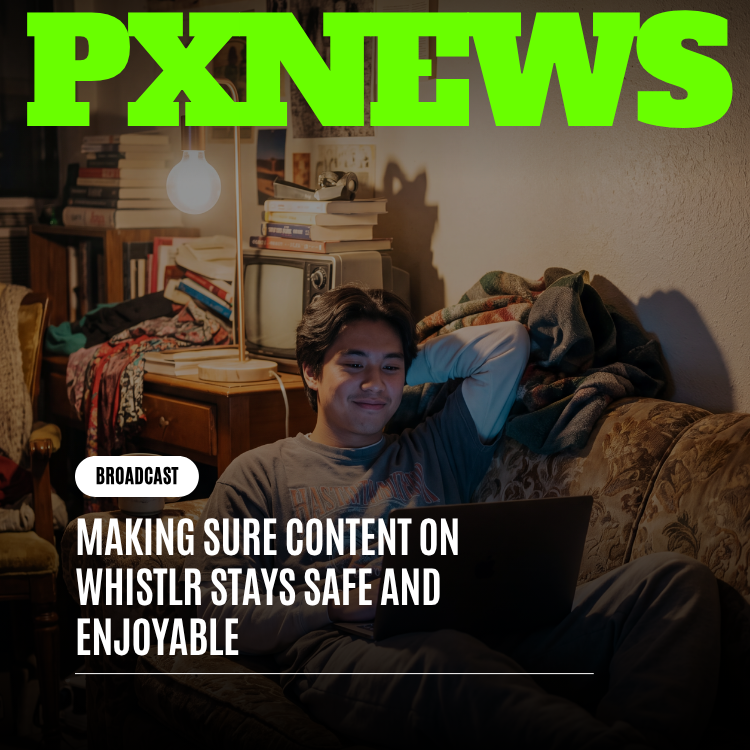
Ask most people what would make a social platform safer, and they'll describe restrictions — fewer things you're allowed to post, more hoops to jump through, a stricter version of what already exists. Ask what would make it more fun, and they'll describe the opposite — more freedom, less friction, fewer rules getting in the way. On Whistlr, we've tried to build toward a different premise entirely: that the two aren't opposites at all. A well-moderated Circuit is a more enjoyable Circuit. A community where people trust that harassment gets addressed is a community where people actually relax and show up as themselves. This is a look at how Whistlr's Community Guidelines work in practice, the tools you have to shape your own experience, and why we think safety is less a constraint on fun than the thing that makes it possible.
What the Community Guidelines Are Actually For
It's easy to think of community guidelines as a legal document — a list of prohibitions written by lawyers to protect a company, handed down to users as fine print nobody reads until something goes wrong. That's not how we think about Whistlr's Community Guidelines, and it's not how we've tried to write them. At their core, they're a description of the kind of place we want Whistlr to be: somewhere people can post something unpolished without regretting it, somewhere a joke lands as a joke instead of a landmine, somewhere showing up as yourself doesn't require armor.
That framing matters because it changes what the guidelines actually cover. They're less a checklist of banned words and more a set of shared expectations — be who you say you are, don't harass people, don't exploit or endanger anyone, respect the difference between a Circuit meant for close friends and a SubCircuit meant for the whole internet. Most of what keeps Whistlr feeling good day to day isn't a rule anyone had to memorize. It's a culture that the guidelines describe and that enforcement quietly reinforces.
We also try to keep the guidelines written in language an actual person would use, not legal boilerplate. If a rule needs a law degree to parse, it's not doing its job — because the whole point of having guidelines in the open is so that people can hold the platform to them, not just the other way around. You should be able to read them in ten minutes and come away with a clear sense of what's expected of you and what you can expect from everyone else.
The Tools You Actually Have
Guidelines only matter if you have a real way to act on them in the moment. Whistlr gives every user a small set of tools that cover almost every situation you'll actually run into — from a single annoying comment to a pattern of behavior that crosses a real line. None of them require you to justify yourself at length, and none of them require the other person to know you used them.
- Report: Flag a specific post, Story, Thought, comment, message, or profile for review. Reporting sends the item to a dedicated team for a real look — it doesn't notify the person you reported, and it doesn't remove anything automatically just because it was reported.
- Block: Cut someone off completely. A blocked account can't see your profile, your posts, your Stories, or message you, and you stop seeing them too. It's the tool for "I don't want this person in my Whistlr experience at all," and it's fully reversible if you ever change your mind.
- Mute: A quieter option for when you don't need someone gone, just less present. Muting hides someone's posts and Thoughts from your Flow without them knowing, which is useful for the person you're not ready to block but also don't need to see right now.
- Private Circle controls: Decide who can see your posts, who can add you to a group chat, and who can find your profile at all. Tightening these settings is a proactive way to shape your experience before you ever need to report or block anything.
- Comment and message filters: Set boundaries on who can comment on your posts or message you directly — everyone, people you follow back, or nobody outside your existing circles — so you're not relying on reactive tools for things you can prevent up front.
- Leave or mute a group chat or SubCircuit: For shared spaces rather than one-on-one interactions, you can step back from a conversation, mute its notifications, or leave entirely without needing to resolve a conflict with every other member first.
None of these tools require you to pick the "correct" one. If you're not sure whether something rises to the level of a report, report it anyway and let the review team make that call — that's what they're there for. The tools are designed to be low-friction on purpose, because a safety feature people hesitate to use isn't really a safety feature.
What Happens After You Report Something
This is the part that's usually the most opaque on other platforms, so it's worth laying out plainly. When you report a post, message, comment, or profile on Whistlr, here's what actually happens on your end and behind the scenes.
First, the report goes to a dedicated team that reviews reported content — not an automatic takedown, and not a black hole. Reporting something doesn't mean it instantly disappears, and it doesn't mean nothing happens either; it means a person looks at what you flagged against Whistlr's Community Guidelines and decides what, if anything, needs to happen next. That might mean the content comes down, the account gets a warning, further action is taken against a repeat offender, or the team determines the guidelines weren't actually violated and no action is needed.
Second, you'll typically hear something back. You won't get a play-by-play of an internal investigation, but you're not left wondering whether your report vanished into the void either — Whistlr lets you know that your report was received and reviewed. If action was taken as a result, the person on the other end also learns why, in terms that point back to the specific guideline involved rather than a vague notice. That two-sided clarity is intentional: a reporter who never hears back stops trusting the tool, and a person who gets punished with no explanation never learns what actually went wrong.
Third, reporting is anonymous to the person you reported. They're never told who filed the report, which matters enormously in practice — plenty of the situations worth reporting happen between people who know each other, in shared Circuits or group chats, and the fear of retaliation is one of the biggest reasons people hesitate to speak up at all on other platforms. Removing that fear is part of what makes the tool usable.
"I reported a comment on one of my Stories that I honestly wasn't sure counted as anything — it felt petty to even flag. I got a notification a bit later that it had been reviewed and the comment was removed for violating the harassment guidelines. Nobody made me explain myself, nothing came back to me, and I didn't have to wonder if I'd overreacted. That's the version of 'trust the process' that actually works."
— Priya Kapoor, Whistlr user
A Human Team Behind Every Report
It's worth being direct about something we think gets lost in a lot of trust and safety messaging: a dedicated team of actual people reviews reports on Whistlr. Not an unaccountable process happening somewhere abstract — people whose job is to look at what gets flagged, weigh it against the Community Guidelines, and make a judgment call. Context, tone, and intent matter enormously in moderation, and those are things a human being is still better positioned to weigh than any policy document could fully anticipate on its own.
That human element is also why we ask people not to flood the report tool with things that clearly don't belong there, and why the review team has latitude to look at the fuller picture around a single flagged post rather than judging it in total isolation. A joke between friends in a private Circuit reads differently than the same words posted publicly to strangers. A heated exchange in a group chat reads differently in context than a single message pulled out of it. People are equipped to notice that difference; a rigid checklist isn't.
"We ask a lot of our review team, because we ask them to do something genuinely hard — apply the same set of guidelines consistently, thousands of times a day, while still paying attention to the specific situation in front of them. Consistency and judgment usually get treated as opposites in this line of work. Our whole approach is built around refusing that tradeoff, because a moderation team that only does one or the other isn't actually doing the job."
— Jennifer Thompson, VP of Trust & Safety, ETAPX
We also don't pretend the team gets every call right every time — no review process involving human judgment ever will, at any scale. What we can commit to is that decisions come with a reason, that a real appeal path exists if you think a call was wrong, and that patterns matter more than any single edge case in shaping how the guidelines get applied going forward.
Age-Appropriate by Design, Not by Afterthought
Whistlr's user base spans a wide range of ages and life stages, from teenagers building their first real online presence to adults using the platform for creator work, community, and everything in between. Treating every account identically regardless of who's behind it isn't neutral — it's a choice that tends to underserve younger users while assuming everyone wants the same experience.
In practice, that means accounts belonging to younger users see a more conservative default experience: tighter default privacy settings, more limited discoverability by strangers, and more caution baked into what gets recommended into their Flow. It also means the Community Guidelines apply with extra weight around anything that could put a younger user at risk, regardless of who's on the other end of the interaction. None of this is about walling teenagers off from the platform's actual features — Circuits, Waves, Thoughts, and the rest are still there — it's about making sure the default settings someone starts with match what's actually appropriate for their age, rather than requiring a teenager to know to go dig through settings on day one to get there.
We also think this is an area where the tools described earlier — block, mute, comment filters, Private Circle controls — matter even more for younger users learning to navigate a social platform for the first time. Part of what the Community Guidelines are trying to teach, implicitly, is that you're allowed to curate who has access to you. That's a genuinely useful habit at any age, and it's one we'd rather younger users learn on Whistlr with real tools in hand than learn the hard way somewhere else without them.
Why Safety and Fun Were Never Actually in Tension
Here's the assumption we think is worth pushing back on directly: that every safety measure is a small tax on how fun a platform feels, and that the most enjoyable version of any social app is necessarily the least restrained one. That assumption falls apart pretty quickly once you look at what actually ruins people's experience on social platforms. It's rarely "there were too many rules." It's harassment nobody addressed. It's reporting something and hearing nothing back. It's not knowing who can see a post you thought was private. It's a stranger showing up in your comments with no way to stop them without leaving the platform entirely.
Every one of those is a safety failure, and every one of those is also, unmistakably, a fun failure. People don't stop enjoying a platform because moderation exists — they stop enjoying it because moderation doesn't work, or because they have no real tools to protect their own experience. Fix that, and the two goals stop competing. A person who trusts that reporting something actually does something is a person who feels safe posting the unfiltered, spontaneous version of their day. A person who knows they can mute or block freely without drama is a person who stays in a group chat instead of quietly disappearing from the platform.
That's the real relationship between the two. Safety isn't the boring, restrictive counterweight to fun. It's the floor that fun needs to actually happen — the quiet assurance that lets someone post something a little messy, a little real, without bracing for what might come back at them.
Practical Habits for Getting the Most Out of Whistlr's Safety Tools
Most people only think about reporting, blocking, and privacy settings reactively — after something has already gone wrong. A little proactive use goes a lot further, and it costs almost nothing in terms of how the platform feels day to day.
- Set your Circle boundaries before you need them: Decide who can see your posts and message you while things are calm, rather than scrambling to lock things down in the middle of an uncomfortable situation.
- Use mute liberally: It carries none of the social weight of blocking and none of the finality — treat it as a low-stakes first step whenever something in your Flow isn't sitting right.
- Report even when you're unsure: The review team is equipped to make the judgment call on borderline cases. A report that turns out to be unfounded costs nothing; a genuine problem left unreported doesn't get better on its own.
- Revisit your privacy settings occasionally: Especially after a life change — a new job, a public creator account, a move — your Circle and comment settings from a year ago might not match what you actually want visible today.
- Know that blocking is quiet: A blocked account isn't notified, so you never need to weigh "is this worth the confrontation" against your own comfort. It's designed to remove that calculation entirely.
None of these require any special knowledge of how Whistlr works under the hood — that's deliberate. The tools that keep a platform feeling safe should be as easy to reach for as the features that make it fun in the first place; if reporting or adjusting your privacy takes real effort to figure out, most people simply won't do it until it's too late to matter.
The Guidelines Are a Starting Point, Not a Finished Document
Community Guidelines that never change are guidelines written for a platform that never changes, and Whistlr keeps growing new features, new formats, and new ways for people to interact — from Waves listening parties to Live Shopping through Storefronts. Each of those creates new situations the original guidelines didn't anticipate, and we'd rather update the guidelines to meet reality than force reality to squeeze into an outdated document. What stays constant underneath those updates is the underlying philosophy: be who you say you are, treat people the way this community expects to be treated, and trust that if something goes wrong, there's a real process and a real person on the other end of it.
Frequently Asked Questions
How do I report content on Whistlr?
Use the report option available on any post, Story, Thought, comment, message, or profile. Select the reason that best fits the situation, and the report goes directly to Whistlr's dedicated review team — you don't need to do anything else, and the account you reported is never told who reported them.
What actually happens after I report something?
A member of the review team looks at the reported content against Whistlr's Community Guidelines and decides what action, if any, is appropriate — anything from removing the content to warning or restricting the account involved. You'll typically get a response letting you know your report was reviewed, and if action was taken, the affected account is told which guideline it violated.
What's the difference between blocking and muting someone?
Blocking cuts off contact entirely and in both directions — the other person can no longer see your profile or posts or message you, and you stop seeing them too. Muting is quieter: it hides someone's posts and Thoughts from your Flow without them being notified, which is useful when you want less of someone in your experience without a full, visible break.
Can I control who sees my posts and who can message me?
Yes. Whistlr's privacy and Circle settings let you decide who can see your posts, who can find your profile, who can comment, and who can message you directly — anywhere from fully open to limited to people already in your Circles. These settings can be adjusted at any time and apply going forward.
Does Whistlr have extra protections for younger users?
Yes. Accounts belonging to younger users start with more conservative default privacy and discoverability settings, and the Community Guidelines are applied with additional weight around anything that could put a younger user at risk. The goal is to make the safer configuration the default, not something a new, younger user has to find on their own.
None of this works as a single feature or a one-time fix — it's a set of habits, defaults, and a real human team, all pointed at the same goal. Get that right, and safety stops feeling like something layered on top of Whistlr and starts feeling like the reason the rest of the platform is actually enjoyable to use.