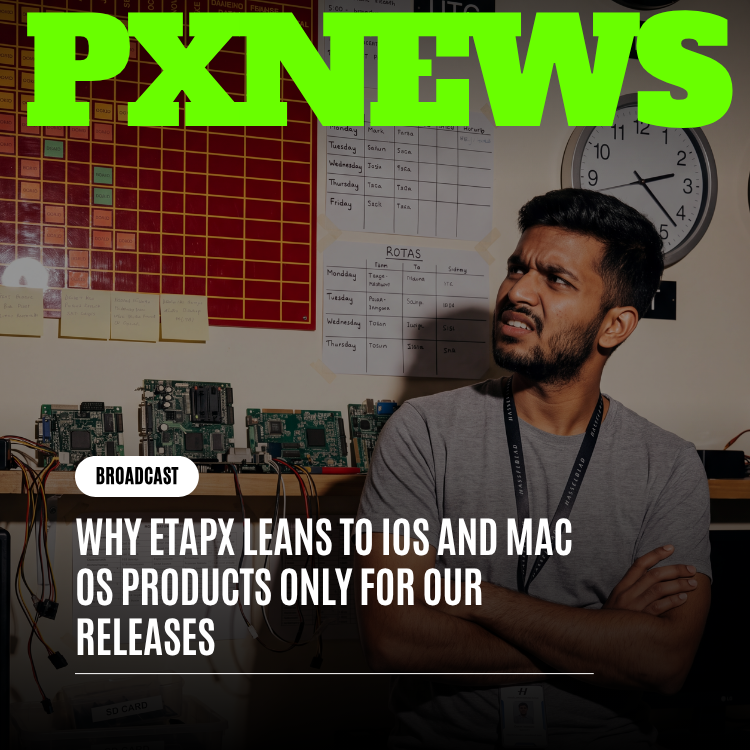
ETAPX ships most of its heaviest releases inside a smaller world than most companies its size would choose. Influxx, the flagship agentic environment, and Ocsidian, the agentic game creation platform, are both built Apple-first — native to iOS and macOS, deep, and unapologetically narrower in reach than either could be if it chased every device on the market. That's not an accident, and it isn't a resource shortcut either. It's a considered bet about what kind of tool each product is trying to be, and John Ridge, ETAPX's CTO, is happy to defend that bet in plain terms: fewer devices, built deeper, beats more devices, built shallower — for tools like these.
Why ETAPX Leans on iOS and macOS for Certain Releases
If you've been following PX News, you already know the recent headline: Influxx and Ocsidian are both standardizing on Apple's ecosystem going forward, and Ocsidian stepping back from its earlier Windows build is the most visible example. That's the announcement. This is the argument underneath it — the reasoning ETAPX keeps coming back to whenever a demanding new release forces a real platform decision, well before any specific product name gets attached to it. It's worth saying plainly what this piece is not. It is not a claim that Apple hardware is inherently superior to anything else on the market. It is not a description of every release ETAPX ships, and it is not a company-wide mandate. It's a case for when narrowing your platform surface on purpose is the more disciplined choice, not the lazier one — and for which of ETAPX's products that reasoning actually applies to.
John Ridge has walked through this reasoning enough times internally that he can deliver it without notes at this point. "Every platform decision is really a decision about what you're willing to say no to," he says. "Building for iOS and macOS first isn't ETAPX saying no to everyone else forever. It's saying yes to depth before saying yes to reach, on the specific products where depth is the thing that actually makes the tool worth using. Influxx and Ocsidian earn their keep by doing a small number of things extremely well on hardware we understand completely. That's a different job than a product that earns its keep by being everywhere at once." AJ, ETAPX's founder and CEO, has made a version of the same point publicly about Influxx's own native release — that shipping fewer platforms well beats shipping more platforms adequately — and Influxx and Ocsidian are where John Ridge applies that instinct most literally.
It's also worth being precise about scope, since "ETAPX leans Apple-first" is the kind of line that's easy to over-generalize into something the company doesn't actually believe. This is a pattern specific to ETAPX's more demanding creative and agentic tools — the ones where the software is asking a lot of the hardware underneath it, and where a check-in, a background task, or a live editor preview needs to behave predictably every single time. It is not a description of ETAPX as a whole, and by the end of this piece, the clearest proof of that will be the product that breaks the pattern on purpose: Whistlr.
Fewer Devices, One Set of Assumptions
Apple controls both the hardware and the operating system for every device Influxx and Ocsidian target. That's not a small detail — it's the entire reason "fewer devices" is worth trading for "more devices" in the first place. A team building for iOS and macOS is building against a known, tightly bounded set of chips, displays, input methods, and OS behaviors. A team building the equivalent tool for everywhere else is building against a genuinely open set of combinations — different manufacturers, different driver quality, different OS versions still in active use years after release, different assumptions about what the hardware can reliably do. Both are solvable engineering problems. They are not the same amount of problem, and pretending otherwise is how teams end up spread thin without meaning to.
What Fewer Variables Actually Buys an Engineering Team
The payoff isn't abstract. Performance work done against Apple Silicon translates cleanly across the product line in a way that's harder to guarantee elsewhere, because the chips ETAPX is optimizing for this year are close cousins of the chips it optimized for last year. A feature that depends on tight timing, on predictable memory behavior, or on an OS-level capability being present and behaving consistently is a much safer bet to build on a single, coherent platform than on a landscape where "it works" has to be verified across a long tail of hardware and driver combinations ETAPX doesn't control. None of that makes the other approach wrong. It makes it a different kind of engineering problem, with a different kind of payoff — usually broader coverage, at the cost of some ceiling on how deep any single integration can go.
What Depth Looks Like in Practice
"Depth" is an abstract word until you can point at something concrete, so it's worth being specific about what it actually buys a tool like Influxx. PX News has covered the native macOS and iOS release of Influxx elsewhere in more detail, but the short version is the part that matters here: background task execution that keeps running after you close the app window, system-level notifications that arrive without a browser tab needing to stay open, native file access, and a signed-in session that hands off between the web app and the native app through a secure deep-link bridge instead of asking you to log in twice. None of that is achievable by wrapping a website in a native-looking shell. All of it depends on the app being treated as a real, first-class citizen of the operating system it's running on, not a guest.
The Kind of Integration You Can't Fake With a Wrapper
John Ridge is fairly blunt about the alternative. "You can absolutely build a version of Influxx that runs adequately on five platforms," he says. "What you can't do is build the version that runs adequately on five platforms and also has the kind of deep OS integration we shipped for macOS and iOS. Something gives. Usually what gives is the depth, quietly, because a shallow feature still technically works and a missing one gets noticed immediately. We'd rather be honest about which one we're optimizing for than pretend we can max out both at the same time."
That trade-off shows up in a handful of concrete places every time ETAPX builds one of these tools Apple-first:
- Background execution that outlives the window: tasks keep running on ETAPX's side after you close the app, the same approach Influxx's native macOS and iOS apps already rely on today.
- System-level notifications: a check-in that genuinely needs you arrives as a real OS notification, instead of sitting inside a browser tab you might not have open.
- Native file and session handling: the app reads and writes to your actual machine, and a signed-in session hands off between web and native app through a secure deep-link bridge rather than a second login screen.
- Apple Silicon as a known quantity: a small, well-understood hardware line means performance work translates cleanly, instead of getting averaged out across dozens of unpredictable configurations.
- Engineering hours that go deeper instead of wider: time that would otherwise go toward maintaining several platform-specific quirks goes instead toward making one platform's version of the tool meaningfully better.
Put together, those five things change what a release actually feels like day to day, not just what it looks like in a changelog. A creator running an overnight render inside Ocsidian, or a builder who handed a multi-step task to Influxx before leaving for dinner, gets to close the laptop without wondering whether the work quietly stopped the moment the window lost focus. That's not a feature you can point to on a marketing page. It's the difference between a tool you have to babysit and one you can actually trust to keep working while you're doing something else, and it only holds up because the team isn't also stretching that same effort across three other operating systems at the same time.
One Ecosystem That's Meant to Work Together
There's a second reason that matters less in any single release and more over time: Influxx and Ocsidian aren't meant to stay strangers to each other forever. ETAPX already keeps identity consistent across its products — the same account carries your reputation and history whether you're inside Whistlr, GLSRM, or the Campus Store — and the ambition for Influxx and Ocsidian follows the same connective thread, applied to two tools that both increasingly lean on agentic workflows. Standardizing the more demanding half of ETAPX's ecosystem on one platform family isn't only about either product individually. It's about not having to solve the same integration problem twice, on two operating systems that behave very differently under the hood, before these tools can genuinely work well together.
"I think about it less as 'which platform' and more as 'how many times do we want to solve the same problem,'" John Ridge says. "If Influxx and Ocsidian are both fluent in the same ecosystem, then the work we do connecting them — shared identity, shared context, eventually shared workflows — only has to happen once. Do that across four operating systems instead of one, and you're not building an ecosystem anymore. You're building four separate integration projects that happen to share a logo."
— John Ridge, CTO, ETAPX
Ocsidian's own history is a small, honest example of this reasoning playing out rather than just a theory. Its desktop editor shipped for both macOS and Windows early on, and PX News has covered elsewhere why Ocsidian is now standardizing on the Apple side of that split going forward. The short version, without retelling that story here: maintaining genuine parity across two hardware and driver ecosystems that behave very differently under the hood was quietly pulling engineering hours away from the engine and the editor itself. Consolidating wasn't a retreat. It was choosing where those hours would do the most good.
Whistlr Is the Deliberate Exception
None of this applies to Whistlr, and it's worth being completely direct about that rather than letting the pattern imply something broader than it is. ETAPX does not lean Apple-only across all of its releases. Whistlr, the company's social platform, is built on the opposite premise from Influxx and Ocsidian, and it's built that way on purpose, not by oversight.
Whistlr's entire mandate is reach. It has Whistlr Go, a lightweight version built specifically for lower-end Android devices and emerging markets where a full-featured app would be too heavy to run well, and it ships a Windows desktop app that most social platforms never bother building at all. If Whistlr followed the same Apple-first instinct behind Influxx and Ocsidian, it would be working directly against the one job it exists to do — connecting as many real people as possible, on whatever device they already own.
Reach Is the Whole Point, Not a Compromise
John Ridge doesn't treat this as a contradiction that needs explaining away. He treats it as the obvious result of asking a straightforward question about each product before writing any code.
"People assume a company either believes in going deep on one platform or believes in reaching everyone, like you have to pick a religion and stick with it company-wide," John Ridge says. "We don't think that's a real tension once you separate it by product. Whistlr's job is to be wherever a person already is, on whatever device they already own — that's Whistlr Go, that's the Windows app, that's the whole design brief. Influxx and Ocsidian's job is to be the best possible version of themselves on a platform we can fully commit to. Neither approach is the 'real' ETAPX philosophy. They're both the ETAPX philosophy, applied to two products trying to do completely different things."
— John Ridge, CTO, ETAPX
Put another way: Whistlr optimizes for how many people can use it. Influxx and Ocsidian optimize for how well the tool works once you're using it. Those are both legitimate goals for a product to chase. They just aren't the same goal, and chasing both at once with the same engineering effort tends to produce a worse version of each.
Reach and Depth Are Different Bets, Not Different Values
None of this is free, and John Ridge doesn't pretend otherwise. Building iOS and macOS first for Influxx and Ocsidian means real people on real devices can't use either product yet. "I'm not going to stand here and tell you narrowing your platform surface has no cost, because it obviously does," he says. "Somebody on a Windows laptop who'd genuinely enjoy Ocsidian's editor today doesn't get to use it today. That's a real person we're not serving yet, not a rounding error. The bet is that the depth we get in exchange is worth more, right now, than the reach we're giving up — for these two products specifically. That's a bet, not a certainty, and it's one we revisit deliberately, not because we're wavering, but because a good bet is supposed to get re-examined as circumstances change."
That's the whole philosophy, stripped of any product-specific detail: match the platform strategy to what the product is actually trying to achieve, and don't let habit or convention make that call for you. Influxx and Ocsidian happen to land on iOS and macOS because depth is the thing they're selling. Whistlr happens to land on nearly everything because reach is the thing it's selling. A future ETAPX product could land somewhere else entirely, and the reasoning would still be the same reasoning — asked fresh, for that product, rather than inherited from whatever the last release decided.
Frequently Asked Questions
Why does ETAPX prioritize iOS and macOS for releases like Influxx and Ocsidian?
Because those tools are built around deep OS-level integration — background execution, system notifications, and secure session handoff between web and native apps — that gets meaningfully harder to deliver well once it's spread thin across many platforms. Standardizing on iOS and macOS lets ETAPX ship fewer, deeper versions of Influxx and Ocsidian instead of more, shallower ones, on hardware the team can fully commit to understanding.
Does this mean Whistlr is Apple-only too?
No. Whistlr is the deliberate exception to this pattern, not a future candidate for it. Whistlr is built for maximum reach, with Whistlr Go serving lower-end Android devices and emerging markets, plus a Windows desktop app extending it to hardware Influxx and Ocsidian don't target at all. Whistlr's whole purpose is reaching as many people as possible on as many devices as possible, which is a different goal from the depth-first approach behind ETAPX's creative and agentic tools.
Is ETAPX against Android or Windows?
No. This is a product-by-product judgment about where depth matters most, not a stance against any platform in general. Whistlr already proves that point by running well on Android, including lower-end devices, and on Windows. The Apple-first approach is specific to tools like Influxx and Ocsidian, where a smaller, more predictable hardware set is what makes deeper integration possible in the first place.
Will Influxx or Ocsidian ever come to other platforms?
Nothing is being ruled out permanently, but there's no roadmap commitment to announce here — this piece is about the reasoning behind the current approach, not a platform promise. Ocsidian's own history is a useful example of how that reasoning can move in either direction: it shipped with a Windows build early on, and its more recent move to standardize on macOS reflects the same depth-over-reach thinking described in this piece, not an exception to it.
Is this approach permanent?
It's a considered current position, not a rule carved in stone. John Ridge describes it as a bet that gets re-examined as the products, the hardware landscape, and ETAPX's own engineering capacity change, rather than a habit the team follows without checking it. If the trade-off ever stops making sense for a given tool, the tool's platform strategy changes — not the reasoning behind why it changes.
Strip away the specific product names and the reasoning is simple enough to sketch on a whiteboard, which is more or less how John Ridge tends to explain it. Depth and reach are both legitimate goals — they're just different goals, and chasing both at once with the same tool tends to blur into mediocrity at both. Influxx and Ocsidian chase depth on iOS and macOS. Whistlr chases reach everywhere it reasonably can. Neither one is the exception that proves the other wrong.