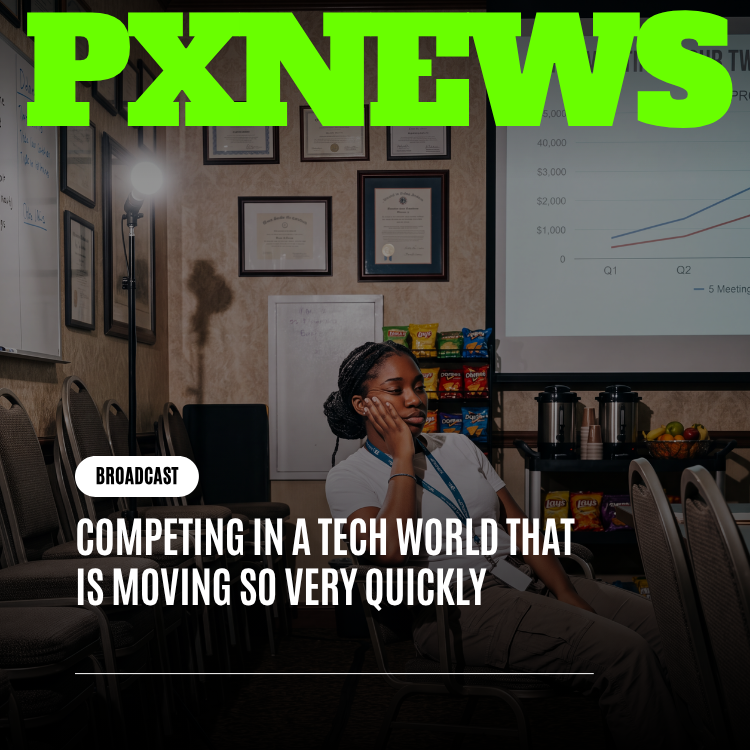
Nobody warns you what it actually feels like to keep competing in a tech world that is moving this quickly. You picture momentum: a team hitting its stride, gaining ground with every release. Most weeks, from inside it, feel less like momentum and more like a relay where the baton never fully stops moving — you sprint your leg, hand it off, and the track has somehow gotten longer while you weren't looking. This isn't the piece about strategy, or about why we don't chase every trend that crosses our feed; we already wrote that one. This is the more honest version: what staying in this race actually costs a smaller team, and the specific, unglamorous things we do so it doesn't cost us more than we're willing to pay.
There's a version of this story where a scrappy small team out-hustles everyone through sheer will, and it makes for a nice trailer. That's not really what a Tuesday looks like. What a Tuesday looks like is four product Slack channels open at once, a decision that needed to happen yesterday, and a genuine, unresolved question about whether the thing you shipped last month is already behind. We're not writing this to complain — we chose this — but if we're going to talk about competing in a tech world moving this fast, it should be the real version, not the highlight reel.
What "Moving Quickly" Actually Feels Like From Inside a Small Team
From outside, a company that ships often looks confident — like every release was obvious, like the roadmap was clear from day one. From inside, most weeks feel like the opposite: a running list of decisions that all seem urgent, made by a group of people who know they can't get equally deep on all of them, moving forward anyway because the alternative is standing still while the ground keeps shifting under everyone else too. That gap between how it looks from the outside and how it actually feels on the inside is probably the least talked-about part of working at this pace, and it's worth naming honestly instead of letting the highlight reel stand in for the whole picture.
The Tuesday Four Products All Need You at Once
ETAPX runs four products that don't share a rhythm. Whistlr moves at the pace of a living social feed, where a bad week for trust can undo months of goodwill in days. GLSRM exists specifically to cover a fast-moving industry, which means its own relevance clock resets every single morning — a story that mattered yesterday can be stale by lunch. Ocsidian and Influxx each have their own cadences again, shaped by the people building on top of them and the partners depending on their stability. On a bad day, all four ask something of the same small group of people within a few hours of each other, and the actual cost isn't the hours — it's the mental tax of reloading a completely different context four separate times before noon. Anyone who's worked across more than one serious project at once knows that tax is real. Multiply it by four products that all move at breakneck speed and the tax compounds instead of simply adding up.
The strange part is how rarely that tax shows up as a missed deadline. It shows up quieter than that — as a kind of low hum of always feeling one step behind, even in a week where the team genuinely shipped good work. Moving quickly doesn't remove that feeling. If anything it sharpens it, because the bar for "caught up" keeps resetting before anyone gets to enjoy having met it.
The Timeline Compression Nobody Warns You About
A few years ago, a decision about which direction a product should take could reasonably take a year to mature — research, a slow pilot, a considered launch. That timeline doesn't exist anymore for a lot of what we build, and pretending otherwise would be its own kind of dishonesty. Now, a call that deserves a year sometimes gets a matter of weeks, not because we've gotten reckless, but because waiting for the old timeline is itself a decision — usually the decision to let someone else answer the question for the market before we do.
That compression is uncomfortable in a specific way that's hard to describe until you've lived inside it. It means shipping with less certainty than feels responsible, on a schedule that doesn't leave room for the kind of deliberation that used to feel like basic professionalism. We've had to build an actual tolerance for being locally wrong — making a call, watching it not quite work, and adjusting in public — in exchange for not being frozen while a more patient version of ourselves debates a question the market has already moved past.
Watching Someone Else Ship the Thing You Were Also Building
There's a specific, physical feeling to opening a competitor's release notes and seeing the exact idea your team scoped three weeks ago, already live, already getting attention. It happens more often than anyone likes to admit out loud, and there's no version of competing in a tech world this crowded where it stops happening entirely. The instinct in the moment is defensive — to rush a version out anyway just to prove the idea was already ours. We've learned, slowly and with a few counterexamples we're not proud of, that the better question isn't "can we still ship this," it's "is this still the right thing for our users now that it's no longer new." Sometimes the honest answer is yes, and we ship it anyway, because it was never about being first — it was about being right for Whistlr or GLSRM specifically. Sometimes the honest answer is no, and the harder discipline is admitting that the work already sunk into it doesn't earn a half-finished idea a permanent place on the roadmap just because walking away feels like a waste.
How We Actually Decide What Not to Build
Everyone says they stay focused. Almost nobody can describe what that means on a random Tuesday when three good ideas and one real deadline are competing for the same three engineers. Saying no needs to be a process, not a personality trait, or it collapses the first time it's genuinely inconvenient. A few of the habits that actually hold up under pressure, instead of just sounding good in a meeting:
- Something comes off the list for everything that goes on it: a new initiative doesn't get added to a roadmap without naming, out loud, what specifically gets shelved to make room for it. If nobody can answer that question, the new idea waits.
- A hard cap on active bets per product: each of the four products is only allowed a small number of major initiatives genuinely in motion at once. Wanting to start a fifth doesn't create room for a fifth — it just means one of the existing four has to finish, or get cut, first.
- One person owns the "no" for each product: without a named owner, every idea gets a hearing and most of them survive by default, simply because nobody wants to be the one who kills a teammate's work. Naming the owner turns the no into someone's actual job instead of everyone's uncomfortable guess.
- Recency doesn't outrank fit: the fact that something is trending this week gets treated as context, not as a reason on its own. An idea still has to answer why it belongs in Whistlr or Ocsidian specifically, not just why it happens to be popular right now.
None of this makes the decisions painless. Cutting something a teammate has already sunk two weeks into is a genuinely bad afternoon, every time, no matter how many times we've done it by now. The habits don't remove that cost. They just make sure it gets paid on purpose, by a specific person, for a specific reason, instead of by default because nobody wanted to have the conversation.
Catching Burnout Before It Catches You
The pace described above is sustainable for a stretch and genuinely isn't sustainable forever, and treating both of those facts as true at the same time is the only honest way to run a small team through a moment like this one. We've caught this late more than once, which is exactly why we stopped trusting ourselves to catch it purely by instinct and built a few concrete habits instead of relying on good intentions alone.
The Signs We Actually Watch For
Burnout on a small team rarely announces itself. It shows up as someone who used to push back in planning meetings going quiet instead. It shows up as Slack replies getting shorter, or as someone suddenly saying yes to everything, which sounds like enthusiasm and is often the opposite. We've learned to treat those as real signals worth a direct, private check-in, not as personality quirks or a rough week that will sort itself out on its own.
- No single point of context: at least two people understand the full picture of each product, so nobody becomes the one person who can't take a real day off because too much lives only in their head.
- Rotating who absorbs the worst weeks: when a product hits one of the high-pressure stretches described earlier, the load gets deliberately spread instead of defaulting to whoever handled it last time because they're already familiar with the mess.
- Permission to hand something off without asking twice: saying "I need to hand this off" is treated as useful information about capacity, not as a failure that needs a justification attached to it.
This part of the job is never finished. We don't get to solve burnout once and move on to the next problem — we get to keep noticing it, again, on a schedule the industry doesn't slow down to accommodate.
The Advantage of Being Small in a Race Like This
It would be easy to write everything above and conclude that being small is simply a disadvantage we tolerate. That's not the full picture, and the part we'd be leaving out is the part that actually makes the pace survivable. Being small removes a specific kind of friction that has nothing to do with talent or effort: a decision here doesn't need to survive four layers of approval before it can move. When something needs to change, it can change by the end of the week, not the end of the quarter, because the people who understand the problem and the people who can act on it are often the same small group — sometimes the same person.
"Being small in this race is uncomfortable a lot more often than it's fun, and I won't pretend otherwise. But it means when we realize something needs to change, it can actually change by the end of the week instead of waiting for the end of the quarter. That speed cuts both ways — we're wrong just as fast as we're right, sometimes — but given the choice, I'd still take it over the alternative every time."
— AJ, Founder & CEO at ETAPX
There's a second advantage that's less about speed and more about memory. On a small team, almost everyone can still explain why each of the four products exists, in their own words, without checking a deck first. That shared memory turns out to matter more than headcount when the whole industry is moving quickly enough that yesterday's rationale needs re-checking against today's reality on a regular basis. A larger competitor might out-resource a single feature without much trouble. It's much harder for a larger competitor to out-remember why a product exists in the first place, because that kind of institutional memory tends to thin out exactly as an organization grows past the size where everyone was in the room for the original decision.
What We've Stopped Pretending
None of the above adds up to a company that has this figured out, and it would be dishonest to end on that note. We don't win every timing race. More than once, a call made in a matter of weeks turned out wrong within a month, and we've had to walk it back in public, which is never comfortable no matter how many times it happens to us. We are not always the fastest, and being disciplined about what we build doesn't make us immune to being outpaced on any individual day of the week.
"The uncomfortable truth is we don't get to be as certain as I'd like before most of what we ship. We've had to get comfortable making the best call available in the time we actually have, and accepting that a real share of those calls will need to be revisited later. What we owe people isn't certainty — it's telling them honestly when we got one wrong."
— John Ridge, CTO, ETAPX
We've also stopped pretending the current intensity is something we can hold at full throttle indefinitely without a cost showing up somewhere, which is exactly why the practices in this piece exist at all. They're not evidence that we've resolved the tension between competing hard and staying whole as a team. They're evidence that we've stopped assuming the tension will resolve itself, and started treating it as a permanent part of the job that has to be actively managed, this quarter and every quarter after it.
Frequently Asked Questions
How does a smaller company like ETAPX keep up with a tech world that moves this quickly?
Mostly through ruthless prioritization rather than raw hours — a hard cap on how many major initiatives can be active per product at once, a named owner responsible for each product's "no," and a rule that nothing new gets added to a roadmap without naming what gets shelved to make room for it. Being small also removes layers of approval that slow bigger companies down, which helps offset the fact that we have fewer people than most of the competitors we get measured against.
Doesn't competing at this pace lead to burnout?
It can, and being honest about that risk is the point of this piece. We've caught it late before, which is why we now watch for specific, concrete signs — someone going quiet in planning meetings, replies getting shorter, someone saying yes to everything — and treat them as signals worth a direct check-in rather than a personality quirk. We also make sure at least two people understand each product deeply, so no single person becomes a point of failure who can never take real time off.
What happens when a competitor ships something ETAPX was already building?
It happens more often than anyone likes to admit, and there's no way to compete in a tech world this crowded and avoid it entirely. When it does, we ask whether the idea is still right for our users now that it's no longer new, rather than rushing out a copy just to prove we had it first. Sometimes we still ship it because it genuinely fits Whistlr or GLSRM; sometimes the honest answer is that it doesn't fit anymore, and we let it go instead of building out of spite.
How does ETAPX decide what not to build when everything feels urgent?
Through a short list of standing rules rather than a fresh case-by-case debate every time: a cap on active initiatives per product, a named owner for each product's "no," and a requirement that trending ideas justify themselves on fit, not just on popularity. The goal is to make saying no routine enough that it doesn't require an exhausting new argument every single time it comes up.
Is being a smaller team a real disadvantage when competing against bigger companies moving quickly?
In some ways, yes — we have fewer hands and fewer resources than a lot of the companies we're compared against, and we don't pretend that gap doesn't exist. But being small also means decisions can move without four layers of approval, and almost everyone on the team can still explain why each product exists without checking a deck. In a race that rewards fast, well-understood decisions almost as much as raw resourcing, that turns out to matter more than it sounds like it should on paper.
None of this is a solved problem, and we'd be suspicious of anyone who told us theirs was. Competing in a tech world moving this quickly is a permanent condition, not a phase to push through until things calm down, and the habits above are simply how we've chosen to run that race without losing the team, or ourselves, somewhere along the way.