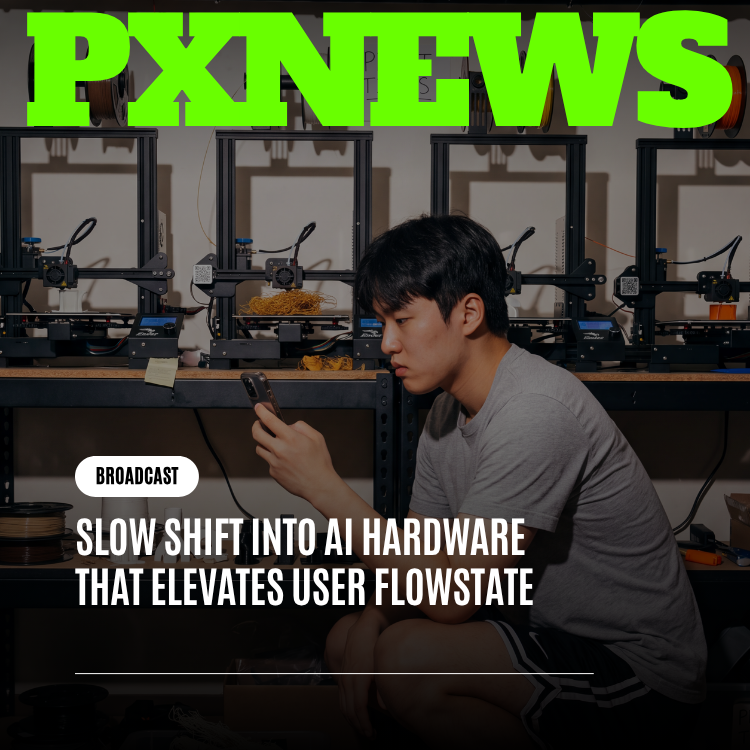
Every meaningful shift ETAPX has made as a company has started with the same question: what is this actually protecting? As we begin exploring AI hardware as a new category — extending the same thinking behind Influxx into the physical world — that question matters more than usual, because the thing worth protecting here isn't a feature or a market position. It's flowstate: the state of focused, uninterrupted engagement where a tool disappears and the work, or the thought, simply flows. Most of what surrounds people today is built to interrupt that state rather than protect it, and we don't believe a device meant to defend someone's attention can itself be born from a rushed, hype-driven sprint. This piece is about why we're taking our time.
What We Mean by Flowstate
The term didn't originate with us, and we're not going to pretend it did. Psychologists have had a name for this specific condition for decades: a period of such complete absorption in a task that self-consciousness falls away, the sense of time gets strange, and effort quietly stops feeling like effort. We write it as one word, flowstate, because that's closer to how it actually shows up in a real day — not two separate ideas, "flow" and "state," but a single condition you're either inside of or you're not. You know it when a piece of writing starts finishing its own sentences in your head, or when code stops feeling like syntax and starts feeling like thought, and an hour disappears before anyone thinks to check the time.
The Work That Happens When the Tool Disappears
The detail that matters most for anything ETAPX builds, hardware included, is what flowstate has in common across every version of it: the tool gets out of the way. Nobody in flowstate is thinking about the pen, the keyboard, the notebook, or the software sitting between them and the work. The instrument recedes entirely, and what's left is just the thinking and the doing, with nothing noticeable in between. That's the actual target, stated as plainly as we can state it. Not a faster tool. Not a smarter tool. A tool quiet enough to disappear.
This is where the thesis behind Influxx and the thinking behind exploring AI hardware turn out to be the same thesis, just aimed at two different layers of a person's day. Influxx exists because we believe the point of AI was never the conversation — it was always the outcome. A good tool should carry work through to done instead of handing back an answer and calling that finished. Hardware raises the identical question one level down, at the level of attention itself: what would it take for something to carry a person's focus through to done, instead of interrupting it every few minutes and calling that engagement?
What Breaks It, Long Before Any Hardware Does
Before we can talk seriously about protecting flowstate, it's worth being honest about what's actually breaking it right now, because the answer isn't exotic or dramatic. It's not one big distraction. It's the accumulation of small ones, each individually reasonable in isolation, together adding up to a day that never quite lets anyone sink into anything for very long.
The Notification Tax
A notification doesn't have to be urgent to do its damage. It only has to arrive. The moment attention gets pulled toward a screen — even for something dismissed in half a second — the thread that was actually being followed has to be picked back up from wherever it got dropped, and that reconstruction isn't free. It isn't the glance that costs anything — it's the slower rebuild of context afterward, a quiet tax paid every single time whether or not anyone notices they're paying it. Stack that across a normal day of pings and badges, and a handful of long, real stretches of focus turns into many short ones stitched together with effort nobody actually budgeted for.
The Distance Between a Small Task and the Screen in Your Hand
The other quiet cost is friction, and it shows up in the gap between deciding to do something and actually doing it. Checking one piece of information. Confirming one small detail. Sending one short reply. None of it is hard on its own, but almost all of it now runs through the same ritual: pick up a device, unlock it, find the right layer among many, do the small thing — and then, because the device is already in hand and already lit up, do two or three things that were never the plan at all. The tool built to help with one small task has become the same tool that pulls a person into everything else it also happens to contain — less a flaw in any single app than a structural property of routing every kind of task through the same general-purpose screen.
Outcome Over Conversation, Extended Into AI Hardware
This is the point where it's fair to ask why a company that has spent its energy on agentic environments and social platforms is looking at hardware at all. The honest answer is that we didn't start by asking whether to build a device. We started by asking the same question we asked before Influxx existed: where is the gap between what people actually need and what the current shape of the tool can give them? With Influxx, that gap sat between a good answer and a finished outcome. With hardware, the gap looks like the space between a moment that deserves someone's full attention and a screen that can't give it to them without also offering everything else it contains.
A phone cannot help but be a phone. By design, it's a gateway to everything at once — every app, every notification source, every possible distraction, sitting one layer beneath whatever it was actually picked up for. That's not a criticism of the phone. It's an extraordinarily good gateway, which is exactly the problem when the job at hand is protecting one moment of focus rather than offering access to all of them at once. A tool built specifically to protect attention may need to be a tool that deliberately can't do everything else too — on purpose, by design, as a feature rather than a limitation.
Why a Screen Might Be the Wrong Shape for This Job
We don't know yet exactly what that looks like, and we're not going to pretend otherwise in this piece. What we do know is the design question we're actually sitting with, and it has nothing to do with form and everything to do with intent: could something exist whose entire job is protecting a moment of focus, the same way Influxx's entire job is carrying a task through to completion? Extend "outcome over conversation" far enough and it stops being a statement about software specifically. It becomes a statement about attention itself — the outcome that actually matters isn't a notification acknowledged, it's a thought finished, and everything about a tool should serve that instead of quietly competing with it.
Designing for Protection, Not Attention
Nearly every consumer device built over the last two decades has optimized, whether its makers set out to or not, for one metric above the rest: how often someone comes back to it. That's a defensible thing to optimize for if a business depends on attention as its fuel. It is close to the worst possible thing to optimize for if the stated purpose is protecting someone's flowstate instead. A tool can't be built to protect focus using the same design instincts that were built to capture it — the two goals pull in opposite directions from the very first decision onward, not just at the margins.
So the principles we keep returning to in these early conversations aren't really about what a device would do. They're about what it would refuse to do, which is a harder design conversation, and we think the more important one:
- Presence without pull: something that's there when you reach for it and quiet when you don't, instead of a tool that reaches for you first.
- Feedback that doesn't require looking: confirmation that something is happening, or done, delivered in a way that doesn't cost you the visual attention you were already spending on something else.
- Fewer layers between intention and action: less time spent navigating toward a small thing you wanted to do, and more of that time actually spent doing it.
- Interruption earned, not defaulted: the same instinct behind Influxx's check-ins, translated outside a screen — surfacing a moment only when a real decision needs a person, and otherwise staying out of the way entirely.
- Absence as a design choice: knowing when the right answer is nothing at all, because most of what happens in a given hour doesn't actually need anyone's attention on it right now.
"I've spent a lot of time thinking about interfaces that disappear, because that's the whole game with Podz — the moment you stop noticing the boundary between one piece of work and another is the moment the tool actually did its job. I think about hardware exactly the same way, except the boundary isn't between two projects, it's between a person's attention and everything competing for it. The question I keep asking in these early conversations isn't 'what could this device do.' It's 'what would it feel like to trust something enough that you stop checking it.' That's a design problem before it's ever an engineering one, and it's a much harder one to get right."
— John Ridge, CTO, ETAPX
Notice what's absent from that list: nothing about sensors, materials, silhouettes, or specifications. That's deliberate. Those are downstream decisions, and ones made before the philosophy is settled tend to calcify into a shape nobody can quite explain later. We'd rather be slow and clear about the "why" than fast and vague about it.
The Shift We're Choosing Not to Rush
None of this is a secret internally, and it shouldn't need to be one externally either: we are early. What's happening right now inside ETAPX is a shift in where our philosophy applies, not a countdown toward a product announcement. We're exploring AI hardware as a category the way we've approached anything genuinely new — by getting clear on the philosophy first, because the philosophy is the part that's actually difficult to get right and the part that's nearly impossible to fix later if it's wrong from the start.
The Hypocrisy of Building Fast and Hyped
There's a specific contradiction we're actively trying to avoid, worth stating plainly rather than dancing around: a device whose entire premise is protecting someone's focus cannot itself be the output of a rushed, hype-chasing sprint. A process that's scattered and reactive, driven by fear of missing a news cycle, tends to leave that same scatter inside the finished thing, regardless of how good the intentions were going in. You can't design calm out of chaos, and you can't protect attention using a process that's busy fragmenting your own team's attention just to hit an arbitrary date. The process has to match the philosophy, or the philosophy was never real to begin with.
"AI hardware is having a moment across the entire industry right now, and moments like this are exactly when discipline matters most, not least. It would be easy to announce something just to be part of the conversation. I'm not interested in that version of it. If ETAPX ever brings a device like this to people, I want the reason it exists to be as simple as everything else we've built: it protects something that actually matters to them, and it gets out of the way for everything else. That takes longer than jumping on a trend cycle. It's the only version of this worth building."
— AJ, Founder & CEO, ETAPX
That instinct isn't new for ETAPX, even if the category is — it's the same posture the company has taken toward every AI hype cycle so far: watching closely, moving where the reasoning holds up, and declining to move just because everyone else is.
What Slow Actually Looks Like From the Inside
Slow doesn't mean idle, and it's worth being specific about the difference, because "we're taking our time" can sound like a polite way of saying nothing is actually happening. Plenty is happening. It just isn't happening in the shape of a countdown. Right now that means long, sometimes circular conversations about what flowstate actually requires, well before anyone touches a question like what a device should look like or do. It means testing philosophy against real days — our own, and the people we talk with who feel this specific kind of exhaustion most acutely — before testing anything else at all. It means staying genuinely willing to conclude, at any point in the process, that the honest answer is "not yet," without treating that as a setback.
This is consistent with how ETAPX has approached every product it has actually shipped. Whistlr, GLSRM, Influxx — none of them arrived because a category was trending and we felt behind; they arrived because a specific gap became clear enough that building the fix felt more honest than continuing to talk about it. AI hardware is held to that same bar, not a lower one just because the category happens to be popular right now. If anything the bar sits higher, because getting this wrong doesn't just waste our own time — it puts something into someone's daily life that fails at the one job it was supposed to do: protecting their attention instead of quietly demanding more of it.
So this piece isn't an announcement, and it isn't a preview. It's a record of where our thinking actually is, stated as plainly as we can manage: we think flowstate is worth protecting, we think most of what surrounds people right now does the opposite, and we think hardware might have a real role to play in fixing that — but only if the thing itself is built with the same patience it's meant to protect in whoever eventually uses it. Outcome over conversation got Influxx right. We think it's the right compass for this too, however long it actually takes to get there.
Frequently Asked Questions
What does ETAPX mean by "flowstate"?
Flowstate is the state of focused, uninterrupted engagement where a tool disappears and the work, or the thought, simply flows — the condition psychologists have described for decades as a total, effortless absorption in what you're doing. ETAPX uses the term to describe the specific thing it believes is worth protecting as it explores new categories, including AI hardware, rather than any specific feature or product.
Is ETAPX building an AI hardware device?
ETAPX is exploring AI hardware as a new category, reasoning from the same philosophy behind Influxx extended into the physical world. That exploration hasn't produced an announced device, a form factor, a timeline, or a set of specifications, and this piece intentionally doesn't speculate about any of those. It's a look at the thinking behind the exploration, not a preview of a product.
What actually breaks flowstate today?
Mostly small, individually reasonable interruptions rather than one dramatic distraction: notifications that force attention to reset even when dismissed instantly, and the friction of picking up a general-purpose device and navigating through several layers just to do one small thing. Neither is exotic on its own. Both add up across a normal day into far less real focus than it tends to feel like in the moment.
Why is ETAPX moving slowly on this instead of announcing a product?
Because a device meant to protect someone's attention can't credibly come from a rushed, hype-driven process — the scatter of a sprint built around a deadline tends to show up in the thing it produces. ETAPX is treating this shift the way it has approached every product it has actually shipped: get the philosophy right first, and let the timeline follow the thinking rather than the other way around.
How does this connect to Influxx?
Directly. Influxx is built on the idea that the point of AI was never the conversation, it was always the outcome — that a good tool carries work through to completion instead of handing back an answer and calling it done. ETAPX is asking the same question about attention: what would it take for a device to protect a moment of focus all the way through, instead of interrupting it and calling that engagement.
Flowstate isn't a new idea, and ETAPX isn't claiming to have invented the feeling of a tool disappearing into the work it makes possible. What's new, for us, is asking whether that feeling is something hardware could protect on purpose, rather than something people are left to defend for themselves against everything currently competing for their attention. We don't have a device to show for that question yet, and we're in no hurry to manufacture one just to have something to announce. We'd rather take the time the philosophy actually deserves, and let this particular shift happen at the pace that keeps it honest.