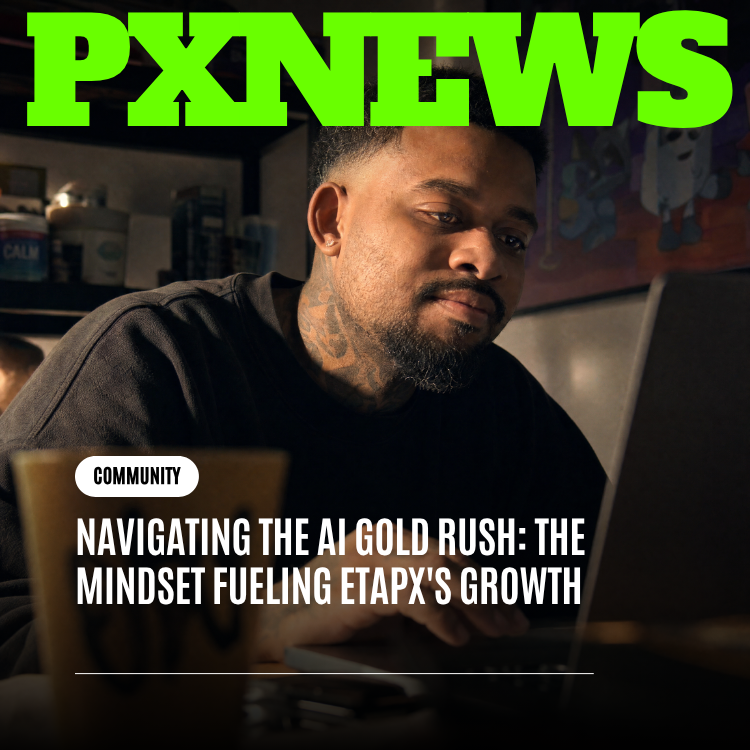
Every company building anywhere near AI right now is being offered the same trade: chase whatever's trending this quarter, or spend the time building something durable enough to matter in ten years. Most take the first option, because it's faster and it photographs better in a board deck. ETAPX has spent this AI gold rush deliberately choosing the second, betting that restraint — not speed, not headlines — is what actually compounds into growth worth having.
Nobody sends out a press release for the feature they decided not to build. There's no announcement for "we looked at what a competitor shipped, thought seriously about copying it, and decided our users didn't actually need it." That's exactly why it's worth writing about. The decisions a company doesn't make say more about what it actually values than the decisions it does, and lately we've been making a lot of the quiet kind.
The Gold Rush Every AI Company Is Standing In
Call the current moment what it is: a gold rush. A genuinely important technology arrived, the whole industry noticed at the same time, and now every company anywhere near it is grabbing a shovel. The metaphor holds up better than most tech-industry comparisons, because actual gold rushes have a well-documented pattern behind the mythology — thousands of people rush the same hillside, most of them find nothing worth the trip, and the ones who came out ahead usually weren't the fastest diggers. They were the ones who figured out which ground was worth working at all.
You can watch the rush happen in real time across the industry, because we track it — literally, through GLSRM. Social apps that had nothing to do with AI a year ago suddenly have a companion living in the inbox. Productivity tools grow a chat sidebar that wasn't there last release. Entire product roadmaps get reorganized around whatever a competitor announced last week, or whatever model launch is dominating the news cycle this morning. None of this is a conspiracy. It's the rational behavior of companies responding to a market that currently rewards being seen moving on AI, right now, more than it rewards the thing actually being good.
Everyone Feels the Same Pull, Including Us
We'd be lying if we pretended ETAPX is somehow immune to this. We're not watching the gold rush from a safe distance — we build AI-adjacent products for a living, we track the frontier daily through GLSRM, and we feel the exact same competitive pressure every company in this space feels. The temptation isn't abstract or hypothetical. It shows up as a handful of very specific, very concrete urges, and we've felt each of them directly.
- Bolt on the feature everyone else already shipped: when every competitor has an AI companion or an AI-generated feed, there's real pressure to ship a version too, whether or not it actually makes the product better.
- Copy whatever's working for someone else: a rival ships something, it gets attention, and the fastest response is to build our own version before the moment passes and the attention moves elsewhere.
- Chase the news cycle: a model launches, a benchmark goes viral, a story dominates GLSRM's own Wire for a day, and there's a pull to ship something — anything — that lets ETAPX insert itself into that day's conversation.
Each of those moves would probably work, in the narrow sense that it would generate a news cycle of our own for a week or two. None of them are why we started this company, and none of them are why anyone should trust what we build next. Knowing that in the abstract turns out to be the easy part. Saying no to a specific, tempting version of it in a real product meeting is the actual discipline.
Why Restraint Is a Competitive Advantage, Not a Weakness
Here's the part that took us longer to fully believe than we'd like to admit: in a genuine gold rush, restraint isn't the cautious choice. It's the aggressive one. When almost every competitor is optimizing for whatever gets covered this quarter, a company that optimizes for what earns trust across the next decade isn't playing it safe. It's making the harder bet available — that the rush eventually cools, and only the durable stuff is still standing when it does.
Most companies don't make that bet, and it's not because they're careless. Optimizing for the visible thing — the launch that gets covered, the metric that ticks up this quarter, the feature that looks good in a deck — is a rational response to how most companies actually get judged, by people who won't be around eighteen months later to ask what happened to the thing they praised. We've made a different bet: that the market for durable trust is undersupplied precisely because almost nobody is patient enough to compete in it. Being one of the few companies still running that race after the crowd thins out is the whole advantage.
"If we optimized for whatever gets a headline this quarter, we'd be shipping completely different products than the ones we're actually shipping. We're not trying to win this quarter's news cycle. We're trying to be the company still standing, still trusted, after everyone who chased that cycle has already moved on to the next one."
— AJ, Founder & CEO at ETAPX
The Questions We Ask Before We Chase Anything
Discernment only works if it's an actual process, not just a mood or a vague sense of taste. Every time something trending crosses our desk — a competitor's feature, a viral use case, a request that suddenly shows up everywhere because it's suddenly everywhere — we run it through the same set of questions before deciding whether to build it at all.
- Does this solve a problem our own users actually have, or does it solve the problem of us not having announced anything recently?
- Would we still want this in two years, once the trend that inspired it has moved on to whatever comes next?
- Does it make the core product better at the one job it has, or does it just make the product different?
- Are we building this because we understand it, or because a competitor's version got attention and we want some of our own?
- If we shipped nothing and simply explained why, would that explanation hold up in the room? "Because everyone else was doing it" doesn't survive being said out loud, and that alone disqualifies most trending ideas before they get any further.
A test that everything passes isn't a test
Most trending ideas fail at least one of those five questions, and that's the entire point of asking them. If a framework never says no, it isn't a filter — it's decoration. We've walked away from features that would have been easy headlines because they failed on question two or four, and we don't publicize most of those decisions, because a company explaining every trend it didn't chase starts to sound like it's still chasing the credit for chasing nothing.
Two Bets That Prove the Point
Abstractions about discipline are easy to write and just as easy to ignore. The more useful evidence is what this actually produced when pointed at real product decisions, not just at a hypothetical.
Whistlr exists because we think the internet has an authenticity problem, and the fix was never a feature — it required an entire feed built around the premise that the person on the other end is a real human being. Circuits and SubCircuits reward a community sorting itself around genuine shared interest through upvotes and real discussion, not an algorithm optimized to maximize time-on-app. Waves is built around music people actually want to share with each other, not a recommendation gimmick dressed up as a feature. Gems is designed as a real, healthy economy between creators and the people who support them, with a split that reflects that relationship, not a tip jar engineered to extract as much as possible. None of those are exciting because they chased whatever was trending. They're durable specifically because they didn't.
The clearest proof: keeping AI out of Whistlr's feed
The single clearest example is one we've already written about in detail elsewhere: the decision to keep AI out of Whistlr's core feed entirely, and build GLSRM as a completely separate initiative rather than bolt a companion onto the app people already trust. An AI chatbot in the inbox would have been the easy, on-trend feature — straightforward to ship inside a quarter, and guaranteed to generate a news cycle. We decided a feed whose entire premise rests on the person on the other side being real couldn't absorb that compromise, so we built our AI ambitions somewhere else entirely instead. We won't re-litigate the full argument here; it's been made in depth already. In this piece it's simply the cleanest evidence that the mindset described above isn't theoretical.
Even something as small as the Campus Store reflects the same instinct at a different scale. It would have been easy to time a rushed merch drop to whatever was getting attention that month. Instead it shipped small, made to order, and considered, on its own schedule, because we'd rather get a small thing right than get it out fast.
"I've watched apps I liked get worse the moment AI became the thing every company had to talk about — bolted on overnight like someone panicked in a meeting. ETAPX is the first place I've seen the opposite happen. They said no to the easy version and went and built the hard version somewhere else instead. That's the first time a company's 'we actually thought about this' has felt true to me."
— Freya Lindqvist, ETAPX community member
What Growth Actually Means to Us
Say "growth" inside most companies during a boom like this one and everyone assumes the same three or four numbers: installs, sign-ups, some multiple attached to a valuation. We think that definition is exactly backwards for a company trying to build something that outlasts the rush it was born into. What we're actually optimizing for is closer to this: do people still trust us to be straight about what we're building, and do they keep showing up because they want to, not because a notification told them to.
That's not a rejection of ambition. We intend to build something large, and we're not shy about that. It's a rejection of one specific kind of ambition — the kind that treats attention as the goal instead of the byproduct. A gold rush produces an enormous amount of activity that looks exactly like progress and evaporates the moment the rush cools. We'd rather be judged on what's still standing after that happens: whether SubCircuits are still full of people who showed up because the conversation was genuinely good, whether Campus still has a real back-and-forth between our team and the people using the product instead of a canned support queue, whether a creator still believes a Gem sent their way reflects a fair split instead of a rigged one.
This is also why we're comfortable admitting we're not the fastest mover in every category, and why that doesn't bother us the way it might look like it should. Speed is a good trait when it's speed toward something durable. It's a liability when it's speed for its own sake, because the fastest way to ship the wrong thing is exactly as fast as shipping the right one — the calendar can't tell the difference, only time can.
What Happens When the Rush Cools
Every gold rush ends. The hillside gets picked over, the headlines move on to the next thing, and most of the towns that sprang up around the frenzy turn out to have been built on nothing sturdier than the frenzy itself. What's usually left standing afterward is never the operation that moved fastest during the scramble. It's the one that was building something people actually needed, independent of whether gold was still coming out of the ground.
We're not claiming special insight into exactly when the current AI boom cools, or pretending we can time it better than anyone else watching the same industry we cover. What we do have a clear position on is what we want to be standing on the other side of it: not the company remembered for how many trend-shaped features it shipped in 2026, but the one whose products people still reach for because they still work, still feel considered, and still treat the person using them as the point instead of the resource being harvested.
"A gold rush rewards whoever moves fastest, for exactly as long as the rush lasts. We're not building for the length of the rush. We're building for what's still true after it's over, and that means we have to be willing to look slow for a while before anyone can tell the difference."
— AJ, Founder & CEO at ETAPX
Frequently Asked Questions
What does ETAPX mean by "the AI gold rush"?
It's shorthand for the current moment across the industry, where a genuinely important technology has triggered a rush of companies scrambling to be seen adopting it, often faster than they've actually thought through why. Like a real gold rush, most of the resulting activity generates noise rather than lasting value, and the companies that come out ahead tend to be selective about which ground is worth working rather than simply digging the fastest.
Is ETAPX against building with AI?
No. GLSRM exists specifically because we think AI is consequential enough to deserve serious, dedicated coverage, not less attention. The position in this piece isn't anti-AI, it's anti-chasing: we're careful about which AI-adjacent decisions actually solve a real problem for our users, versus which ones would mainly exist to prove we noticed a trend.
How does ETAPX actually decide whether to build a trending feature?
We run it through a specific set of questions before committing to anything: whether it solves a problem our users genuinely have, whether we'd still want it in two years once the trend fades, whether it makes the core product better at its actual job, and whether we're building it because we understand it or because a competitor's version got attention. If the honest answer is "because everyone else is doing it," that disqualifies the idea on its own.
Doesn't moving deliberately risk ETAPX falling behind faster-moving competitors?
It's a real risk and we don't pretend otherwise — a company optimizing for durability will sometimes look slower than one optimizing for this quarter's headline. Our bet is that the companies who come out ahead in a genuine gold rush are rarely the fastest diggers; they're the ones still standing once the rush ends, and that's the race we've chosen to run.
What does "growth" mean at ETAPX if it isn't user or revenue numbers?
Growth, to us, is durable trust and real usage: people coming back to Whistlr, Circuits, and Waves because they want to, creators believing Gems reflects a fair economy, and a community in Campus that believes the team behind it is actually listening. Numbers can rise even while a product is quietly getting worse underneath them, so we try to optimize for what a healthy number is supposed to represent, not the number by itself.
Where can I see this mindset applied to an actual decision, not just described?
The clearest example is our decision to keep AI out of Whistlr's core feed entirely and build GLSRM as a separate initiative, instead of bolting an AI companion onto the app people already trust — a decision we've written about in full elsewhere. It's the same discipline described throughout this piece, just applied to one concrete, specific product call instead of stated as a philosophy.
None of this makes for a particularly exciting press release, which is more or less the point. The companies worth trusting during a gold rush are rarely the loudest ones digging — they're the ones who can tell you exactly why they turned down the last three trends everyone else chased, and mean it. That's the bet running underneath Whistlr, GLSRM, Circuits, Waves, Gems, and everything else we build under the ETAPX name: not the fastest hands in the rush, but the steadiest ones once it's over.