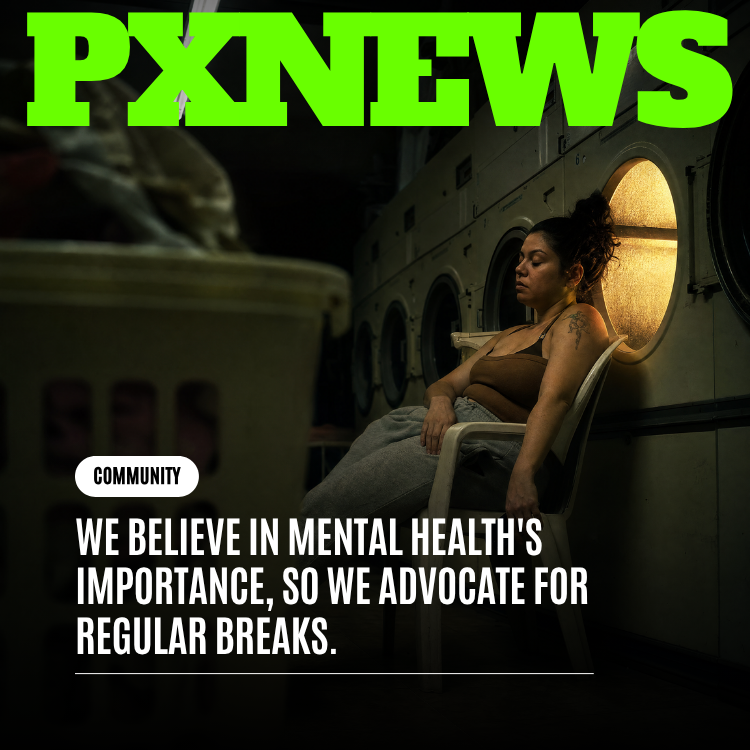
"We believe in mental health's importance" is a sentence companies say so often, and act on so rarely, that it barely registers as a claim anymore. We'd rather show our work instead: ETAPX treats regular breaks as an actual practiced value, not a poster in a break room, because a team building fast-moving products like Whistlr and GLSRM burns out exactly the way anyone else does. And once you actually believe that internally, it gets a lot harder to justify building a product engineered to make it hard for anyone else to put their phone down.
Why "We Care About Mental Health" Is a Claim We Know Sounds Hollow
Every company says some version of this sentence. It shows up in a values deck, maybe a dedicated Slack channel, a mental health awareness week with a guest speaker and a table of granola bars, and then the workweek continues exactly as it did before, because the sentence was never actually connected to a practice. We know how that sounds, because we've read the same decks everyone else has. A claim like "we believe in mental health" is cheap to say and expensive to actually build around, which is exactly why most companies stop at saying it.
So this isn't going to be a piece about how much we care. We'd rather be specific about the one thing we've actually built a practice around: pushing back on always-on hustle culture and treating regular breaks, real ones, as something the company advocates for on purpose, not something we tolerate whenever someone's calendar happens to be quiet. If that sounds like a small thing to build an entire post around, that's because most companies never get past the poster.
What Building Whistlr, GLSRM, and Everything Else Actually Demands
This isn't a company with one product and a comfortable, settled roadmap. Whistlr alone spans creator monetization, live streaming, an in-app AI video editor, Circuits, and a growing commerce side. GLSRM is trying to become the front page of AI inside an industry that meaningfully changes on a weekly basis. The Campus Store, Ocsidian, and everything else ETAPX is building move at the same time, often on overlapping teams, with the kind of velocity that comes from trying to build several genuinely ambitious things at once instead of one safe thing slowly.
That pace is a choice we've made, and we don't regret it. But it's worth being honest about what it costs the people doing the actual building. A team moving that fast can talk itself into believing the current sprint, the current launch, the current fire, is the one time it's fine to skip the weekend, skip the walk, skip the actual rest, because everything happening right now feels urgent. The problem is that "everything happening right now feels urgent" describes nearly every week at a company building this much. Left unchecked, that means breaks never actually happen. They get deferred one justified week at a time, until someone burns out and the company acts surprised.
Hustle Culture Is a Bad Bet, Not a Badge of Honor
There's a specific belief we're pushing back against here, and it's worth naming directly: the idea that a team's seriousness is measured by its willingness to grind without limits, that always-on is a sign of ambition rather than a sign that something upstream is broken. That belief is common enough at fast-moving companies that it rarely even gets questioned out loud, and one of the more contrarian things we'll say in this piece is that we think it's not just unpleasant, we think it's wrong on the merits.
Someone who never actually steps away doesn't produce more good work over the course of a year. They produce a shorter tenure and worse decisions along the way. Judgment erodes before energy does, and by the time a person is visibly exhausted, the quality of their work has usually already been quietly slipping for weeks. Treating rest as an input to good work, rather than a threat to it, isn't the soft position here. It's the more rigorous one, and it's the one we're actually betting on.
"We don't push back on always-on hustle because it's a nice thing to do for people. We push back on it because we've watched it produce worse work, not more of it. Somebody who hasn't stopped in three weeks isn't your most committed team member — they're your next resignation letter, and usually your next mistake before that."
— Derek Amadi, Head of People at ETAPX
None of this means we've built a company where nobody ever works hard or deadlines don't exist. Building fast-moving products means real intensity sometimes — real pushes before a launch, real weeks that ask more of people than a quiet week would. The actual distinction we're drawing is between intensity that's occasional and chosen, and always-on as the default operating temperature. One of those is sustainable. The other one is just burnout with a deadline attached to it.
What Advocating for Regular Breaks Actually Looks Like Here
This is usually where a piece like this turns vague, so we'd rather be specific instead — specific in the sense of describing a practiced value, not reciting an official policy document. This isn't about a wellness week once a year. It's a handful of smaller, more boring things happening consistently enough that they actually add up.
- Weekends stay weekends, by default: the expectation isn't an instant reply to a message sent on a Saturday, and a slow reply on a Sunday isn't read as a lack of commitment.
- Managers model stepping away, not just permit it: a manager who visibly takes real time off changes a team's actual behavior more than any policy sentence could.
- Time off is meant to be used, not banked as a talking point: the time people have earned is treated as something to actually take, not a number that looks good sitting unused in a system.
- Urgent is a real category, not every category: most things that feel urgent in the moment can wait until Monday, and treating everything as equally urgent is exactly how breaks quietly disappear.
- Checking out doesn't require a justification: stepping away for an afternoon or a weekend doesn't need a reason good enough to satisfy someone else first.
None of that is dramatic, and that's sort of the point. The gestures that earn a company public credit — a mental health day announced with fanfare, a wellness stipend listed in the benefits deck — are the easy version of this. The version that actually changes someone's week is quieter: a manager who doesn't message at 11pm, a team that treats a real weekend as the default instead of a stretch goal, a culture where taking the break you've already earned doesn't require building a case for it first.
The Product Question We Couldn't Answer Two Different Ways
At some point in building this practice internally, an uncomfortable question showed up, and we couldn't find a version of ourselves that answered it two different ways depending on who was asking. If we genuinely believe people need to be able to step back, put the work down, and not be punished for it, what does that actually say about a product engineered to make stepping away as hard as possible for the person using it?
We've written before about why Whistlr's Trending surface is a finite list you can actually reach the bottom of, instead of an infinite well built to be un-finishable, and why the ranking underneath it weighs deliberate signals like saves and shares over passive ones like a raw view count, so the app isn't quietly optimized for whichever post just keeps someone reacting the longest. That wasn't originally framed as a mental health decision. It was framed as a ranking and product-quality decision. But sitting next to the internal conversation about breaks, it's obviously the same instinct wearing a different hat: don't build the thing that's engineered to make it hard for a person to stop.
"I deleted two other apps off my phone this year because I genuinely couldn't put them down, and I don't mean that as a compliment to them. Whistlr is the one app where I can open it, actually get to the end of what's trending, and close it again without that itch to keep going. It sounds like a small thing until you notice how rare it actually is."
— Talia Ferro, ETAPX community member
We're not going to pretend every design decision across Whistlr is purely altruistic — plenty of them are just good product judgment that happens to also be the healthier choice. But a company that tells its own team "step away, it's fine, it's expected" and then builds a product engineered to punish a user the moment they try to do the same thing would be running two completely different value systems at once: one for the people who work there, and one for the people who use what they make. We didn't want to be that company, so we haven't built that product.
Why the Internal Value and the Product Choice Have to Match
It would be easy to treat these as two separate topics — an internal culture conversation over here, a ranking algorithm over there, connected only by a marketing team looking for a tidy narrative. We don't think that holds up under any real scrutiny. A company's product is downstream of what it actually believes, whether it says so out loud or not, and a company that privately believes rest matters but publicly ships a product engineered to prevent it is telling you which belief is real and which one is decoration.
We'd rather be the more boring, more consistent version of this. Advocating for regular breaks internally and refusing to design Whistlr around maximizing time spent past the point of actual enjoyment aren't two separate initiatives that happen to rhyme. They're the same position, applied to two different groups of people, stated plainly instead of dressed up as two unrelated announcements.
We Don't Have This Perfectly Figured Out
We want to be honest about the limits of what this piece is. This is a company culture and product philosophy piece, not a mental health resource, and we're not qualified to be one. If what someone is dealing with is heavier than a demanding stretch at work — something that feels less like "I need a weekend" and more like something that isn't lifting on its own — that's a conversation for a therapist, a doctor, or a real support system, not a company blog post. We'd rather say that plainly than let a well-meaning paragraph here stand in for actual help.
We also don't want to claim we've solved this. Advocating for regular breaks is a practice we're actively building, not a finished system we're announcing as complete. Some weeks we're better at it than others. Some launches make the boundary harder to hold than we'd like. The honest answer is that this takes ongoing attention, not a policy that gets written once and then runs itself forever. What we can say is that it's a value we're actually trying to practice, out loud, on purpose, rather than a line that lives in a deck and gets forgotten right after.
Frequently Asked Questions
Does ETAPX have an official mental health policy?
We don't publish this as a rigid, one-size-fits-all policy document, and we're intentionally not turning it into a specific numbers-based mandate here. What we can say honestly is that regular breaks, real boundaries around always-on availability, and pushing back on hustle culture are treated as an active, practiced value across the company, not just a line in an onboarding deck.
Isn't this just a marketing angle, since ETAPX writes about its own products so directly?
That's a fair thing to be skeptical about, and we'd rather you be skeptical than take a "we care" claim at face value. This piece exists because the same instinct that shapes how ETAPX treats its own team's time also shows up in product decisions like Whistlr's finite, non-infinite Trending surface. That connection is the actual point, not a coincidence dressed up after the fact.
Does advocating for breaks mean ETAPX doesn't have intense, high-pressure weeks?
No. Building fast-moving products across Whistlr, GLSRM, and other initiatives means real pushes before launches and weeks that ask more than a quiet week would. The distinction is between occasional, chosen intensity and always-on as the default expectation. The first is normal for any ambitious team. The second is what actually leads to burnout.
Is Whistlr designed to reduce how much time people spend in the app?
Not exactly, and that's a subtly different claim. Whistlr isn't designed around maximizing time spent past the point where someone's actually enjoying it, which is different from trying to minimize usage outright. Choices like a finite Trending list and ranking that weighs deliberate actions over passive ones are about respecting a stopping point, not discouraging people from using the app at all.
What should someone do if they're dealing with a real mental health struggle, not just a demanding week at work?
Talk to a therapist, a doctor, or whatever real support system fits what's actually going on. This piece is about company culture and product philosophy, not a mental health resource, and it isn't a substitute for real support if what's needed is more than rest.
How does this connect to ETAPX's other products, like GLSRM or the Campus Store?
The same instinct applies across everything ETAPX builds, not just Whistlr. GLSRM is built around serious editorial judgment rather than a race for constant attention, and the Campus Store exists as a straightforward storefront rather than something engineered around compulsive browsing. The common thread is that velocity across the company isn't supposed to come at the cost of the people building it, or the people using what gets built.
None of this is a finished announcement, and it isn't a claim that ETAPX has cracked something every other company has missed. It's a plainer statement than that: a team building fast-moving products needs real breaks to keep building well, saying that only counts if it shows up in how people are actually treated, and a product built by that same team should let its users do the exact same thing we ask of ourselves — step back, and not be punished for it.