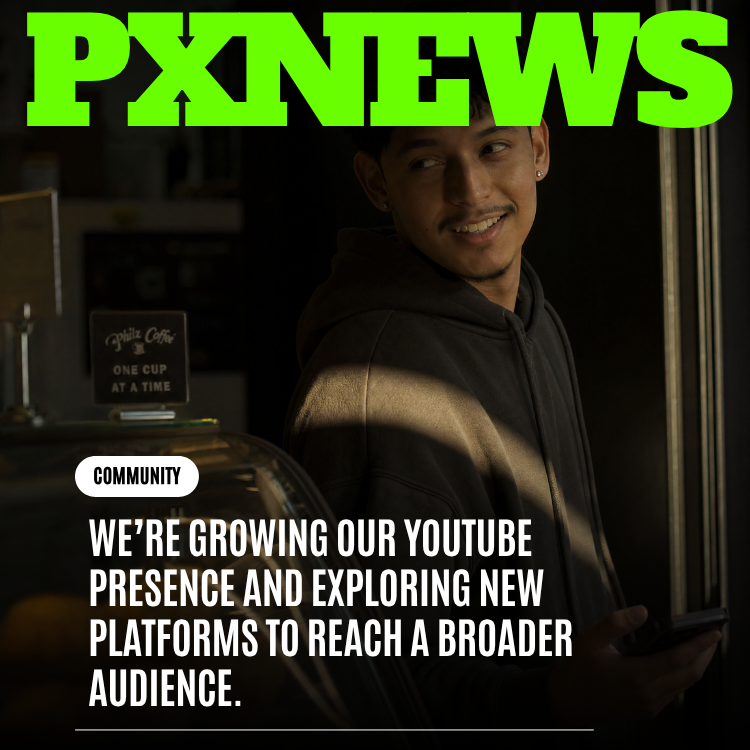
ETAPX's YouTube channel has moved past the stage where we were just testing whether the idea would hold up — it clearly did, so we're putting more into it: more formats, more of the team on camera, more of the content that genuinely works better shown than written. That's the smaller half of this post, though. The bigger point is the philosophy underneath it — video is one more front door into ETAPX and Whistlr, alongside Campus and PX News, and we're actively looking at where else our community already spends time instead of assuming everyone eventually finds their way to us on their own.
We wrote about why the channel exists when we first launched it, and we're not going to retell that story here. What's worth telling instead is what's happened since: enough of that early content held up — enough people watched a walkthrough instead of skimming a changelog, enough of the behind-the-scenes material actually landed — that treating the channel as a side experiment stopped being an honest description of what it had become.
A Channel That's Earned More Than a Trial Run
If you've spent any time on the ETAPX homepage recently, you've already seen where this is heading before we've said a word about it. There's a hero banner spotlighting our newest video, and underneath it, a carousel of other channel content — real placement, not a footer link buried under six other things competing for attention. That's not decoration. Homepage real estate is the most contested space we have, and everything on it is there because it earned that position over something else that wanted it just as badly.
The channel earned it by doing the thing we hoped it would do when we first published to it: make some of what we build genuinely easier to understand. A written explainer of a redesign is fine. Watching the person who made the call talk through it, in their own voice, with the actual interface on screen, is a different kind of understanding — faster to absorb, harder to misread, and more convincing simply because you can see it isn't being spun. Once that pattern held up across enough videos, the internal conversation stopped being "should we keep doing this" and became "why weren't we resourcing this more already."
That shift matters more than it sounds like. A homepage placement is easy to grant and just as easy to quietly walk back a quarter later if the content stops holding its own. Ours hasn't been walked back. If anything, the conversation has gone the other direction — toward whether the current placement is doing the channel justice at all, rather than whether it deserves to be there in the first place.
Why Some of This Still Needs a Face and a Voice
We're not going to pretend every company needs a video strategy, or that writing is somehow an inferior format YouTube is rescuing us from. Plenty of what we publish is and should remain writing — PX News exists because some stories deserve the precision and permanence of a written record, something you can quote, link to, and reread without a scrubber bar. But once you're shipping interfaces with the surface area ours have — a streaming command center in Creator Studio, a timeline-based AI video editor, Live Shopping's real-time mechanics — text increasingly works against you instead of for you. Describing where a control lives, how a timeline behaves under a specific edit, or what a live sale actually looks like from the seller's side asks a reader to reconstruct a picture from a paragraph. Showing it collapses that effort to zero.
Tone Carries Information Too
There's a second reason, less about clarity and more about trust. A founder or an engineer explaining why a feature shipped the way it did reads one way in a press release and an entirely different way on camera, where you can hear the hesitation in a hard tradeoff or the actual conviction behind an unpopular call. That texture doesn't survive being flattened into quotes and paraphrase. It's a large part of why the behind-the-scenes content has outperformed our own expectations relative to the more polished material — people can tell the difference between a decision being explained and a decision being defended, and video is a much harder format to fake sincerity in than a blog post.
"We didn't go back and increase the channel's budget because a dashboard told us to. We did it because we kept noticing the same thing showing up in Campus and in PX News comments — people referencing something specific they'd watched, not just that they'd watched it. That's a different kind of signal than a view count, and it's the one that actually moved us."
— Renata Solis, VP of Growth at ETAPX
What's Actually Expanding
"Investing more" is a vague thing to say without being specific about what it means in practice, so here's the concrete version. This isn't a rebuild of the channel's original premise — it's the same categories of content we started with, given more attention, more variety, and more of the team's time than a side project usually gets.
- Longer, more hands-on product walkthroughs: less "here's the feature" and more full sessions — setting something up from zero, hitting the edge cases, showing what actually goes wrong and how to fix it.
- More people on camera, not just leadership: the engineers, designers, and support staff who make the calls day to day, explaining their own work in their own words instead of having it relayed secondhand.
- Shorter cuts alongside the long-form pieces: not every idea needs eight minutes, and we've gotten more deliberate about matching a video's length to what it's actually trying to say.
- More community and creator spotlights: the people actually building on Whistlr — streaming, running a storefront, growing a following — getting real airtime instead of a passing mention.
- Tighter ties back to Campus and PX News: a video that references a Campus conversation, or a written piece that links out to the walkthrough that explains it best, instead of three channels that happen to share a logo.
None of that shows up as a single dramatic relaunch. It shows up gradually, as the channel starts looking like something with a real production process behind it instead of whoever on the team had a spare afternoon.
Front Doors, Not Side Doors
Here's the philosophy underneath all of this, and it's the same one that got Campus built in the first place. We don't think there's one correct front door into ETAPX and Whistlr, and we're skeptical of any company that acts like there should be. Campus is where you talk to us in real time. PX News is where you read the considered, written version of a story. The YouTube channel is where you watch the parts of the story that are genuinely better watched. None of these are a funnel stage on the way to some "real" destination — each one is a legitimate place to encounter ETAPX, full stop, and plenty of people will happily stay in exactly one of them indefinitely.
That's a deliberate departure from the more common approach, where a company treats its own website or app as the only legitimate home base and every other platform as a marketing outpost whose entire job is herding traffic back to headquarters. We'd rather have a real, useful presence in the places people already are than a thin one spread everywhere, all pointing at a thick one nowhere but our own domain.
This isn't just tone-matching for its own sake, either. Whistlr's whole premise is that a friend-first, creator-focused platform doesn't get to demand people meet it exactly where it lives — it goes to where the people already are, in whatever form that takes for a given feature or community. Extending that same instinct to how we communicate, rather than only expecting it of the product itself, is less a new policy than it is just being consistent with something we already believe.
The Trouble With Waiting for People to Find You
There's a comfortable assumption a lot of companies make once their core product is working: build the thing well enough, and discovery takes care of itself. App stores surface it, word of mouth carries it, and every other platform becomes optional at best. We think that assumption is mostly wrong, and it's definitely wrong for a company still earning its place the way we are.
Someone who's never heard of Whistlr is not going to stumble onto it by browsing an app store category page. They're far more likely to see a video that answers a question they were already looking for an answer to, or watch a teammate explain a decision in a way that makes them curious what else this company is building. A YouTube channel that's actually good at explaining things doesn't just serve people who already use Whistlr — it does real introduction work for people who've never heard of it, in a place they were already going to be regardless of whether we showed up there or not.
"I found ETAPX's channel through a completely unrelated recommendation, watched one video about the AI video editor out of curiosity, and only afterward realized I should probably actually try Whistlr. I don't think I would have found it any other way — I wasn't looking for a new app, I was just watching a video."
— Yasmin Torres, ETAPX community member
Where We're Looking Next
The same logic that applies to YouTube doesn't stop at YouTube. If the goal is meeting the community where it already spends time, video is one answer, but it's very unlikely to be the only one, and we'd be lying if we said we weren't actively looking at what else might make sense.
What We're Not Promising
We're not going to name specific new platforms today, and that's not false modesty. We've watched what happens when a company announces a platform expansion before it's actually ready — a thin presence gets stood up to satisfy the announcement, it under-delivers, and the company either quietly abandons it or props it up long past the point it's earning its keep. We'd rather tell you honestly that we're evaluating where else our community already spends time, and only actually show up once we're confident we can do it properly, than hand you a list of logos today and a string of apologies later.
What we can say is that the criteria won't change from what got the YouTube channel this far: does the format fit content we're already good at making, does it reach people who genuinely haven't found Whistlr yet, and can we resource it properly instead of treating it as an afterthought. Anything that doesn't clear all three stays a maybe, not an announcement. We're already having those conversations internally, weighing format fit against where our own production bandwidth realistically sits, and we'd rather take the time to get that evaluation right than rush a name onto a slide to fill out a roadmap.
The Bar Doesn't Move, Even as the Investment Does
Growing the channel's budget and attention doesn't mean loosening the standard that got it here. We said at launch that we weren't going to chase a rigid upload schedule just to hit a quota, and that hasn't changed — more resourcing means more good videos get made, not that a weaker one ships on a Tuesday because the calendar said so. The same will hold for whatever comes after YouTube, if anything does: we'd rather move slowly into a new platform and be genuinely good at it than move fast and be forgettable there.
That's a slower way to grow a following than chasing every trend or standing up a presence on every platform at once. We're fine with that trade. A community that finds us because a specific video actually helped them is worth more than one that found us because we were simply everywhere.
Frequently Asked Questions
Is ETAPX launching new social media platforms?
Not today, and we're not going to hint at specific platforms before they're real. We're actively evaluating where else our community already spends time, and we'll only announce something once we're confident we can show up properly rather than just to say we did.
Where can I watch ETAPX's YouTube content?
The channel is at youtube.com/@etapx-inc. You can also find our newest video and a carousel of recent uploads built directly into the ETAPX homepage.
Is YouTube replacing PX News or Campus?
No. All three are meant to coexist as different front doors into the same company, and we have no plans to consolidate them into one. PX News is for written, considered coverage. Campus is for real-time community conversation. YouTube is for the content that's genuinely better watched than read. Each one is a complete destination on its own, not a waypoint toward the other two.
What new kinds of videos should I expect?
More hands-on product walkthroughs, more team members explaining their own work on camera, a mix of shorter and longer formats depending on what a given topic actually needs, and more spotlights on the creators and community members building on Whistlr.
Will ETAPX upload more often now?
Cadence will likely increase simply because more people and more planning are behind the channel, but we're still not committing to a rigid schedule. Quality and actual usefulness remain the bar, same as at launch.
How can I suggest a platform ETAPX should consider?
Campus is the best place for that conversation. It's where we hear this kind of feedback in real time, and community input is a genuine part of how we're thinking through where else to show up.
None of this is a pivot. It's the same company, communicating the same way we always have, just with more conviction that video deserves a real seat at that table, and more honesty that the table itself might need to grow — into places the community already lives, whenever we're actually ready to show up there properly instead of just showing up. If that ends up meaning a new platform announcement down the line, we'd rather you hear it from us once it's real than watch us speculate about it today.