
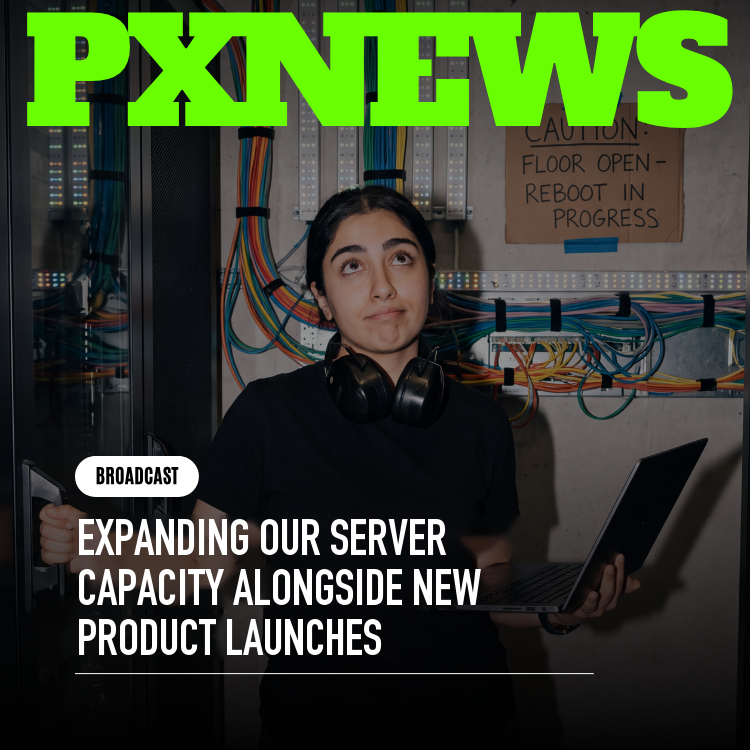
ETAPX is increasing the server capacity behind Whistlr and the rest of its products. More people are using what we build, our new launches are getting bigger, and the systems underneath all of it need more room to work. So we're adding that room now, ahead of the launches already on the calendar, instead of waiting for growth to push against our limits. The goal is simple: everything we ship should feel just as fast and dependable on a record-breaking day as it does on a quiet one.
What We're Actually Expanding
It helps to be precise about what this is. ETAPX doesn't build or own data center facilities. Like most modern software companies, we run our products on cloud infrastructure from hosting partners, and what we're expanding is the capacity we run there. That means more servers, more processing power and more storage, set up so we can scale up quickly when demand rises.
In practice, the added capacity goes to the parts of our products that work hardest:
- Application servers: More capacity for the requests behind opening the app, loading a feed, posting and searching, so busy hours don't turn into slow ones.
- Databases: More headroom for the reads and writes behind profiles, messages, comments and creator tools, which grow with every new member and every new feature.
- Live and video delivery: More room for live streams and short-form video, where a sudden crowd shows up all at once rather than gradually.
- Real-time messaging and notifications: More capacity for the connections that make a message or alert land the moment it's sent.
- Storage: More space for the photos, videos and uploads people trust us to keep.
Why We're Doing It Now
The reason is straightforward. ETAPX has more users and more usage than it did a year ago, and the trend points the same way for the year ahead. Whistlr keeps adding members and communities, and each release asks a little more of the systems behind it than the last one did.
Timing matters as much as the decision itself. We have several launches coming, and each brings its own audience and its own usage patterns. Adding capacity now means those launches arrive on a foundation that's already sized for them, rather than one that finds its limits the day real usage shows up. It's the difference between moving into a bigger space before the move-in date and signing the lease the week the boxes arrive.
Planning Capacity Ahead of Growth
It would be cheaper in the short term to wait until growth strains what we have and add servers then. Plenty of companies work that way, and many of them pay for it at the worst possible moment: a launch day, a viral post, the week a new feature lands and everyone tries it at once. We've chosen to scale before we strictly need to, because the cost of being early is almost always smaller than the cost of being late.
Here's how that works day to day:
- We forecast before the need arrives. Capacity decisions come from where usage is heading over the coming months, not from watching a dashboard until it turns red.
- Headroom is the point. We plan for more than the expected case on purpose, so a stronger-than-expected launch is a good problem instead of an emergency.
- Capacity lands before the announcement. The servers behind a launch are running and tested before it goes public, not added in a hurry afterward.
- Reliability is a feature. Staying fast through growth gets the same priority as anything on the product roadmap, because to the people using our products, it is part of the product.
Why Reactive Scaling Is a Trap
Reactive scaling looks fine until it fails, and it tends to fail exactly when a product is having its best moment. A feature travels further than expected or a launch draws more attention than projected, and if capacity was sized for yesterday's usage, the first thing people notice about your big moment is that it couldn't keep up. Capacity planning exists to teach that lesson in advance. We'd rather pay for room we grow into over a few months than for a scramble we have to apologize for.
"The easiest infrastructure mistake is a quiet one: you wait to add capacity until the numbers say you have to. By then you're not planning anymore, you're recovering. We'd rather stay a step ahead of our own growth than a step behind it, and that's the whole reason we're scaling now."
— John Barnes, Marketing Operations Executive, ETAPX
What It Means for You
Ideally, you'll never notice any of this, and that's by design. Added server capacity shows up as things that don't happen: no slowdown on a busy evening, no stuttering stream when a creator's audience surges, no lag on the day a new feature ships.
- Consistency as we grow: An ordinary Tuesday and a record-breaking day should feel the same.
- Steadier launches: New features land on infrastructure that was ready for the extra attention.
- Fewer surprises: The measure of success isn't just "did it get faster" but "did it stay steady," even as many more people use it.
Speed matters, but consistency matters more. A product that's sometimes very fast and sometimes struggling is a worse experience than one that's reliably good every time. Scaling ahead of demand is how we make reliably good the default.
The Business Case
Underneath the reliability argument is a business one. Trust is the hardest thing we've built, and it's easy to lose. Someone who has a rough experience during a product's biggest moment doesn't treat it as a one-off; they start expecting less. Capacity added ahead of growth is a direct investment in that trust.
It's also the cheaper way to grow. Adding capacity on our own schedule costs a predictable amount that we can plan for. Adding it reactively costs more, on a schedule set by whichever product happens to be having its biggest week.
"Every dollar we put into capacity before we strictly need it is a dollar spent on not having an emergency later. That trade is almost always worth making. We've got more launches ahead, and the boring, disciplined move is to make sure the foundation is ready before the growth shows up, not after."
— AJ, Founder & CEO, ETAPX
What Comes Next
This isn't tied to a single launch, and it isn't a one-time project. We're sizing capacity for a stretch of releases, not just the next one, and we'll keep reviewing it on a rolling basis as usage grows. Because we run on cloud infrastructure, we can add capacity in steps as we need it rather than betting on one big build-out, which keeps us flexible as plans change.
We're announcing it like a product update because, in a real sense, it is one. More server capacity doesn't add a new button or screen, but it's what lets every other launch land the way it's supposed to.
Frequently Asked Questions
Is ETAPX building its own data centers?
No. ETAPX doesn't own or operate data center buildings. Our products run on cloud infrastructure from hosting partners, and this expansion increases the server capacity we use there.
Why is ETAPX adding server capacity now?
Usage keeps growing, and several launches are planned for the months ahead. Adding capacity now means it's ready before those launches arrive, instead of being added after usage has outgrown what's in place.
Is this a response to an outage or a specific problem?
No. It's a planned investment tied to growth and upcoming launches, not a reaction to an incident. The point of scaling ahead of demand is to avoid ever having to do it in response to something going wrong.
Will I notice any changes?
Ideally the only thing you'll notice is that nothing changes: Whistlr stays fast and reliable as more people join and as we ship more often.
Adding server capacity isn't a headline most companies get excited about, and it isn't supposed to be exciting. It's supposed to be dependable, the same way our products are supposed to be dependable for the people who use them every day.