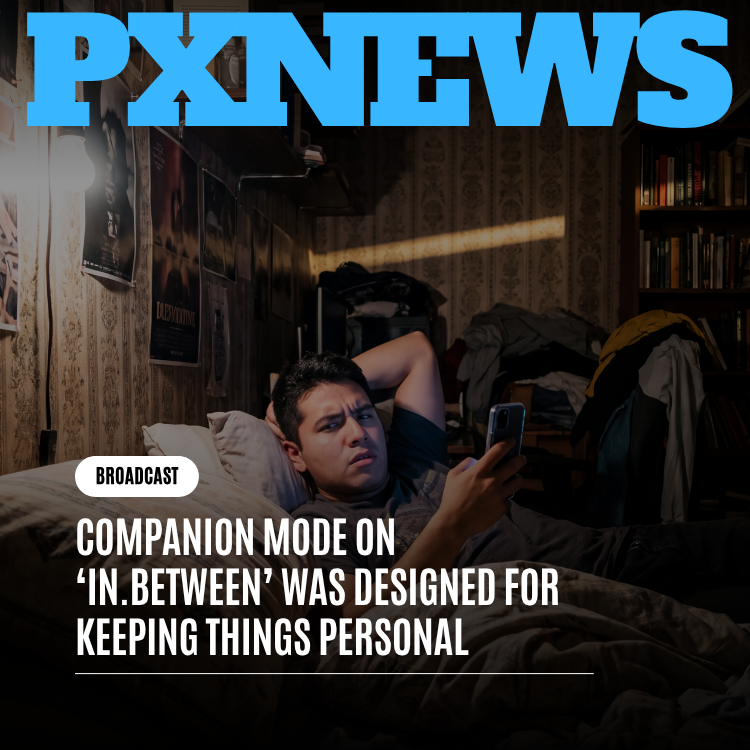

There's a familiar shape to a lot of nights: the day winds down, the lights go off, and somewhere in that last stretch before sleep, a phone comes out for "just a few minutes." What actually happens in those minutes varies enormously — a call with a friend, a few chapters of an audiobook, a scroll through something fast-moving and loud. Most people never stop to notice which one it was, or what it left behind. in.between, ETAPX's AI-powered sleep and reflection journal, has added a small, deliberately quiet nudge to its nightly flow that asks exactly that: what did you watch or scroll through tonight, and how did it leave you feeling? It isn't a warning. It isn't a rule. It's a question, offered gently by Nalani, in.between's AI companion, as part of the same conversation where you'd already be reflecting on your day.
The Gap Nobody's Watching For
Most reflection tools, in.between included, are built around a fairly intuitive idea: if you look back on your day with a little structure and a little help, you notice things you'd otherwise miss. What's easy to overlook is that the last few minutes before sleep are their own small category, distinct from the rest of the day, and often invisible to that same reflection. By the time someone sits down to journal, the content they consumed right before bed has usually already blurred into "the evening" as a whole — a vague, undifferentiated stretch rather than a specific choice with a specific effect.
That's a meaningful gap, because last-thing-before-sleep content tends to have a particular character. It's often chosen for how easy it is to fall into rather than how it will feel afterward — quick, algorithmically paced, sometimes tuned for exactly the kind of stimulation that keeps a scroll going. None of that makes it bad. It makes it worth noticing, because the gap between what someone consumed and how they actually felt afterward is often wider than they'd assume, and that gap tends to stay invisible unless something gently points at it.
The team behind in.between kept coming back to a simple observation while building out the nightly journaling flow: people are generally good at noticing how their day went, and much less practiced at noticing how the last few minutes of it — the ones spent with a screen, right before the lights go off — actually landed. Building a soft prompt into the existing reflection flow was a way to close that gap without turning in.between into something it was never meant to be: a monitor, a scold, or a gatekeeper standing between a user and their phone.
What the Nudge Actually Looks Like
The feature itself is understated by design. It shows up as part of the normal nightly conversation with Nalani — not a separate screen, not a mandatory checkpoint, and not something that interrupts the flow of journaling to demand an answer before you can continue. At a natural point in the conversation, Nalani might ask something close to: "What did you watch or scroll through tonight, and how did it leave you feeling?" The phrasing varies from night to night and adapts to what someone's already said, the way any question from Nalani does, but the spirit stays consistent — an invitation to notice, not an interrogation.
There's no menu of apps to select from, no category to check off, no tracking happening in the background. The entire exchange lives inside the conversation itself: the user describes, in their own words, what they were watching or scrolling through, and Nalani asks a follow-up that's really the heart of the feature — not what was it, but how did it leave you feeling. That second half of the question is doing most of the work. It's easy to name what you watched. It's much rarer to sit with how it actually left you feeling, and that's the part most nightly routines skip entirely.
Because it's woven into the existing journaling conversation rather than bolted on as a new destination, the prompt doesn't add a step to the routine so much as it deepens a step that was already there. Someone who's already telling Nalani about their day is simply invited to extend that same reflection to the last few minutes before they put the phone down, if they choose to.
Why Awareness, Not Restriction
It would have been a much simpler product to build a version of this that tracked screen time, flagged certain kinds of content, or nudged people toward putting the phone away by a certain hour. ETAPX deliberately built something else. The decision to make this purely reflective — something a user shares and considers themselves, inside a conversation, rather than something the app observes or enforces — wasn't a limitation the team ran into. It was the actual design goal from the start.
The reasoning comes down to a fairly simple belief about how people change habits that actually stick. Restriction tends to produce compliance or rebellion, and often both in sequence — a blocked app gets uninstalled and reinstalled, a screen-time limit gets overridden the moment it becomes inconvenient. Awareness works differently. When someone notices, in their own words, that a certain kind of content tends to leave them wired instead of settled, that noticing doesn't need to be enforced by anything external. It just becomes something they know about themselves, and people generally act on things they know about themselves more durably than on things a piece of software has decided for them.
That's also why the feature was built to sit entirely inside the conversation, with nothing automated running underneath it. in.between doesn't watch what's on a user's screen, doesn't pull activity data from other apps, and doesn't maintain any kind of consumption log outside of what a user chooses to say to Nalani. The reflection is only as detailed as the user makes it, on any given night, and that's intentional — the feature only works if it stays something a person does for themselves, not something done to them.
- No app blocking: in.between never restricts, limits, or interferes with any app on a user's device. The reflection lives entirely inside the journaling conversation, with no enforcement mechanism attached to it.
- No automated tracking: There's no background monitoring of screen activity. What Nalani knows about a night's pre-sleep content is exactly and only what the user chooses to share in conversation.
- No judgment built into the response: Nalani doesn't label content as good or bad, doesn't rank choices, and doesn't respond differently based on what was consumed — the follow-up is always about how it felt, not what it was.
- No naming or singling out platforms: The prompt asks about the experience of watching or scrolling, not about which specific app or service it happened on, keeping the focus on the user's own felt sense of it.
- Fully optional, every night: Like every part of the nightly flow, this reflection can be skipped, answered briefly, or gone into at length, depending on what a given night calls for.
Put together, those choices describe a feature that hands information back to the user rather than acting on it for them. Nalani doesn't decide anything about what someone should or shouldn't watch. It just makes room, once a night, for the person to decide that for themselves, armed with a little more clarity about how their own last few minutes before sleep tend to actually feel.
The Adrenaline Problem, Named Without Blame
A lot of what gets consumed right before bed shares a common quality, regardless of format: it's built to keep attention moving. Fast cuts, unresolved storylines, a feed that never quite runs out — all of it is well-suited to filling a spare ten minutes, and much less well-suited to the specific job of winding a mind down toward sleep. That's not a criticism of any particular kind of content or of the people who reach for it at the end of a long day; reaching for something fast and easy at 11pm is about as universal a habit as exists. It's simply a mismatch between what that content is optimized for and what the body is trying to do in the hour before sleep.
The in.between team's interest in this space wasn't about identifying "bad" content. It was about the fact that this mismatch is so common and so rarely named. Someone can go through months of restless nights, attribute it to stress or a mattress or caffeine, and never connect it to the fifteen minutes of fast-paced scrolling that closed out each of those nights — not because the connection isn't real, but because nobody ever asked them to look at it directly. The nudge exists to ask, gently and without an agenda, so that if there is a connection there, the person doing the noticing gets to be the one who finds it.
"We talked a lot internally about how easy it would have been to build this as a warning — flag certain kinds of content, tell people to cut it out before bed, wrap the whole thing in a message about digital wellness that's really just restriction with better branding. We didn't want to build that, and honestly I don't think it would have worked even if we had. What we wanted was for someone to be able to say, out loud, in their own words, 'I watched something intense right before bed and I can feel it,' and have that just be a normal, unremarkable thing to notice about yourself — not a confession, not a failure, just information. That's a completely different feature than the one we could have built, and it's the one we think actually helps people."
— Maya Lindqvist, Head of in.between, ETAPX
What Noticing Actually Does
It's fair to ask what a single reflective question, asked once a night, can realistically accomplish. The honest answer is that it doesn't do very much on any given night by itself. What it does over time is give someone a running, personal record — held in their own memory and their own conversation history with Nalani, not in any external tracking system — of how different kinds of pre-sleep content tend to leave them feeling.
That kind of pattern recognition is hard to do in the moment. In the middle of a scroll, everything feels roughly the same — mildly absorbing, easy to keep doing. It's only afterward, lying in the dark with a racing mind or drifting off easily, that the difference becomes felt. Most nights, that felt difference never gets connected back to its cause, because nothing prompts the connection. The reflection built into in.between exists to make that connection a little more often, a little more explicitly, so that the pattern — if there is one — has a chance to surface in the user's own words rather than staying a vague, unexamined feeling.
Nalani doesn't compile these reflections into a dashboard or present them back as a verdict. The value is closer to what happens when a person keeps a habit of writing something down regularly: the noticing itself does most of the work, simply because putting a feeling into words tends to make it more visible than leaving it unspoken. Over weeks, a user might start to notice on their own that certain nights feel different from others, and start connecting that difference to what they'd been consuming right before bed — not because in.between told them so, but because they'd been asked the question often enough, gently enough, that the pattern had room to become visible to them.
Designed to Never Feel Like a Lecture
A reflective prompt like this one lives or dies on tone. Ask the same underlying question with even a slightly different framing — "are you sure that's a good idea before bed?" instead of "how did that leave you feeling?" — and it stops being a reflection and starts being a scold, however unintentionally. The in.between team spent real time on that distinction, because it's the difference between a feature people actually engage with honestly and one they learn to answer defensively or skip entirely.
Part of how that tone gets protected is structural: the question is always about feeling, never about the content itself. Nalani isn't asking whether a choice was wise. It's asking what it did to the person who made it, which is a subtly but importantly different question — one that doesn't presuppose an answer. A night of watching something fast and chaotic that left someone feeling perfectly fine gets received exactly the same way as a night that left someone wired and restless: with curiosity, not a verdict. The feature has no stake in which answer someone gives.
The other part is consistency. Nalani's response to this reflection doesn't shift based on what's disclosed — there's no lecture that kicks in past some threshold of "too much" screen time or "too intense" content, because there is no threshold built into the feature at all. That consistency is what makes it safe to be honest. A user who knows the response will be the same whether they say "I watched something relaxing" or "I was doomscrolling for half an hour and couldn't stop" is a user who'll actually tell the truth, and the truth is the only thing that makes the reflection worth anything.
"I genuinely didn't expect this to change anything for me — it felt like a small add-on to something I was already doing. But after a couple weeks of actually answering it honestly instead of just skipping past it, I started noticing my own pattern: the nights I watched something with a lot of quick cuts and drama, I'd be lying there afterward with my thoughts racing even though I felt tired. Nobody told me that was happening. I just started seeing it because I kept being asked and kept answering for real. I still watch that stuff sometimes. I just know now what it tends to do, and that's been enough to change what I reach for on nights when I actually want to fall asleep fast."
— Devon Achebe, in.between user
Where This Fits Inside the Broader Journal
This reflection isn't a standalone feature bolted onto in.between — it's one thread inside the same nightly conversation that covers the rest of a person's day. That placement matters. Asking about pre-sleep content in isolation, as its own dedicated screen or checklist, would frame it as something separate and slightly clinical, closer to a screen-time report than a personal reflection. Folding it into the same unhurried conversation where someone's already talking about their day, their mood, and whatever's on their mind keeps it feeling like exactly what it is: one more thing worth noticing, alongside everything else Nalani helps surface.
That also means the reflection benefits from everything else in.between already does well. Nalani carries context across nights, so if a pattern starts to repeat — a string of nights where fast-paced content lines up with a harder time settling down — that continuity is available the same way it would be for any other recurring theme in someone's journaling. Nalani isn't running a separate analysis in the background; it's simply present across the conversations, the way any companion who's been listening over time would be, and able to gently note a connection if one seems genuinely worth naming, rather than manufacturing significance where there isn't any.
What This Doesn't Do, By Design
It's worth being explicit about the boundaries here, because a feature this easy to misread deserves a clear answer. This is not a screen-time tracker. in.between does not monitor, log, or have any visibility into what's actually on a user's screen at any point in the day or night — the only information it has is what a user chooses to type or say to Nalani, in the same way it learns about every other part of someone's day. It doesn't block, limit, or interfere with any app. It doesn't rate or rank content, doesn't maintain a record of "good" versus "bad" nights, and doesn't change its behavior based on what a user discloses. There is no punitive layer anywhere in the feature, at any level.
It's also worth restating plainly that Nalani, in this feature as in every part of in.between, is a wellness companion — not a licensed therapist, not a medical device, and not a substitute for professional mental health care. If someone's relationship with screens, sleep, or anxiety feels like it needs more than a reflective conversation can offer, the right next step is a licensed professional, not an app, however thoughtfully that app is built. in.between's role here is narrow and specific: to offer a calm, low-stakes moment to notice something that's easy to otherwise miss, nothing more.
Underneath a single nightly question sits a broader bet the in.between team has made repeatedly across the product: that people generally know what's good for them once they can actually see it clearly, and that the more useful role for a piece of software is to help them see clearly rather than to decide on their behalf. That bet shows up in how in.between handles reflection generally, and it shows up here in a particularly concentrated form, because pre-sleep content is exactly the kind of thing that's easy to lose track of precisely because it happens in the blurry last minutes before consciousness fades for the night.
The team has talked about this feature less as a solution to a problem and more as a small correction to an information gap — the gap between an experience and the felt memory of it, which tends to be wider than people assume for anything absorbed in a half-tired, half-scrolling state right before sleep. Closing that gap doesn't require restriction. It just requires asking, consistently and without judgment, and then getting out of the way.
Frequently Asked Questions
Does in.between track what apps or content I use before bed?
No. This is a reflective conversation, not an automated tracking feature. in.between has no visibility into what's on your screen and doesn't monitor app usage in the background. The only information Nalani has about your pre-sleep content is whatever you choose to share yourself, in your own words, as part of the nightly journaling conversation.
Will in.between block apps or set screen-time limits based on what I share?
No. in.between never restricts, blocks, or interferes with any app on your device, regardless of what you tell Nalani. This feature is purely conversational and reflective — it's designed to help you notice how something felt, not to enforce any kind of limit on what you consume.
Is Nalani going to judge or lecture me if I say I was doomscrolling?
No. Nalani's response is built around curiosity about how something left you feeling, not judgment about what you chose to watch or scroll through. The tone stays the same regardless of what you share — there's no threshold where the conversation shifts into a warning or a lecture. The goal is to make it comfortable to answer honestly, and shame would work against that.
Do I have to answer this every night?
No. Like the rest of the nightly journaling flow, this reflection is entirely optional and can be skipped, answered briefly, or explored in more depth depending on the night. There's no requirement to participate for the rest of in.between to work as intended.
Is Nalani a substitute for therapy if I realize my screen habits are affecting my sleep or mood?
No. Nalani is a wellness companion designed to support reflection, not a licensed therapist, medical device, or replacement for professional mental health care. If this kind of reflection surfaces something that feels like it needs more support — around sleep, anxiety, or anything else — the right step is a licensed professional, and in.between is built to point in that direction rather than to stand in for it.
The idea behind this feature is a modest one: that a single honest question, asked gently and consistently, can do more for someone's relationship with their own habits than any restriction ever could. in.between isn't trying to change what anyone watches or scrolls through before bed. It's just trying to make sure that, if it's worth noticing how that content actually feels, someone eventually gets the chance to notice.