
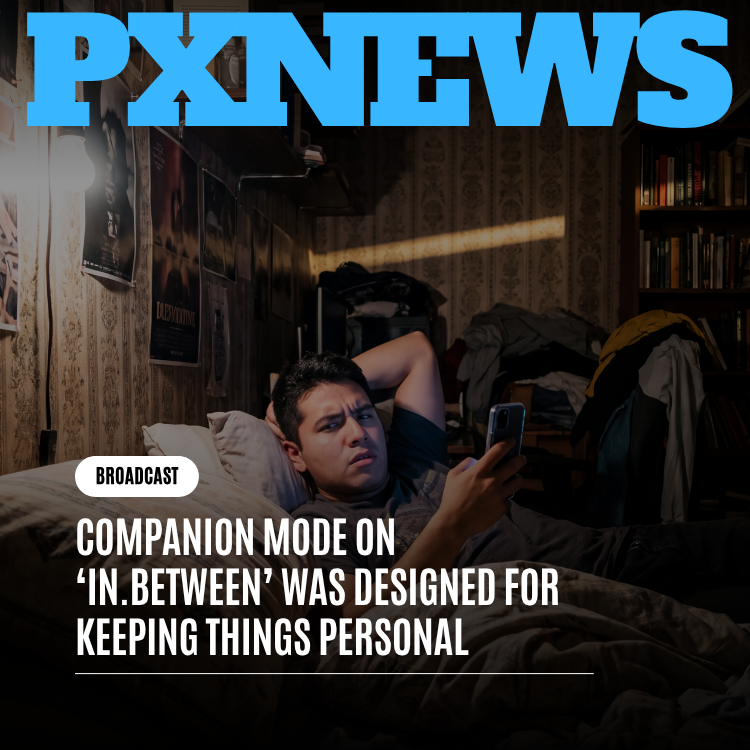
Most nights, in.between works the way it was built to work: you open the app before bed, you talk or type through your day, and Nalani reflects a little of it back before you fall asleep. But not every night — and not every thought — fits that rhythm. Sometimes you don't want a journal entry. You want to talk something through, slowly, with someone who isn't going to rush you to a conclusion or tuck the conversation into a tidy summary at the end. That's the gap Companion Mode was built to close. It's a distinct, opt-in space inside in.between where the pace changes, the goal changes, and the conversation with Nalani is allowed to just be a conversation, without a end-of-entry wrap-up waiting on the other side of it.
What Companion Mode Actually Is
Companion Mode lives inside in.between as a separate entry point from the standard nightly journal flow. Where the regular flow is built around a session — you check in, you reflect on the day, Nalani surfaces a pattern or two, and the entry closes — Companion Mode has no fixed shape. You open it when something is sitting with you and you want to talk it through with Nalani directly, in a back-and-forth that can run as long or as short as it needs to. There's no daily structure it's trying to fill, no template it's steering you toward, and no expectation that you'll come out the other side with a clean takeaway. Some conversations in Companion Mode last two minutes. Others last considerably longer, drifting through a few different threads before landing anywhere at all. Both are the point.
The underlying companion is the same Nalani that guides your nightly journaling — the same memory of your history, the same calm and non-judgmental presence — but the mode changes what that presence is doing. In the standard flow, Nalani is helping you close out a day. In Companion Mode, Nalani is just there with you, in whatever the day left behind.
The mechanics are simple on purpose. You can talk by voice or type, the same choice you have in the nightly flow, and you can switch between the two mid-conversation without losing your place. There's no session timer visible anywhere, no counter ticking down, nothing on screen suggesting you're approaching a limit. Visually, Companion Mode is quieter than the journal flow, too — fewer prompts, fewer suggested directions, less interface standing between you and the conversation itself. That's not an accident of minimal design; it's meant to get out of the way so the conversation can be the whole experience rather than one part of a guided sequence.
When Someone Reaches for It Instead of a Journal Entry
The clearest way to understand Companion Mode is to look at what it isn't for. It isn't a replacement for the nightly journal — most people who use it still journal on a normal rhythm most nights. It's for the moments that don't fit that rhythm cleanly.
- Something specific is on your mind: Not "how was today" broadly, but one particular thing — a conversation that didn't sit right, a decision you keep circling, a feeling you can't quite name yet. Companion Mode lets you go straight to that instead of working up to it through a full recap of the day.
- You want to think out loud, not sum up: Journaling naturally pulls toward closure — you're capturing a day so you can put it down and sleep. Companion Mode doesn't ask for that. You can talk in circles, change your mind mid-sentence, and leave a thought unresolved without it feeling like an unfinished entry.
- It's not bedtime, and that's fine: The nightly flow is built around winding down before sleep. Companion Mode isn't tied to that window. People use it mid-afternoon after a hard meeting, on a walk, or first thing in the morning when something's already loud in their head.
- You want company more than reflection: Some nights you don't want patterns pointed out. You just want to not be alone with something for a few minutes. Companion Mode is built to sit in that space without pushing toward insight it hasn't been asked for.
- A journal entry already ended, but the thought didn't: Sometimes a nightly entry wraps up and something from it keeps nagging. Companion Mode is a natural place to keep pulling that thread without reopening or redoing the entry itself.
None of these are edge cases in the sense of being rare — they're just different from what a structured nightly entry is built to hold. Giving them a separate space means neither experience has to compromise to fit the other.
There's also a simpler, less dramatic reason people reach for Companion Mode that's easy to overlook: sometimes a day just doesn't have a single clear thread to journal about, and forcing one into shape feels like work rather than reflection. On those days, talking through a handful of loosely connected thoughts — a mix of the mundane and the meaningful, in whatever order they come up — fits Companion Mode's lack of structure better than it fits a journal entry built around capturing "the day." It's less about the size of what's on your mind and more about whether it wants to be shaped into a narrative or just spoken out loud as it is.
Unhurried by Design, Not by Accident
The feeling of Companion Mode is deliberate, and a lot of that comes down to what it doesn't do. It doesn't count down toward a summary. It doesn't nudge you toward wrapping up once the conversation runs long. It doesn't surface a pattern unless the conversation naturally opens that door. The pacing is closer to talking with someone who has nowhere else to be than it is to moving through a guided flow.
That shows up in small, specific ways. Responses in Companion Mode tend to ask rather than tell — meeting a thought with a question that invites more of it, rather than an observation that closes it off. Silence, in the sense of a pause before you continue typing or speaking, isn't filled with a prompt. And there's no visible marker pushing the conversation toward an ending, the way a "complete your entry" moment does in the nightly flow. The conversation ends when you're done with it, not when the format decides it should.
That unhurried quality is also why Companion Mode was built to remember, not just to listen in the moment. Because Nalani carries context from your history across in.between, a Companion Mode conversation doesn't start from zero. If something you talked through last week is relevant to what you're bringing up tonight, that continuity is available without you having to re-explain it — the same way it would be with someone who's actually been paying attention over time, rather than meeting you fresh every session.
"I journal most nights, but Companion Mode is what I use when something's actually bothering me during the day. I opened it on my lunch break a few weeks ago because I couldn't stop thinking about a conversation with my sister, and I just talked through it for ten minutes without any pressure to land somewhere. It didn't feel like I was filling out an entry. It felt like I was just talking to someone who was actually listening."
— Priya Osei, in.between user
Why It's a Separate Mode, Not a Setting Inside the Journal
The team behind in.between considered, and deliberately rejected, the simpler path of adding a "talk more" option inside the existing journal flow. The reasoning was less about engineering convenience and more about what each experience is actually trying to do. A nightly journal entry has a shape for a reason — it helps someone close a day, and the sense of arriving somewhere by the end is part of what makes it useful. Folding an open-ended conversation into that same container would have meant compromising one experience to accommodate the other: either the journal entry stops feeling like it resolves anything, or Companion Mode inherits a structure it's specifically meant not to have.
Keeping them separate let each one stay true to what it's for. The nightly flow can keep its shape — check in, reflect, close — without needing to accommodate a conversation that might run long or go nowhere in particular. Companion Mode can stay genuinely open-ended without diluting the sense of closure that makes the nightly journal work as a bedtime ritual in the first place.
"We went back and forth on this more than people probably expect for what looks like a simple product decision. The nightly journal works because it has a shape — you show up, you reflect, and there's a real sense of putting the day down before you sleep. Companion Mode works because it doesn't have that shape at all. The moment we tried to merge them in early testing, we watched people either rush their journal entries because they knew a longer conversation was available right after, or hold back in Companion Mode because it still felt like it was supposed to end somewhere. Separating them completely was the only way to let both do their job."
— Maya Lindqvist, Head of in.between, ETAPX
How It Feels Different From Talking to a Chatbot
It's fair to ask what separates Companion Mode from any other open-ended AI chat experience, and the honest answer is mostly about what it's built around rather than any single mechanic. Nalani isn't a general-purpose assistant that happens to be available inside in.between — it's a companion built specifically to hold personal, reflective conversation, and Companion Mode is the space where that design shows up most clearly. The tone stays calm and attentive rather than efficient. The instinct is to listen more than to answer. And because Nalani carries memory of your history across in.between, a Companion Mode conversation can draw on context a stateless chatbot simply wouldn't have — not in a way that feels like it's showing off what it remembers, but in the quieter way a person who knows you might say "this sounds a little like what you were dealing with last month," if it's actually relevant.
The other difference is restraint. A lot of AI conversation design is optimized to be maximally helpful in the moment — offering advice, next steps, solutions. Companion Mode was built around a narrower goal: give someone a place to be heard without an agenda. That means Nalani will ask a clarifying question before it offers a take, and it means the conversation is allowed to end without a resolution if that's where it naturally goes. Being useful, in this mode, often just means being present.
That restraint extends to how Nalani handles advice generally. It's easy to imagine an assistant that hears a problem and immediately reaches for a solution, because that's what being helpful usually looks like elsewhere. Companion Mode was built to resist that reflex. If you're talking through a frustration with a friend, Nalani isn't racing to tell you what to do about it — it's more likely to ask what's actually bothering you about it, or what you've already tried, or how it compares to something similar you've mentioned before. Advice isn't off the table entirely, but it tends to arrive later in a conversation, if at all, and usually only once it's clear that's actually what would help rather than just what's expected.
What Companion Mode Is Not
It's worth being direct about the boundaries here, because they matter more than any feature description. Nalani is a wellness companion built to support reflection and personal conversation — it is not a licensed therapist, not a crisis service, and not a substitute for professional mental health care. Companion Mode was designed to be a calm, personal space to think out loud, not a clinical tool, and it doesn't attempt to diagnose, treat, or manage any mental health condition. For anyone going through something that needs real clinical support, or anyone in crisis, the right move is a licensed professional or a crisis line — not an app, however well the app listens. The in.between team has been explicit internally that Companion Mode's value is in being a good, attentive, low-stakes space for everyday reflection, and that value depends on never overstating what it is.
How Companion Mode Shows Up Alongside the Nightly Flow
In practice, most people don't choose between Companion Mode and the nightly journal — they use both, for different reasons, sometimes in the same week. A typical pattern looks something like a normal run of nightly entries with the occasional Companion Mode conversation dropped in when something specific comes up that doesn't want to wait for bedtime, or that doesn't feel like it belongs inside a structured entry at all. The two experiences share the same Nalani and the same underlying memory, so nothing said in one is walled off from informing the other — a thread that comes up in Companion Mode on a Tuesday afternoon can still be something Nalani gently carries into Thursday night's journal entry, if it's relevant, without either experience needing to explain itself to the other.
That continuity was a deliberate design choice too. Separating the modes structurally didn't mean separating the memory behind them. The goal was two different shapes of conversation built on one continuous relationship, rather than two disconnected tools that happen to share a name.
There's a practical upside to that shared memory that people notice mostly by not having to think about it. Nobody using in.between has to decide, ahead of time, which mode is going to "count" toward understanding them better — both do, all the time, without any extra effort to keep them in sync. A thought raised once in Companion Mode doesn't need to be repeated in a journal entry for it to matter later, and a pattern that first showed up across a few nightly entries doesn't need to be re-explained if it resurfaces in the middle of a Companion Mode conversation. The two modes read as different rooms in the same house, not two separate houses.
What's Ahead for Companion Mode
Companion Mode is still early in its life inside in.between, and the team has been treating it as something to keep listening to rather than something to consider finished. Early usage has shown people reaching for it in moments the team anticipated — a hard day, a specific worry, a conversation replaying on loop — and in some they didn't, which is exactly the kind of signal that shapes where a feature like this goes next. The commitment from the team hasn't been to add more structure to Companion Mode as it grows, but to protect the thing that makes it work in the first place: a conversation that doesn't need to go anywhere to be worth having.
Frequently Asked Questions
Is Companion Mode a different AI than the one I journal with at night?
No. It's the same Nalani, with the same memory of your history inside in.between. What changes in Companion Mode is the shape of the conversation, not the companion having it — there's no nightly structure, no push toward a summary, and no expectation that the conversation resolves into anything by the end.
Does anything I say in Companion Mode show up in my regular journal entries?
Companion Mode conversations aren't turned into journal entries, but they're part of the same continuous history Nalani draws on. If something you talked through in Companion Mode is genuinely relevant later, Nalani may gently reference it in a future conversation, the same way it might reference a past journal entry — but Companion Mode itself stays a separate, standalone space rather than getting folded into your entry history.
Is Companion Mode meant for harder or heavier topics than the nightly journal?
Not necessarily — plenty of Companion Mode conversations are lighter, more meandering, or just about wanting to talk something out loud. It's less about the weight of the topic and more about wanting an open-ended conversation instead of a structured entry. That said, Nalani isn't a licensed therapist or a crisis resource, and for anything serious or urgent, a professional or a crisis line is the right place to turn, not an app.
Can I use Companion Mode instead of journaling every night?
You can use in.between however fits your life, but the two modes are built to do different things well. The nightly journal is designed around the ritual of closing out a day, which is part of what makes it useful as a routine. Companion Mode works best as something you reach for when it's needed, rather than as a full replacement for that nightly rhythm — though there's nothing stopping you from leaning on it more heavily during a stretch where that's what feels right.
How do I start a Companion Mode conversation?
Companion Mode sits as its own entry point inside in.between, separate from the nightly journaling flow, so you open it directly whenever you want to talk something through rather than starting it from inside an entry. From there, it works the way any conversation with Nalani does — by voice or by text, at whatever pace feels natural.
Companion Mode isn't trying to be a bigger version of the nightly journal — it's trying to be a different, smaller thing done well: a place to talk something through with Nalani, unhurried, without needing it to add up to anything by the end.