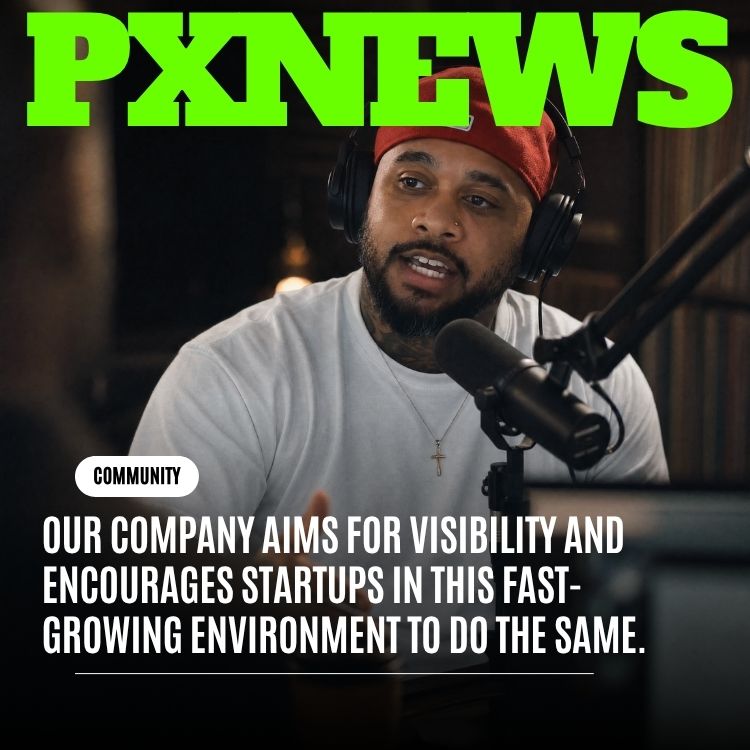
ETAPX runs its own newsroom, posts product walkthroughs under its own name on YouTube, and answers questions in a public Discord server instead of routing them through a ticket queue. None of that is incidental. It is a deliberate bet by AJ, ETAPX's founder and CEO, that visibility is worth more than a polished front — that in a fast-growing environment where every company is competing for the same scarce resource, genuine trust, the ones willing to show their actual thinking will out-earn the ones that only ever show a highlight reel. This is AJ's case for that bet, in his own words, and for why he actively encourages startups building in this same fast-moving moment to make the same one.
The Default Nobody Actually Chose
Most companies don't decide to be secretive. They inherit it. The instinct to guard the roadmap, keep the founder's opinions off the record, and route every external word through a review process arrives early, usually with the first hire who once worked somewhere that got burned by talking too soon. Nobody sits down and makes the affirmative case for it. It just becomes the water the company swims in, the way "of course we don't say that publicly" becomes a sentence nobody remembers agreeing to.
ETAPX started the same way most companies start: small, unproven, and aware that talking about unfinished things in public felt like it carried real risk. The difference is that AJ actually stopped to ask whether that risk was real or just assumed. Somewhere along the way, secrecy stops being a decision and starts being a reflex — and a reflex is exactly the kind of thing worth interrupting on purpose.
That question — is this risk real, or did we just inherit it — turned out to matter more than it looks. Once AJ actually interrogated the assumed risks of visibility instead of accepting them as settled, most of them turned out to be smaller than they looked, and the cost of the alternative — staying quiet, staying generic, staying unknown — turned out to be larger than anyone had bothered to calculate.
What Visibility Looks Like at ETAPX
This isn't an abstract commitment. It shows up as specific, ongoing choices about how the company talks about itself, and none of them are new for the occasion of this article.
"We didn't stand up PX News, the YouTube channel, and Campus because a marketing plan told us to. We built them because the alternative — a company that only ever speaks through a press release — never made sense to me. If people are going to trust what we make, they should get to see how we actually think, not just the version we cleaned up for an announcement."
— AJ, Founder & CEO, ETAPX
Put together, the channels form a fairly complete picture of a company that has chosen to be findable rather than filtered:
- PX News: our own editorial outlet, recently recommitted to a higher bar precisely so it functions as real coverage of the company, not a marketing feed with a publish button.
- YouTube: product walkthroughs and founder updates at youtube.com/@etapx-inc, the parts of building this company that are simply better shown than written.
- Campus: our Discord server, where anyone can ask the team a direct question and watch the answer happen in public, instead of disappearing into a support ticket.
- Founder-voice articles: pieces like this one, published under AJ's own reasoning and in his own words, not smoothed into an anonymous corporate voice.
None of these exist because a comms calendar demanded quarterly content. They exist because AJ decided, early and on purpose, that a company people can actually see is worth more than a company that only ever announces.
The same posture holds across everything the company builds. Whether the news that week is a Whistlr feature, a GLSRM editorial call, a decision inside Ocsidian, or an update from Influxx, ETAPX's newest agentic environment, the instinct is the same one: explain it in public, under a real name, instead of letting it arrive as an unexplained line in a changelog. Visibility isn't a policy reserved for whichever product happens to be launching. It's the default setting for how the whole company talks about itself.
Why Visibility Beats Polish
It's worth being precise about what visibility is actually competing against, because it isn't secrecy in the dramatic, cloak-and-dagger sense. Almost no startup is hiding something sinister. What most startups are actually optimizing for is polish — the controlled, camera-ready version of the company, released on the company's own schedule, in the company's own words, with every rough edge sanded down before anyone outside ever sees it. It's an understandable strategy, and a common one, because polish is fast to produce, easy to control, and rarely embarrassing. The problem isn't that it's dishonest. The problem is that it's generic — every well-funded company can produce the same polished surface, which means polish alone was never going to be the thing that made one company more trustworthy than the next.
Polish Is Something You Buy. Trust Isn't.
Polish is real, and it isn't worthless. But it's also purchasable. Any company with enough runway can hire a strong design partner, tighten the copy on its landing page, and cut a launch video that looks inevitable. None of that tells a user or a future employee anything about how the company will actually behave when a decision is hard, a feature misses, or a quarter goes sideways. Visibility does, because it's an accumulated record — built over time, in public — that can't be fabricated retroactively the way a highlight reel can.
"Polish is something you can buy. You hire the right people, tighten the copy, put out a beautiful launch video, and for a minute you look like you've got it all figured out. Visibility is different. You can't fake a real record of your own reasoning, published before you knew how it would turn out. That's exactly why it earns more trust than polish ever will — it's the one thing a competitor can't copy overnight."
— AJ, Founder & CEO, ETAPX
That's the actual mechanism, and it's worth stating plainly: trust isn't a feeling a company generates through good branding. It's an inference other people make from evidence, accumulated over time. A polished announcement is one data point, released on your own terms. A public track record — the calls you made, the reasoning behind them, and how they held up — is hundreds of data points, released whether they flatter you or not. One of those is much harder to fake, and it's the one people actually rely on when they decide whether to use your product, join your company, or bet their own venture on working with you.
The Wins and the Struggles, Both Published
Visibility only means something if it includes the parts that don't flatter you. A company willing to publish its wins and nothing else hasn't actually opened up — it has just found a more sophisticated format for the same highlight reel. Real visibility means the roadmap change that didn't work gets explained with the same seriousness as the one that did, and the feature that shipped late gets a real account of why, instead of silence until the next announcement quietly supersedes it.
That standard is part of why PX News itself operates the way it does — treating a tradeoff or a misstep as something worth explaining honestly rather than something to bury until it's old news. That commitment only means something because AJ holds the same standard for himself. A company that asks its own newsroom to be honest about setbacks, while its founder stays invisible and unaccountable, is asking for a kind of honesty it isn't willing to model.
"Anyone can publish a highlight reel. It takes something else to publish the version where a feature didn't land the way we hoped, or a call we made six months ago turned out to be wrong. We do that on purpose. A company that only ever tells you about its wins hasn't actually told you anything you can rely on when things get hard."
— AJ, Founder & CEO, ETAPX
This is also the part of visibility that's actually hard, and worth being honest about. It is easy to be visible about a launch. It takes real discipline to be visible about a miss, because the natural instinct in the moment is to quiet down, not speak up. AJ's argument is that the instinct to go quiet is exactly backward — that the moments a company is tempted to go dark are the moments visibility is worth the most, because that's when people are actually deciding whether your candor was ever real.
Why We Encourage Startups to Choose Visibility Too
None of this is meant as a private philosophy ETAPX keeps to itself. AJ is direct about wanting other founders — especially the ones building right now, in a genuinely fast-growing environment full of new entrants and short attention spans — to make the same trade. Startups default to guarding everything for an understandable reason: the downside of talking feels vivid and specific, while the downside of staying silent is invisible, because nobody ever notices the trust you failed to build when you never gave anyone the chance to see you build it.
The Risk Everyone Assumes
The most common fear is that visibility hands your roadmap to a competitor. AJ's pushback isn't that the fear is irrational — it's that it's aimed at the wrong scarce resource. Ideas get discussed in pitch decks, investor updates, and casual conversations constantly without any of it deciding who wins. What actually decides who wins is execution, sustained over time, by a team people trust enough to root for. Talking about what you're building rarely gives away the thing that makes you win. It's the years of grinding out the actual execution that competitors can't shortcut, no matter how much they've seen.
The Risk Nobody Adds Up
The overlooked risk runs the other way. A startup with a locked roadmap and a silent founder is also a startup nobody can vouch for — no visible reasoning to point to, no track record to check, nothing for a future user or a future hire to go on except the same polished copy everyone else in the category is also running. In a fast-growing environment where new competitors show up every week, being genuinely known isn't free marketing. It's earned, slowly, through an accumulated visible track record — and it's exactly the thing an invisible competitor has no way to build overnight, no matter how much funding they raise.
"If you're a founder sitting on a roadmap you're afraid to talk about, I'd gently push back on that instinct. I understand exactly where it comes from — I felt it too, early on. But in a market this crowded and this fast-moving, the startups people actually trust aren't the ones with the tightest NDA. They're the ones whose thinking you've already seen, whose last few misses you already know about, before you've even tried the product."
— AJ, Founder & CEO, ETAPX
"I asked a fairly dumb pricing question in Campus one night, half-expecting silence. AJ answered it in about twenty minutes, in the open channel, where anyone else in the server could see the answer too. I started publishing my own build notes the same week. It sounds small, but it genuinely changed how I think about what my own company owes the people watching it build."
— Renata Sokolova, founder of a seed-stage startup, via ETAPX Campus
Visibility as a Competitive Advantage in a Fast-Growing Environment
The underlying argument is simple, even if it cuts against a lot of inherited startup instinct: in a crowded, fast-moving market, being genuinely knowable is an advantage, not a liability. Features get copied in weeks. Pricing gets matched in days. A visible track record — years of public reasoning, public misses, and public follow-through — is the one thing a fast-following competitor cannot replicate on any timeline shorter than the one it actually took to build.
AJ's broader read on where social and consumer technology are heading reinforces the same point: he's said plainly that the next decade belongs to companies that stay useful and honest rather than the ones chasing whatever is loudest that quarter. Visibility is that belief applied to the company itself, not just its products. A startup chasing hype can look impressive for a news cycle. A startup that's actually known — whose founder you could pick out of a lineup, whose past decisions are a matter of public record — earns something that doesn't decay the moment the next hype cycle starts.
That's also why AJ frames this as encouragement rather than a competitive secret he'd rather keep to himself. If visibility worked purely because ETAPX happened to be first to try it, giving the advice away freely would be a strange thing to do. It works for a more durable reason: trust, once earned through an honest track record, doesn't transfer to a competitor just because that competitor read the same advice. Two startups can both choose to be visible, in the same fast-growing environment, and still end up trusted to very different degrees — because the advantage was never the idea of visibility itself. It was the years of actually following through on it.
For a founder wondering where to actually start, the shift is less about grand gestures and more about a handful of consistent habits:
- Publish the reasoning, not just the result: a changelog tells people what shipped; explaining why builds a kind of trust a changelog alone never will.
- Say the thing that didn't work: a track record with an occasional acknowledged miss in it reads as honest; a track record with none in it reads as edited.
- Put a real name on it: statements from an actual founder, not an anonymous "team," are what make visibility feel like a relationship instead of a press release.
- Let people talk back: a channel where questions get answered in public, not routed to a queue, is what turns visibility into trust rather than performance.
"Being knowable is not a weakness. In an environment this loud and this fast-moving, it's one of the only advantages that compounds instead of decaying the moment someone copies your feature."
— AJ, Founder & CEO, ETAPX
Frequently Asked Questions
What does it mean for ETAPX to "aim for visibility"?
It means ETAPX treats being genuinely knowable as a deliberate strategic and cultural choice rather than a personality trait. In practice, that's PX News, the YouTube channel, the Campus Discord server, and founder-voice articles like this one — channels where the company shows its actual reasoning, including the parts that don't flatter it, instead of speaking only through polished announcements.
Why does AJ encourage other startups to build in public too?
Because in a crowded, fast-growing environment, visibility builds a kind of trust that a polished announcement can't buy. AJ's view is that startups willing to be known — to show their reasoning, admit their misses, and let people respond directly — tend to earn more durable credibility than ones that stay hidden until they're ready for a big reveal.
Doesn't building in public risk giving competitors your roadmap?
AJ's argument is that this fear targets the wrong scarce resource. Ideas get discussed constantly without deciding who wins a market; sustained execution does. Talking honestly about what you're building rarely hands away the thing that actually makes a company succeed, and the visible track record you build in the meantime is much harder for a competitor to copy than any single feature.
Does visibility mean ETAPX only talks about its wins?
No — the opposite is the point. A company that only publishes its wins has just found a more polished highlight reel, not real openness. ETAPX's standard, reflected in how PX News covers the company, is to explain tradeoffs and setbacks with the same seriousness as launches, because that's the only version of visibility that actually earns trust.
How can a startup actually become more visible?
AJ's advice is to start with habits rather than a grand relaunch: publish the reasoning behind decisions, not just the outcomes; be willing to say when something didn't work; put a real named founder behind public statements instead of an anonymous team voice; and give people a direct way to ask questions and get an answer in public.
ETAPX still runs its own newsroom, still posts under its own name on YouTube, and still answers questions in the open instead of behind a ticket queue — the same choices this piece opened with, made the same way every time: on purpose, because AJ believes a company willing to be seen will always out-earn one that only ever announces. That's the bet ETAPX made for itself, and it's the one AJ keeps encouraging the next wave of founders, building in this same fast-growing environment, to make too.