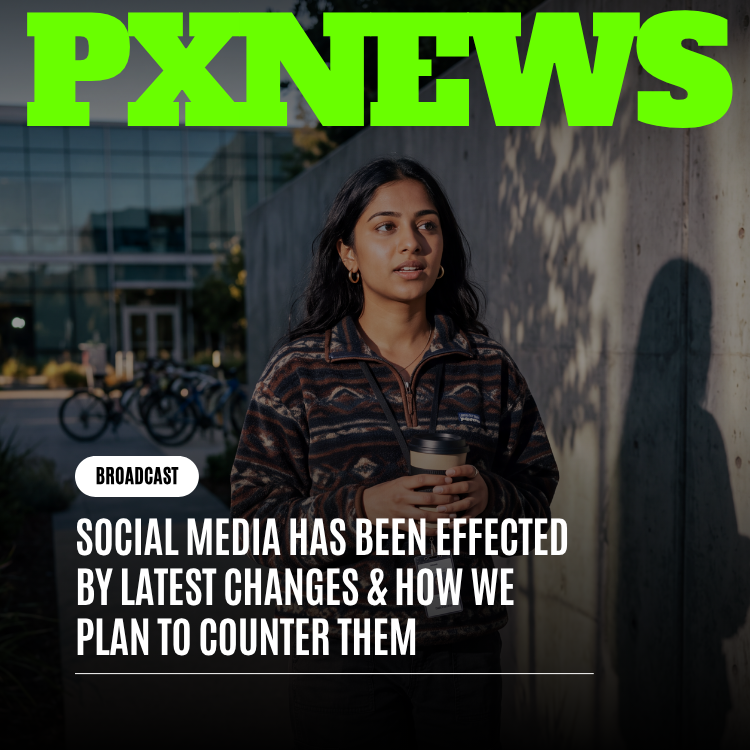
Something has shifted in how social media feels, and most people who use it every day could tell you that even if they couldn't name exactly what changed. Feeds are louder. Ads show up more often and in more places. The line between a post from a friend and a post trying to sell you something has gotten blurrier across the industry. And a quiet, cumulative fatigue has settled over an activity that used to feel, at its best, like catching up with people you like. At ETAPX, we've been watching these shifts closely — not because we think we're above them, but because we build a social platform, Whistlr, and we think the industry's current direction is a choice, not a law of nature. This is our read on what's changing, and the specific, practical ways we're building Whistlr to counter it.
The Industry Is Getting Louder, Not Better
Across the social media industry broadly, several trends have converged over the last few years in a way that's worth naming plainly. Ad density in feeds has crept upward, quarter after quarter, as platforms chase revenue growth in a maturing market. Content that used to arrive from people you actually know now competes for the same real estate as sponsored posts, suggested content, and algorithmically surfaced material from accounts you never followed. The result, for a lot of people, is a feed that feels less like a window into their own social world and more like a stream that happens to include their social world somewhere inside it.
None of this is a conspiracy. It's an incentive structure. When a platform's growth depends heavily on advertising revenue and on maximizing time spent, the natural pull is toward more inventory, more algorithmic insertion, and more content engineered to provoke a reaction rather than convey something true. Many platforms across the industry have leaned into this pull to varying degrees, and the cumulative effect — even when no single decision was unreasonable on its own — is an experience that can feel crowded, noisy, and strangely impersonal for something built around the word "social."
We think that's worth naming because it's the backdrop against which every product decision at ETAPX gets made. We're not building Whistlr in a vacuum, and we're not building it in opposition to any one company. We're building it as a considered answer to a direction the whole industry has been drifting toward.
"You can watch an entire industry optimize itself into a corner. Every individual choice — a little more ad load here, a slightly more aggressive recommendation algorithm there — makes sense on a spreadsheet. Add them all up over a decade and you get feeds that are technically full of content and somehow emptier of connection than they've ever been. That gap is exactly where we think Whistlr belongs."
— AJ, Founder & CEO, ETAPX
Algorithm Fatigue Is Real, and People Are Naming It
Ask almost anyone under thirty how they feel about their main social feed and you'll hear some version of the same sentiment: it's fine, it's fast, and it doesn't really feel like theirs anymore. That's algorithm fatigue, and it's become common enough across the industry that it's practically its own genre of conversation — people comparing notes on which apps feel most "off," swapping tips for resetting a feed that's drifted somewhere strange, or simply admitting they scroll on autopilot without much memory of what they saw five minutes later.
Part of what's driving this is opacity. When a feed is a single, unlabeled stream generated by a system nobody outside the company can see or explain, using it starts to feel less like navigating and more like being steered. You didn't choose what showed up. You don't know why it showed up. And when something finally does land — a post that actually makes you laugh, a video from a friend you'd lost touch with — it arrives buried in so much undifferentiated content that its impact is diluted before you even register it.
This isn't an argument against algorithms as a category. Recommendation systems, used well, can genuinely help people find things they'd never have found on their own. The issue the industry is grappling with is different: when a single opaque algorithm becomes the only lens through which people experience a platform, it removes agency at exactly the moment people are craving more of it. Renata Osei, ETAPX's VP of Product, has spent a lot of internal conversation on this exact tension.
"We don't think the answer to algorithm fatigue is 'no algorithms.' We think the answer is giving people a say in which lens they're looking through, and being honest with them about what each lens is for. A feed that never explains itself trains people to stop trusting it. That's the opposite of what we want Whistlr to feel like."
— Renata Osei, VP of Product, ETAPX
Engagement-Bait Content Has Eroded Trust
There's a specific texture of content that's become impossible to miss across social media right now: the post engineered purely to provoke a reply, the manufactured controversy, the caption that promises a story it doesn't deliver, the video that exists only to bait a comment. This kind of content isn't new, but its volume has grown, and something important has happened as a result — people have gotten better at spotting it, and worse at trusting the platforms that keep serving it to them.
That erosion of trust matters more than any single bad post. Once someone starts assuming that what's in front of them might be engineered rather than genuine, they read everything a little differently. A real moment from a real friend gets filtered through the same skepticism as an obvious engagement-bait post, because the feed doesn't clearly distinguish between the two. That's a real cost, and it's one the broader industry has largely treated as an acceptable side effect of optimizing for time-on-platform.
Whistlr's answer starts with structure rather than moderation alone. Circuits and SubCircuits exist specifically to give people spaces where the content they see is bounded by actual relationships and shared interest rather than by whatever the wider platform has decided is engaging today. A Circuit is a real community — people who chose to be in it together — and a SubCircuit narrows that further into a specific shared interest inside that community. Content inside a Circuit doesn't have to compete against manufactured drama from strangers for attention, because the drama largely isn't there to begin with. The people in the room chose to be in the room.
- Circuits: Community spaces built around real relationships and shared interests, not algorithmic assembly — the people you see are the people who joined, not whoever the feed decided to insert.
- SubCircuits: Focused pockets within a Circuit for a specific topic, hobby, or thread of conversation, so a broad community can still support tight, relevant discussion without diluting it.
- Friend-first discovery: New people and content surface through genuine connection paths — friends of friends, shared Circuits, mutual interests — rather than being pushed at you because they're statistically likely to provoke a reaction.
- Halo: A quiet, ambient signal around a person's avatar that something's happening with them right now, viewable at a glance with no notification badge demanding a response.
- Creator Studio: A direct, transparent set of tools at whistlr.studio that let creators understand their own audience and build for them, instead of guessing at an opaque system's preferences.
None of these features are framed as a cure-all. They're a bet that trust gets rebuilt the same way it gets eroded — incrementally, through a long series of small, honest choices about what a platform shows you and why.
Authentic Connection Is Getting Crowded Out
Maybe the most human version of this whole conversation is the simplest one: a lot of people feel like it's gotten harder to just talk to their friends on social media. Group chats compete with algorithmic feeds for the same screen real estate. A genuine post from someone you care about gets the same visual treatment, the same font, the same card layout, as a sponsored post from a brand you've never heard of. Over time, that flattening effect trains people to treat everything on their feed with roughly the same low level of attention, friends included.
We think this is one of the more quietly damaging trends in social media right now, because it doesn't announce itself the way an outage or a controversy would. It just slowly changes what "checking your feed" means, from "seeing what my people are up to" to "scrolling past content until something catches." That's a meaningful loss, even if it happened gradually enough that most people never quite named it.
Whistlr's product philosophy treats authentic connection as the thing to protect first, not the thing to fit in around everything else. Group chats, Thoughts, Moods and Blips, relationship status — these aren't secondary features bolted onto a content platform. They're central to what the app is for. A Mood tells the people who care about you how you're doing right now, in a lightweight, low-pressure way. A Blip is a quick, casual share that doesn't carry the performance pressure of a polished post. Thoughts exist specifically so sharing a passing feeling doesn't require the emotional overhead of "making content."
"I deleted most of my other social apps over the last year, not dramatically, just one by one because I noticed I wasn't actually talking to anyone on them anymore. Whistlr is the one I kept because my group chat with my college friends is still the first thing I open, and it doesn't feel buried under a feed I never asked for. It feels like the app remembers that people are the point."
— Priya Chandrasekaran, Whistlr user
Consolidation Is Reshaping the Industry's Center of Gravity
Another shift worth naming honestly: the broader social media industry has been consolidating. Fewer companies control more of the surface area people spend their time on, and features that once distinguished one app from another have converged into a fairly similar playbook across the board — the same short-video format, the same story format, the same live-shopping push, the same creator monetization tools, often rolled out within months of one another across multiple platforms. That convergence isn't inherently bad; healthy competition does spread good ideas. But when convergence happens alongside consolidation, the net effect can be less genuine variety in how people are offered to experience social media, even as the number of apps on a home screen stays roughly the same.
For a company like ETAPX, building outside the very largest platforms, this consolidation actually clarifies the mission rather than complicating it. We don't need Whistlr to be the biggest social platform in the world. We need it to be a genuinely different one — a real, sustained alternative for people who've felt the drift described in this piece and want something that points a different direction.
That's part of why ETAPX has built Whistlr as one piece of a broader, cohesive ecosystem rather than a single app trying to do everything alone. Waves handles music discovery and listening. Minis gives people a lighter, faster way to share short moments. Storefronts and live shopping let creators sell directly to the people already supporting them, inside the same relationship rather than through a separate, disconnected commerce app. WTC Gems let audiences support creators directly and immediately, during a live moment, rather than through an abstracted ad-revenue split months later. Because these pieces are built together, under one roof, with one account carrying a person across all of them, the whole experience can stay coherent instead of feeling stitched together from a decade of acquisitions.
- Waves: Music and audio discovery built into the same social fabric as everything else, so listening and sharing don't require switching apps or context.
- Minis: A lightweight format for quick moments, built for low-pressure sharing rather than performance.
- Storefronts and live shopping: Commerce that happens inside a creator's actual relationship with their audience, not bolted on as a separate marketplace.
- WTC Gems: A direct way for audiences to support creators in the moment, during live streams, so appreciation has an immediate, tangible path back to the person who earned it.
- Creator Studio: A dedicated home at whistlr.studio where creators manage their presence, understand their audience, and build with clarity instead of guesswork.
What "Countering" Actually Means for Whistlr
It would be easy to describe all of this as Whistlr being "different" and leave it vague. We'd rather be specific about what counter actually means in practice, because vague positioning is exactly the kind of thing that erodes trust over time, and we've spent this whole piece talking about trust.
Countering rising ad density and feed clutter means being deliberate and restrained about how much of any given screen is dedicated to anything other than the people and communities someone chose to be part of. Countering algorithm fatigue means giving people named, understandable spaces — Circuits, SubCircuits, Flow — instead of a single unexplainable stream, so a person always has some sense of why they're seeing what they're seeing. Countering engagement-bait erosion of trust means building community structures where the people around you are there because they chose to be, not because an algorithm decided you'd react to them. Countering the crowding-out of authentic connection means treating group chats, Moods, Blips, and relationship status as first-class, not afterthoughts squeezed in around a content feed. And countering the flattening effect of industry consolidation means staying genuinely different rather than converging toward the same playbook everyone else is running.
John Ridge, ETAPX's CTO, frames the discipline required here in plain terms — not as a technical challenge, but as a standard the whole team holds itself to when deciding what to build next.
"Every feature request eventually runs into the same question in our reviews: does this respect the person using it, or does it just extract a little more attention from them. That's not a rhetorical question for us — it's genuinely the filter. Some good ideas don't survive it, and we're fine with that. Being a deliberate counter to where the industry has drifted only works if we actually hold the line when it's inconvenient."
— John Ridge, CTO, ETAPX
This Is a Direction, Not a Finish Line
None of what's described here is presented as a solved problem. Social media as an industry is enormous, still evolving quickly, and shaped by economic pressures that aren't going away just because one company decides to build differently. ETAPX isn't claiming Whistlr has fixed social media, and we're wary of anyone who claims their platform has. What we're claiming is narrower and, we think, more honest: we've looked carefully at where the broader industry has been drifting, we've named the parts of that drift we think are genuinely worth resisting, and we've built specific, real features — not press-release promises — that point the other way.
That's the whole premise of this piece, and it's the premise behind Whistlr as a product. Friend-first discovery, Circuits and SubCircuits, ambient signals like Halo instead of demanding notifications, a Creator Studio built for transparency instead of guesswork — these aren't marketing language. They're the actual mechanics of the app, available today, shaped by a specific point of view about what social media owes the people who use it. We think that point of view is worth stating plainly, in public, and being held to.
Frequently Asked Questions
Is ETAPX saying other social media platforms are bad?
No. This piece is about broad trends visible across the social media industry as a whole — rising ad density, algorithm-driven fatigue, engagement-bait content, and industry consolidation — not about any single competitor. We think these are real, industry-wide dynamics worth naming honestly, and we're describing how Whistlr's product philosophy is built to counter them, not calling out any specific company.
What does "friend-first discovery" actually mean on Whistlr?
It means new people and content tend to surface through genuine connection paths — friends of friends, shared Circuits, mutual interests — rather than being inserted primarily because an opaque system predicts they'll provoke engagement. It's a philosophy about how discovery should work, prioritizing relationships over raw attention-capture.
What's the difference between a Circuit and a SubCircuit?
A Circuit is a community space built around real relationships and shared interests. A SubCircuit is a more focused space inside a Circuit, organized around a specific topic or thread, so a larger community can still support tight, relevant conversation without everything blending into one undifferentiated stream.
How is Halo different from a typical notification?
Halo is an ambient, glance-based signal — a soft ring around a person's avatar that shows something's happening with them right now. It doesn't carry a badge count, doesn't push an alert, and doesn't demand a response. You can notice it or scroll past it with no consequence either way, which is the opposite of how most notification systems are designed to work.
Does building a "counter" to industry trends mean Whistlr avoids ads or monetization entirely?
No — sustainable products need sustainable business models, and Whistlr is no exception. The point isn't the absence of commerce; it's where the balance sits and how directly value flows back to the people who create it. Features like Storefronts, live shopping, and WTC Gems are built so creators are compensated directly and transparently, rather than commerce and monetization crowding out the relationships that made the platform worth using in the first place.
Where the broader industry goes from here is genuinely an open question, and we don't pretend to have a monopoly on the answer. What we do have is a clear, stated point of view, a specific set of product decisions that follow from it, and a willingness to keep being held to both as Whistlr keeps growing.