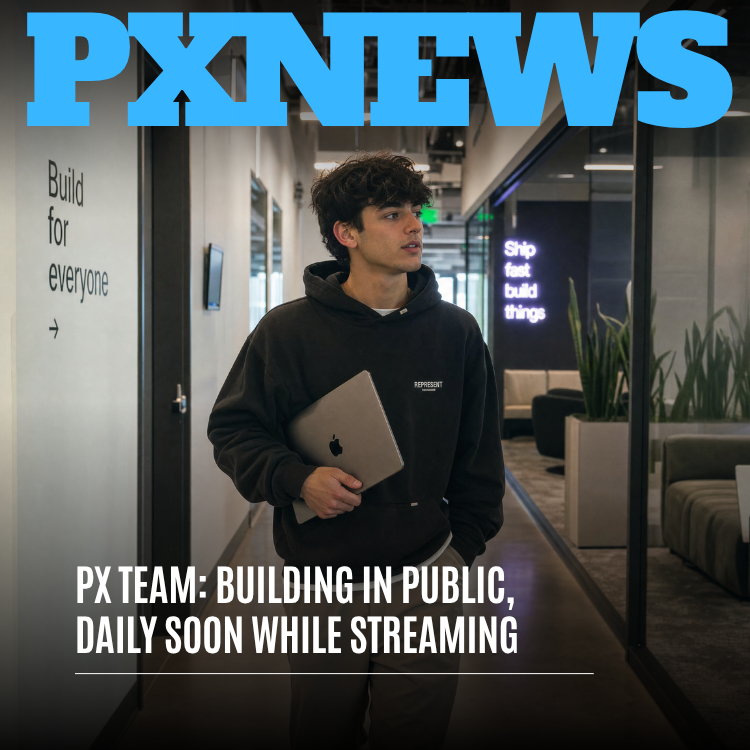

Walk through PX Campus on any given afternoon right now and you can feel it before anyone explains it to you: the pace has changed. Whiteboards fill up faster than they get erased. Standups run long because nobody wants to stop talking about what they're building. Four products that used to feel like four separate bets — Whistlr, GLSRM, Ocsidian, and Influxx — are starting to feel like four expressions of a single, much larger idea about where ETAPX is going. AJ, founder and CEO of ETAPX, has a phrase he's been using in nearly every internal meeting this quarter: "we're not close to done arguing about how big this gets." This is that argument, made in public, for anyone who wants to understand where the company's ambition actually sits right now — and why it keeps climbing.
A Different Kind of Quarter
Every growing company has quarters where the roadmap moves and quarters where the company itself moves. ETAPX has had plenty of the first kind — a new Circuit feature here, a Waves update there, a GLSRM surface added because the news cycle demanded it. This is shaping up to be the second kind. Not because any single release is bigger than what came before it, but because the team's sense of scale has shifted underneath all of it. People who joined a year ago to build one feature inside one product are now the ones asking, unprompted, how that feature should work across all four.
AJ traces the shift to a fairly ordinary planning meeting a few months back, one that was supposed to be about Whistlr's roadmap and ended up becoming something else entirely. "We were sketching out where Circuits go next, and somebody just said — out loud, half as a joke — 'why does this only live in Whistlr?'" AJ recalls. "And nobody in the room had a good answer. That was the moment. Not a strategy offsite, not a board meeting. A regular Tuesday, where the question got asked and the obvious answer was: it shouldn't. None of this should be siloed the way we built it."
That question didn't get answered that day, and it still isn't fully answered now. But it changed the texture of every conversation that followed. Ambition, at ETAPX, stopped being a word reserved for pitch decks and became a live variable in ordinary product meetings — the thing people actually argue about, out loud, in rooms that used to be about smaller things.
What "Campus" Actually Means Right Now
PX Campus is both a literal place where ETAPX's team works and a shorthand the company uses for its culture — the open, argumentative, show-your-work way the team builds. Lately, both meanings of the word have been running hotter than usual. The literal campus is louder: more whiteboard sessions that run past their allotted slot, more people staying to keep arguing about a design decision instead of tabling it for next week. The cultural campus — the posture the whole company brings to its work — has gotten more confident without getting more reckless, which is a harder balance to strike than it sounds.
Part of what's driving the shift is simple accumulation. Whistlr has spent seasons building out Circuits and SubCircuits, Waves, Minis, WTC Gems, Storefronts and Live Shopping, Creator Studio, Flow, Moods and Blips, relationship status, and most recently Halo. GLSRM has spent that same stretch becoming a genuinely trusted front page for an industry that badly needed one. Ocsidian has been quietly proving that agentic game creation isn't a science project — it's a real production path. Influxx has grown from an idea into a flagship agentic environment with native macOS and iOS apps, its own development environment in ADE, and Podz as a real, used feature rather than a demo. None of those are new announcements. They're the accumulated proof that the company can actually finish what it starts, at a scale that keeps expanding every time it does.
"You can feel when a team stops asking 'can we build this' and starts asking 'how big should this actually be.' That second question is a completely different kind of ambitious. It's not about wanting to look impressive. It's about realizing you've built four things that all deserve to be bigger than you originally scoped them, and refusing to let old scope decisions be the reason they stay small."
— AJ, Founder & CEO, ETAPX
That's the real substance behind "ambitions are soaring" — not a mood, but a recalibration. The company keeps discovering that the ceiling it originally assumed for a given product was lower than the product actually deserved, and it keeps choosing to raise the ceiling rather than protect the original plan.
Four Products, One Throughline
It would be easy to describe Whistlr, GLSRM, Ocsidian, and Influxx as four separate businesses that happen to share a parent company. That's not how the team talks about them internally, and it's increasingly not how they're built. Each one is a different answer to the same underlying question: what does it look like to build technology that treats people as more than an engagement metric, and treats intelligence as something woven through the product rather than bolted on top of it?
- Whistlr: the flagship social platform, where identity, community, and commerce already live together — Circuits and SubCircuits for belonging, Waves for music, Minis and WTC Gems for expression, Storefronts and Live Shopping for creators who want to sell what they make, Creator Studio for the people building all of it, and Halo as the newest layer connecting people around what they're actually doing right now.
- GLSRM: the front page of AI — an intelligence platform built for an industry that moves too fast for traditional coverage to keep up with, exercising real editorial judgment instead of just amplifying volume.
- Ocsidian: agentic game creation built for the Apple ecosystem, where the ambition isn't to make game development slightly easier — it's to make it possible for someone with an idea and no engineering background to actually finish a game.
- Influxx: ETAPX's flagship agentic environment, with native macOS and iOS apps, its own development environment in ADE, and Podz as a real working feature — built for people who want to direct intelligent agents rather than babysit a chat window.
The throughline across all four is a bet that identity, creativity, information, and agency shouldn't live in four disconnected apps that happen to share a logo. AJ has started describing it as "one ecosystem wearing four faces" — a phrase that sounds like branding until you watch how seriously the product teams take it in practice. A Whistlr creator using Storefronts should be able to think about Ocsidian as a place to build something new, not a foreign product they'd have to relearn from scratch. Someone reading GLSRM to understand where AI is headed should recognize the same judgment and craft when they open Influxx. That's the ambition: not four separate wins, but one company whose products keep making the case for each other.
Why the Ambition Is Getting Louder, Not Quieter
There's a version of company growth where ambition gets tempered over time — where a team that shipped a lot learns caution and starts protecting what it has instead of reaching for more. ETAPX is doing the opposite right now, and AJ is candid about why. "Every time we finish something and it actually works — Halo landing the way it did, Podz becoming something people use every day instead of a feature nobody opens twice — it doesn't make me want to protect that win. It makes me want to know what the next one looks like immediately," he says. "Finishing things is supposed to make you hungrier, not more comfortable. If it's making you more comfortable, something's wrong."
That hunger shows up in how planning conversations are structured now. Where a roadmap review used to end with "does this ship on time," it increasingly ends with a harder question: "is this the biggest version of this idea we're capable of building, or is it just the version that was easiest to schedule?" That second question doesn't always have a comfortable answer, and the team doesn't always like what it finds when it asks. But it's become the standard the whole company holds itself to, and it's a big part of why the pace on campus has picked up the way it has.
"I'd rather have a team that finishes a smaller version of a big idea and immediately asks 'okay, now how do we make this bigger' than a team that ships a big-sounding idea and quietly settles into maintaining it. The first team keeps climbing. The second team just got comfortable at whatever altitude they happened to land on. I want us to be a company that's chronically unsatisfied with its own altitude — in the best way."
— AJ, Founder & CEO, ETAPX
It's worth being precise about what this ambition is not. It isn't a promise of a specific number, a specific valuation, or a specific timeline attached to a specific outcome — AJ is deliberately allergic to that kind of talk, because numbers thrown around before they're real tend to become the thing a team optimizes for instead of the work itself. What's actually growing is scope: how big each product is allowed to think of itself, how many of the four platforms a single idea is allowed to touch, and how much the team is willing to reconsider decisions that felt permanent six months ago.
Ambition That Stays Grounded
The word "ambitious" gets used carelessly enough in this industry that it's worth explaining what ETAPX means by it, and just as importantly, what it doesn't mean. It doesn't mean chasing a bigger headline every quarter, or treating every feature as an opportunity to make a grander claim than the last one. AJ has been explicit internally that ambition without discipline is just noise dressed up as momentum — and that the fastest way to lose the trust the company has spent seasons building is to let big talk outrun what's actually shipped and actually working.
What keeps the ambition grounded, in practice, is a short list of habits the team holds itself to even when the excitement in the room is running high:
- Ship before you claim it: a feature gets talked about publicly once it's real and working, not while it's still a promising idea in a planning doc.
- Scope the idea, not the announcement: the question in every review is whether the underlying idea deserves to be bigger, never whether the announcement would sound bigger.
- Let one product's proof carry to the next: Ocsidian doesn't get to claim Whistlr's traction, and Influxx doesn't get to borrow GLSRM's credibility — each has to earn its own.
- Keep the record honest: PX News covers what actually happened, including the parts that took longer than planned, because a track record only means something if it isn't curated.
That discipline is exactly why the ambition can afford to be as loud as it currently is. A company that's careful about what it claims can also afford to think enormously about what it's building, because the two aren't in tension — they're the same habit pointed in two directions. Say only what's true, and there's no ceiling on how big the true thing is allowed to get.
What It Feels Like From Inside the Building
Ask around campus right now and you get a fairly consistent answer about what's changed, even from people working on completely different products. It isn't that the workload has gotten heavier — teams at ETAPX have always worked hard. It's that the horizon each person is building toward has visibly moved. A designer working on a Whistlr Storefronts detail is more likely, these days, to bring up how the same interaction pattern might eventually show up in Influxx. An engineer debugging something in ADE is more likely to reference a conversation they had with someone on the GLSRM editorial side. The walls between the four products haven't come down entirely, and they aren't meant to — but they've gotten a lot more permeable than they used to be.
"I've worked at three startups before this one, and I've never seen a team argue about scope the way this one does — in a good way. Nobody's fighting over credit. They're fighting over how big an idea is allowed to be before someone decides it's 'good enough' and ships the smaller version. I've started doing it myself without even noticing. You catch the ambition here whether you're trying to or not."
— Priya Anand, Senior Product Designer, ETAPX
That kind of testimony matters more than any internal memo could, because it's describing a culture that's self-reinforcing rather than mandated from the top. Nobody on campus was handed a directive that said "think bigger this quarter." The shift happened because enough individual people, across enough individual teams, started noticing that the products they were building had more room in them than the original plan assumed — and started saying so out loud, in rooms where that used to feel like an overreach.
The Shape of What's Ahead
AJ is careful not to turn this into a list of specific promises — that's not what this piece is for, and it's not how the team talks about its own future in public. But he's also not shy about the shape of where the ambition is pointed, even without attaching a date or a number to it. The throughline across every conversation on campus right now is the same: fewer walls between the four products, more of the intelligence that already runs through each of them individually working together across all of them, and a team that keeps refusing to accept the first scope it lands on for a given idea.
"I don't think we're going to look back on this stretch and point to one feature and say 'that's when it changed,'" AJ says. "I think we're going to look back and say this was the season the whole company decided its own ceiling was negotiable. That's a harder thing to point to than a launch, but it's the more important shift by a wide margin. Features come and go. A team that's decided to keep raising its own ceiling doesn't stop."
That's the actual claim behind "ambitions are soaring higher than ever" — not a promise about what ships next month, but a description of how the company has started thinking about its own limits. Every one of Whistlr, GLSRM, Ocsidian, and Influxx has room the team hasn't fully explored yet, and campus right now is full of people actively arguing about how much of that room is worth claiming. AJ's answer, consistently, is: more than you'd assume, and the team keeps proving it by finding more the next time they ask.
Frequently Asked Questions
What does "ambitions on PX Campus are soaring higher than ever" actually mean?
It describes a real shift in how ETAPX's team thinks about scope — not a specific announcement or metric, but a change in how big the team assumes an idea is allowed to become before it ships. Product conversations that used to stay within one platform now routinely ask how an idea could serve Whistlr, GLSRM, Ocsidian, and Influxx together, and the team is choosing to raise its own ceiling rather than protect earlier, smaller plans.
Is this piece announcing a specific new feature or product?
No. This is a vision and culture piece about where ETAPX sees itself heading as a company, told largely through AJ's own reasoning. It's deliberately distinct from a feature announcement — it's about the energy and scope behind the work happening across all four products right now, not a specific release.
How does ambition like this stay grounded instead of turning into empty hype?
By holding a short, consistent set of habits: only talking publicly about what's actually shipped and working, judging ideas on their own merit rather than borrowing credibility from another product, and keeping an honest public record — including the parts that took longer than planned — through outlets like PX News. AJ's view is that discipline about what the company claims is exactly what allows it to think enormously about what it builds.
Why does this ambition span Whistlr, GLSRM, Ocsidian, and Influxx together instead of just one product?
Because the team increasingly sees the four as expressions of one underlying idea rather than four separate businesses — identity and community in Whistlr, judgment and clarity in GLSRM, agentic creation in Ocsidian, and agentic environments in Influxx. The ambition is for each product to keep making the case for the others, so a person who trusts one has real reason to trust the rest.
Where does AJ see this ambition actually heading?
AJ is intentionally light on specific promises or timelines, but consistent on the shape: fewer walls between the four products, more of each platform's underlying intelligence working across the others, and a team that keeps treating its own current scope as negotiable rather than final. His framing is that the real shift isn't any single feature — it's a company that has decided its own ceiling is something to keep raising, not something to protect.
None of this is a promise with a date attached to it, and AJ would rather it not be read that way. It's a description of a mood that's become real on campus — a team that keeps discovering its own products have more room in them than anyone originally scoped, and keeps choosing to claim that room instead of settling for the plan that was easiest to schedule. Whistlr, GLSRM, Ocsidian, and Influxx are the proof the company points to when it says the ambition is earned rather than performed. Whatever comes out of PX Campus next, it's being built by a team that has stopped asking whether it can go bigger, and started only asking how much bigger it's willing to go.