
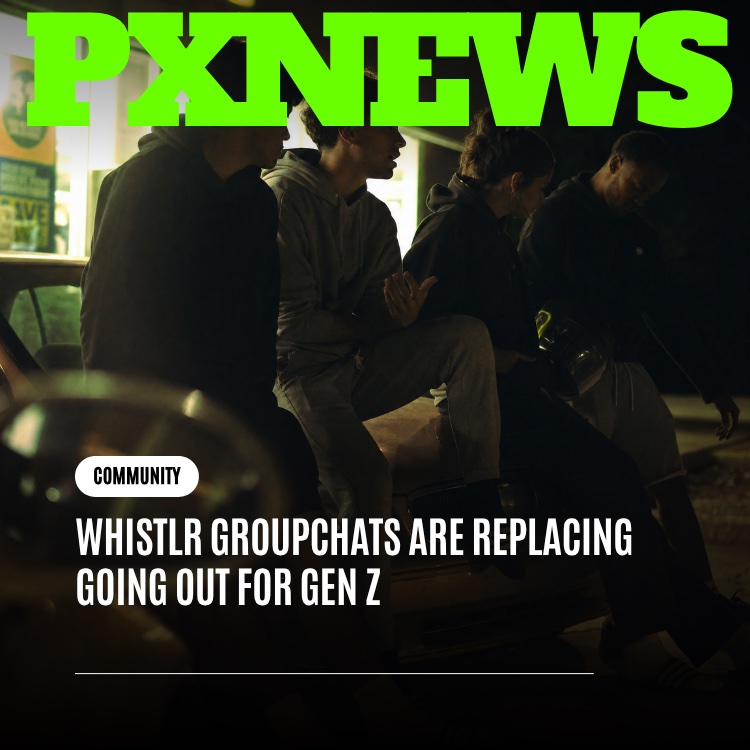
Ask a Gen Z Whistlr user what their Friday night actually looked like, and increasingly the honest answer isn't a bar, a party, or a restaurant — it's a group chat that ran for six hours, drifted through four unrelated topics, had a Wave playing in the background half the time, and ended with everyone agreeing to do it again tomorrow. That's not a consolation prize for a generation that supposedly can't socialize. For a growing number of Whistlr's youngest users, it's the actual plan, chosen on purpose, and it's worth taking seriously instead of writing off as a phase.
The Story That Gets Told, and the One That's Actually True
The popular version of this story treats it as decline — a generation retreating from real connection into screens, trading bars and house parties for isolated scrolling because something about growing up online broke their ability to socialize in person. That story is easy to tell and doesn't match what's actually happening inside a Whistlr group chat on a Friday night. The people in it aren't alone. They're together, actively, for hours, with real back-and-forth, shared jokes only that specific group would understand, and the kind of easy continuity that used to require everyone being in the same physical room. What's changed isn't whether Gen Z wants connection. It's what connection has to look like to count.
"The framing that Gen Z doesn't want to go out gets it backwards," says AJ, Founder & CEO of ETAPX. "It's not that they don't want to spend time with people. It's that going out has real costs — money, planning, everyone's schedules lining up, transportation, the risk that it's actually kind of awkward once you're there — and a group chat has almost none of those costs while still delivering a lot of what people actually wanted from going out in the first place: being part of something happening with people they like, in real time."
What a Group Chat Actually Replaces
It's worth being specific about what's being swapped for what, because "screens instead of real life" flattens a much more interesting substitution. A long-running Whistlr group chat isn't replacing deep, in-person friendship — for most users, it's layered on top of relationships that started in person and simply moved to where the group actually wants to spend time together. What it's more directly replacing is the specific, narrower category of going out for its own sake — the plan built mostly around occupying a Friday night rather than around wanting to do any one particular thing.
- The logistics tax: No coordinating a time everyone's free, no picking a venue everyone can afford, no one person ending up as the default planner every single week.
- The cost: A group chat is free. A night out, even a modest one, adds up fast across a group — and it adds up every single time, not just occasionally.
- The all-or-nothing attendance: A group chat scales down gracefully. Two people talking for twenty minutes and four more jumping in later is still a good hang. A dinner reservation for six that four people can't make is a logistics problem.
- The energy requirement: Going out asks for a certain baseline of social energy just to leave the house. A group chat meets people wherever their energy actually is that night — fully present or half-present in the background, both count.
None of that means in-person time has stopped mattering to Whistlr's Gen Z users — if anything, the group chats often exist specifically to plan the in-person moments that are actually worth the cost and effort, rather than defaulting to going out reflexively every weekend just to have something to do.
The Features Doing the Actual Work
This shift didn't happen because Gen Z users forced a static messaging tool to do something it wasn't built for. It happened because the specific shape of group chats on Whistlr already resembles hanging out more than it resembles texting.
Waves Turn a Group Chat Into a Shared Room
A group chat with a Wave running in the background stops feeling like a thread you check periodically and starts feeling like a room everyone's sitting in together — the same music playing, the same energy in the background, without anyone having to actively narrate that they're "there." That ambient, always-on quality is a big part of what makes a long-running group chat feel like time spent together rather than a series of disconnected messages.
Collab and Group Chats Are Built to Be Genuinely Shared
Whistlr's group features, including Collab and group chats, were built around a specific principle: nothing gets gamed by follower counts or performance metrics, because the entire point is a small group of people who already know each other, doing something together on purpose. Inviting a friend into a Circuit or getting pulled into a group chat someone else started is supposed to feel like walking into a room your friends are already in — not a broadcast you happen to be included in.
It Never Has a "Closing Time"
A bar closes. A restaurant turns over its tables. A house party winds down by a reasonable hour, or an unreasonable one, but it winds down. A Whistlr group chat doesn't have that constraint — it can run for six hours on a Friday night, go quiet for two days, and pick back up on a random Tuesday afternoon exactly where it left off, without anyone having had to plan a second gathering to make that continuation happen.
"We hear from friend groups whose Whistlr chat has basically never actually closed since they started it. Some nights it's five of them talking for hours with a Wave going. Other nights it's just memes back and forth for ten minutes total. Both of those count as hanging out to them now, and honestly the second one is more realistic for most weeknights than pretending everyone's going to get dressed and go somewhere."
— AJ, Founder & CEO, ETAPX
This Isn't Anti-Social — It's Differently Social
The instinct to read this as isolation misses what's actually happening in the data and in the chats themselves: this is a highly social generation, spending real hours in active, synchronous, group conversation with people they know — it's just not happening in a location anyone had to leave their house to reach. AJ put it plainly: "If you measured this generation by how much time they spend actively engaging with friends — not scrolling past strangers, actually talking, reacting, listening to something together — I don't think you'd conclude they're less social than any generation before them. I think you'd conclude they found a lower-cost way to do most of what going out was actually for."
"We didn't design group chats to replace going out. We designed them to remove the friction around staying close to people you already care about, and it turns out a huge amount of what people wanted from 'going out' was never really the venue — it was just spending real time with the people they'd have gone out with anyway. Once that friction's gone, the group chat starts carrying a lot more of the actual relationship than anyone originally expected it to."
— AJ, Founder & CEO, ETAPX
What This Means for How Whistlr Builds
Watching this pattern play out has shaped real product decisions rather than staying an interesting observation. Group chats, Waves, and Collab weren't built anticipating this exact use case, but seeing how heavily Gen Z users leaned into treating a chat as a hangout rather than a logistics tool has pushed the team to keep investing in exactly that direction — richer shared, synchronous experiences inside a chat, rather than only building better one-off messaging tools.
That's also part of the thinking behind Circle, Whistlr's newer feature for meeting people in small, shared-interest groups: if a long-running group chat has become one of the primary ways Gen Z actually maintains friendship, then the front door to a new friendship should be built with that same shape in mind from the start, instead of assuming everyone's still meeting the way older platforms assumed they would.
Frequently Asked Questions
Are Whistlr group chats actually replacing going out for Gen Z users?
For a meaningful and growing share of Whistlr's younger users, yes — not as a total substitute for in-person time, but as the default option for ordinary social time that previously would have meant going out mainly to occupy an evening rather than for a specific plan worth the cost and effort.
Does this mean Gen Z is more isolated or less social?
The pattern doesn't support that read. Users are spending real hours in active, synchronous conversation with people they already know — closer to a shift in where and how socializing happens than a reduction in how much of it is happening.
What features make Whistlr group chats feel different from ordinary texting?
Waves running in the background give a chat an ambient, shared-room quality; Collab and group chat features are built around small, already-connected groups rather than public performance; and there's no "closing time" the way an in-person plan has, so a chat can run for hours or sit quiet for days without losing continuity.
Does Whistlr build features specifically around this behavior?
Yes. Observing how central group chats had become to Gen Z social life directly shaped ongoing investment in richer shared, synchronous experiences within chats, and informed the design of newer features like Circle, which is built around the same small-group, low-pressure shape.
The bar and the group chat aren't really in competition, at least not the way the popular narrative frames it — one is an occasional destination, the other is where a lot of the actual relationship now lives day to day. For a generation that grew up with the tools to make that second option nearly frictionless, choosing it isn't a retreat from socializing. It's most of what socializing looks like now, and Whistlr is one of the places it's actually happening.