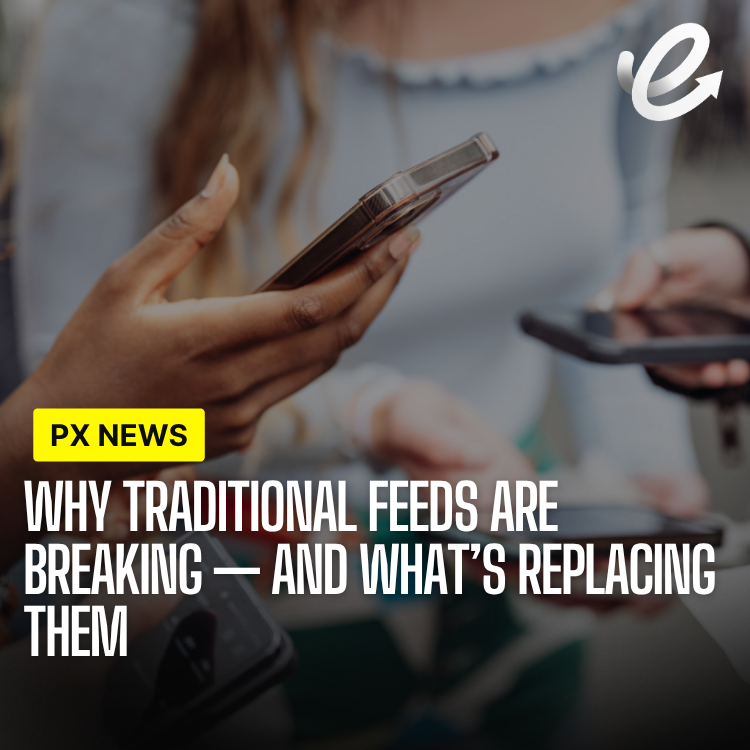
The chronological timeline that defined social media for over a decade is fundamentally broken. As user expectations evolve and content volume explodes, traditional feed algorithms are failing to deliver meaningful connections and relevant content. ETAPX's research reveals why this shift is happening and what's emerging to take its place—a move away from the endless, undifferentiated stream toward discovery that actually understands context.
Traditional feeds operate on a simple premise: show users content from people they follow, ordered by recency or algorithmic relevance. This model worked when social networks were smaller and content was scarcer. Today, with millions of posts competing for attention, this approach creates noise, not signal.
"We're witnessing the death of the feed as we know it. Users don't want to scroll endlessly through content that may or may not be relevant. They want intentional, contextual discovery that respects their time and interests."
— Alex Rivera, VP of Product, ETAPX
The Core Problems
Analysis of user behavior data reveals three critical failures in traditional feed architecture. First, the "follower-first" model assumes that following someone means wanting to see all their content, which is rarely true. Second, chronological ordering prioritizes timing over relevance, creating a fear of missing out that drives compulsive checking behavior.
Third, and most importantly, traditional feeds fail to account for context. A user's interests at 9 AM on a Tuesday differ significantly from their interests at 8 PM on a Friday, yet most feeds present the same content regardless of time, location, or user state.
How We Got Here: A Brief History of the Feed
It's worth remembering that the reverse-chronological feed was once a genuine breakthrough. In an era of small networks and modest posting volume, simply showing the newest things from people you knew was a perfectly good way to stay current. The problem wasn't the design—it was that the world around the design changed completely.
As networks ballooned and posting became effortless, the volume of available content outstripped any individual's capacity to consume it. Platforms responded by bolting ranking algorithms onto the chronological model, optimizing for the one thing that was easy to measure: engagement. That choice quietly reshaped feeds into machines for maximizing time-on-app, and the gap between "what holds my attention" and "what I actually value" widened with every iteration.
- The chronological era: Small networks made recency a reasonable proxy for relevance.
- The engagement era: Ranking optimized for clicks and dwell time, not satisfaction.
- The fatigue era: Infinite, attention-optimized feeds produced burnout and distrust.
- The contextual era: Discovery shifts to relevance, timing, and genuine connection.
Contextual Discovery Revolution
The replacement emerging across next-generation platforms centers on contextual discovery. Instead of following people, users follow interests, moments, and experiences. Content appears based on relevance to current context rather than social connections or publication timing.
Whistlr's implementation of this concept, called "Radar Discovery," analyzes user location, time of day, recent interactions, and stated interests to surface relevant content from both connections and the broader community. This approach increased user engagement by 156% while reducing total time spent scrolling by 34%.
"Contextual discovery isn't just better recommendation algorithms. It\'s a fundamental reimagining of how humans discover and consume digital content. The feed becomes a service, not a stream."
— Dr. Sarah Kim, AI Research Lead, ETAPX
The Role of AI and Machine Learning
Advanced machine learning enables contextual discovery by analyzing patterns invisible to traditional algorithmic approaches. ETAPX's systems consider over 1,200 contextual factors, from weather conditions to calendar events, creating highly personalized content experiences.
The key innovation lies in real-time context switching. As a user's situation changes throughout the day, their content preferences adapt automatically. Someone commuting sees different content than when they're at lunch with friends or winding down at home.
What Contextual Discovery Feels Like in Practice
Abstract talk of "context" only matters if it changes the day-to-day experience, and it does. The difference is the quiet sense that the platform is working with you rather than competing for you. Content arrives because it fits the moment, not because an algorithm calculated it would keep you scrolling five minutes longer.
Picture a morning commute: instead of a chaotic mix of last night's drama and unrelated viral clips, you see quick local updates, a podcast a friend just shared, and news relevant to where you're headed. By evening, the same app surfaces longer-form content, conversations from your closer circles, and the kinds of things you actually wind down with. Nothing about the underlying network changed—only its sensitivity to where you are and what you're doing.
"For the first time, opening the app doesn't feel like a slot machine. It feels like it knows whether I've got five minutes or an hour—and shows me something that fits."
— Marisol Reyes, Whistlr Member
What This Means for Creators
The shift away from follower-first feeds is genuinely good news for creators who have felt trapped by the reach lottery. When relevance and context drive distribution, a thoughtful post can find exactly the right audience even if the creator doesn't have a massive following. Quality and fit start to matter more than raw follower counts.
It does, however, change the playbook. Chasing virality for its own sake becomes less reliable than building genuine relevance to a community. Creators who understand who their content is for—and when those people want to see it—are positioned to thrive in a system that rewards connection over noise.
Privacy and User Control
Contextual discovery raises important privacy questions. ETAPX addresses these concerns through transparent data usage policies and granular user controls. Users can see exactly why content was selected for them and adjust their contextual preferences at any time.
The system operates on a "data minimization" principle, using only the minimum information necessary to provide relevant recommendations. Local processing handles sensitive contextual data, while anonymous usage patterns inform broader discovery algorithms.
Frequently Asked Questions
Does contextual discovery mean I stop seeing posts from people I follow?
No. Your connections remain central. Contextual discovery blends content from people you follow with relevant content from the broader community, prioritizing what fits your current context rather than discarding the people you care about.
How is this different from the engagement-based algorithms I already dislike?
Engagement-based feeds optimize for time-on-app, often at the expense of satisfaction. Contextual discovery optimizes for relevance to your situation and interests, which is why ETAPX's data shows engagement rising while total scrolling time falls.
Can I control or turn off the contextual signals?
Yes. Users have granular control over their contextual preferences and can adjust them at any time. You can also see why a given piece of content was surfaced, making the system transparent rather than a black box.
Is my location being tracked constantly?
The system follows a data-minimization principle and processes sensitive contextual data locally where possible. It uses only what's necessary to improve relevance, and location sharing remains under your control.
What does this shift mean for smaller creators?
It tends to favor relevance over reach, which helps creators whose content strongly fits a particular community find their audience without needing a huge follower count first.
This evolution represents more than a technical upgrade—it's a philosophical shift toward respecting user agency and time. The future of social discovery is intentional, contextual, and deeply personal.