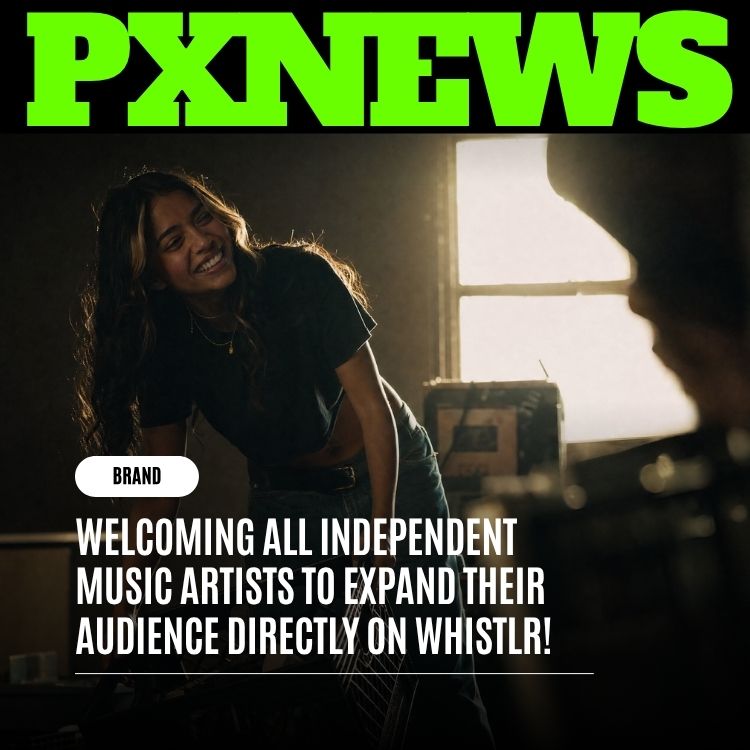
Every independent musician has heard some version of the same advice: build a following first, then hope a label, a curator, or an algorithm decides you're worth the push. Whistlr is offering a more direct path instead. Independent music artists get a standing invitation here — not a consolation-prize corner of the app, but the same tools, the same feed, and the same chance to expand their audience as anyone else. Through Waves, Minis, live performances, and the Circuits that turn scattered listeners into an actual fanbase, an artist's next fan is never more than one good post away. This is what it looks like when a platform decides that discovery shouldn't require permission.
For most of recorded music history, reaching an audience meant going through someone. A label had to sign you. A radio program director had to add you to rotation. A blog had to cover you before anyone influential would listen. Streaming was supposed to flatten all of that, and in some ways it did — but it mostly replaced human gatekeepers with algorithmic ones, and an algorithm deciding whether your song gets heard is still a gatekeeper, just a quieter one. Whistlr was built on a different premise: that a platform's job is to get music in front of real people, not to make artists guess what a recommendation engine wants from them.
That premise is why this reads less like a feature announcement and more like an open door finally being pointed out. Everything an independent artist needs to build a direct relationship with an audience — a place to share songs, a way to perform live, a home base for the fans who show up more than once — already exists inside Whistlr. What follows is simply ETAPX saying so, out loud, to every artist making music without a label's backing who has wondered whether there was a platform actually built with them in mind.
Why Independent Music Artists Don't Need to Wait for a Yes
Independent has always carried a slight apology in it, as if the word were shorthand for "not signed yet" rather than a description of how someone actually chooses to work. That framing made sense when reaching an audience required infrastructure only a label could realistically provide — radio relationships, physical distribution, marketing budgets large enough to buy attention. Almost none of that is still true. What independent artists are missing today usually isn't infrastructure. It's a direct line to the people who would care about their music if they ever actually heard it.
Whistlr's answer is to treat that direct line as the whole point, not an afterthought bolted onto a music catalog. An artist doesn't need a playlist placement from a stranger to reach someone; they need one fan to add a song to a shared playlist, one Mini to catch someone mid-scroll, or one live set that a stranger happens to wander into and stay for. None of that requires a label's approval. All of it is available the moment an artist opens the app.
"Independent artists don't need us to discover them — they need us to get out of the way and hand them a direct line to people who'd genuinely love their music if they heard it. That's the whole idea behind welcoming them here. We're not trying to be a new gatekeeper with better manners. We're trying to make the gate unnecessary."
— Marcus Webb, Head of Creator Partnerships, ETAPX
That's also why "expand their audience" is doing real work in how we describe this, rather than something vaguer like "get discovered." Discovery implies waiting around to be found. Expansion implies an artist already has something worth building on — a handful of fans, a following, a sound of their own — and simply needs the tools to grow it outward, on their own schedule, at their own pace, without asking anyone's permission first.
Waves: A Home Base for New Music on Whistlr
Waves is Whistlr's music-focused feed, and for an independent artist, it functions like a stage that's always available. Tracks shared through Waves sit inside deep Apple Music integration, which means a song doesn't need its own app or its own separate listening habit competing for a fan's attention — it lives right alongside the rest of a fan's music, in the same feed where they're already spending time.
Getting Onto a Fan's Playlist, One Add at a Time
The most powerful discovery tool inside Waves isn't an algorithm — it's a collaborative playlist. Friends, couples, and SubCircuits build playlists together over time, each person adding tracks the others will actually hear. For an independent artist, getting added to even one of those shared playlists means a song now has a standing invitation into an ongoing conversation between real people, one that keeps resurfacing every time that playlist gets played again. A single fan who genuinely loves a song becomes the reason three or four of their friends hear it too — the oldest form of music discovery there is, simply built into the app instead of left to chance.
A Feed Built Around Songs, Not Just Streams
Because Waves treats a song as something worth talking about rather than just something to be played and forgotten, a release becomes a small event inside a fan's feed instead of one more entry in an endless queue. Fans can react to a track, add it to a playlist, and carry it into a conversation with friends, all without leaving Whistlr. For an artist without a label's marketing department, that built-in social layer functions as the marketing department: every fan who engages with a song is, in a small way, promoting it to their own circle.
Minis: Turning a Song Into a Moment People Share
A song rarely sells itself in fifteen seconds, but a moment attached to a song often can. Minis, Whistlr's short-form video format, gives independent artists a fast, low-effort way to turn a track into something visual and shareable — a clip of the exact lyric that hits, a phone-camera look at how a song came together, a snippet of a live take that feels more honest than a polished music video ever could.
The built-in AI video editor lowers the barrier here in a very real way. An artist doesn't need editing skills or a production budget to turn a voice memo, a rehearsal clip, or a rough phone recording into something worth posting — the tools to shape that raw footage into a clean, shareable Mini are already part of the app. That matters for someone making music without a team behind them, because the old choice was between a slick clip made by someone with real production resources, or nothing at all. Minis quietly make "nothing" the wrong answer by default.
Behind-the-scenes content does something a finished single can't: it makes an artist feel like a person a fan is following, not just a name attached to a track. A Mini showing the fortieth take of a chorus, or the exact moment a lyric finally clicked, gives a fan a reason to care about the artist as much as the song — and a fan who cares about the artist sticks around for the next release, not only the current one.
Going Live: Playing Directly for the People Who Show Up
Live streaming through Flow gives independent artists something a release date alone never can: a real-time room. An artist can go live to debut a new song before it's officially out, take requests during an impromptu acoustic set, or simply talk through what a lyric actually means while the people listening ask questions as it happens. None of that requires a booked venue, a tour budget, or a crowd assembled weeks in advance. It requires a phone, a song, and the willingness to press go live.
There's a version of this that matters especially for artists early in building an audience: a small live audience is not a failure of a big one. Ten people watching a stripped-down set and asking questions between songs is, in its own way, a more valuable night than a much larger passive audience, because everyone in that small room chose to be there in that exact moment. Those are the fans who remember an artist was around before anyone else was paying attention — and that memory has a way of turning into loyalty later, when the audience is bigger and the same fan gets to say they were there from the start.
Circuits and SubCircuits: Building a Fandom, Not Just a Follower Count
A follower count measures attention. A SubCircuit measures something closer to belonging. Circuits are Whistlr's communities, and within a broader Circuit, a SubCircuit lets a smaller, more specific group gather around exactly what they care about — in this case, one artist's music, sound, or story. For an independent artist, building a SubCircuit means giving the fans who already care the most a room of their own, rather than leaving them to find each other scattered across the comments of someone else's post.
That distinction changes what growth actually looks like. A follower is someone who once tapped a button. A member of an artist's SubCircuit is someone who shows up to talk about a new release the day it drops, who tells other members when a live set is starting, who treats an artist's music less like content passing through a feed and more like a shared interest worth organizing around. Ten fans like that will do more for an independent artist's momentum than ten thousand passive followers scrolling past every post.
"I spent two years posting music into the void on other apps and getting maybe a handful of likes each time. I started a SubCircuit on Whistlr almost as an experiment, and within a few months it turned into the first real group of people who actually cared when I released something new. They tell their friends. They show up when I go live. One of them added my song to a playlist she runs with her sister, and I picked up more genuine listeners from that single add than from anything I ever paid to promote."
— Jules Tanaka, independent musician on Whistlr
Gems: Support That Doesn't Wait for a Tour
Independent artists have historically had to wait for a specific moment to get supported directly for their work — a merch table after a show, a tip jar at a small venue, a rare good month. Gems gives fans a way to support an artist in the moment a song or a live set actually moves them, instead of that appreciation having nowhere to go until the next show comes around. A fan watching a live set who wants to say thank you for a song that meant something to them can do exactly that, right there, instead of the feeling passing with nothing to show for it.
The value here isn't only the support itself, it's the timing. Appreciation is strongest the moment someone actually feels it. Gems exists to catch that moment rather than let it evaporate between a great live set and whatever comes next. For an artist building an audience one real fan at a time, that immediacy turns an abstract sense that people like the music into something concrete: proof, in the moment, that a specific song reached a specific person enough that they wanted to give something back.
Practical Ways Independent Artists Can Expand Their Audience on Whistlr
None of this requires an overhauled strategy or a marketing plan borrowed from a label. It requires showing up consistently, in the ways Whistlr already makes easy.
- Share new music through Waves: Post a new track where it can land in a fan's feed and get added to the collaborative playlists that carry a song into circles an artist would never reach alone.
- Post behind-the-scenes Minis: Use the built-in AI video editor to turn rehearsal clips, voice memos, and studio moments into short, shareable videos between releases.
- Go live regularly, not only for big moments: A stripped-down set through Flow builds the kind of real-time connection a scheduled release announcement never can.
- Start a SubCircuit: Give the fans who already care the most a dedicated space to gather, talk, and bring in people they know.
- Check in on Creator Studio: Use the dashboard to see which songs and posts are actually resonating, and let that steer what gets posted next.
- Treat every reaction as the start of something: Respond when a fan adds a track to their own playlist or sends a Gem during a live set — that response is often what turns a listener into a regular.
Taken individually, each of these is a small action. Taken together over months, they're how an audience actually gets built — not in one viral moment, but in the accumulation of a hundred small ones: a shared playlist here, a live set there, a Mini that catches someone at exactly the right scroll. That slower, more human version of growth has always technically been available to independent artists. Whistlr's bet is that it works far better when a platform actually builds for it, rather than treating it as something artists have to work around.
ETAPX has said from the beginning that being creators-first means giving independent voices real reach, not reserving the best tools for whoever already has the biggest following. Independent musicians are one of the clearest tests of that promise, because music has always been one of the fastest ways strangers become a community. Welcoming them onto Whistlr isn't a new direction for the platform. It's the same direction, applied to the artists who've been doing the hardest version of this work — making music without a team behind them — for the longest.
Frequently Asked Questions
Do independent music artists need a label to share music on Whistlr?
No. Any independent artist can share original music directly through Waves, post about it through Minis, and perform it live through Flow, with no label, distributor, or industry connection required. Whistlr is built to let independent music artists reach an audience directly, without a signature standing between a song and the people who might love it.
How is Whistlr different from just releasing music on a streaming platform?
A streaming platform is built mainly for playback. Whistlr is built around the relationship that forms around that playback. Waves connects to deep Apple Music integration so songs are easy to hear, but the actual discovery happens through collaborative playlists, live performances, Minis, and SubCircuits — the community layer a pure streaming catalog was never designed to provide.
What's the best way for a new independent artist to start building an audience on Whistlr?
Start small and consistent rather than trying to do everything at once. Share a track through Waves, post a behind-the-scenes Mini about how it came together, and go live for even a short, informal set. Those three habits, repeated over weeks rather than done once, are how most independent artists actually expand their audience on Whistlr.
Can independent musicians earn support directly from fans on Whistlr?
Yes. Gems let fans support an artist directly, including in the moment during a live performance, so appreciation for a song or a set doesn't have to wait for a merch table or a tour date. It's one part of a broader set of creator tools built to let independent artists benefit directly from the community they build around their music.
Do I need an Apple Music subscription to share or discover music through Waves?
No. Anyone on Whistlr can post music, add tracks to a collaborative playlist, and engage with an artist's Waves content. Apple Music subscribers get full playback, while others hear previews — either way, an independent artist's music stays fully shareable and discoverable across the whole community.
Every independent musician making music right now, without a label's backing and without waiting for an algorithm's blessing, already has something worth hearing. Whistlr's job is to make sure that's enough — to turn one good song, one honest live set, and one real fan willing to hit share into the start of an audience. The invitation was always the point. Now it's being said plainly: welcome to Whistlr.