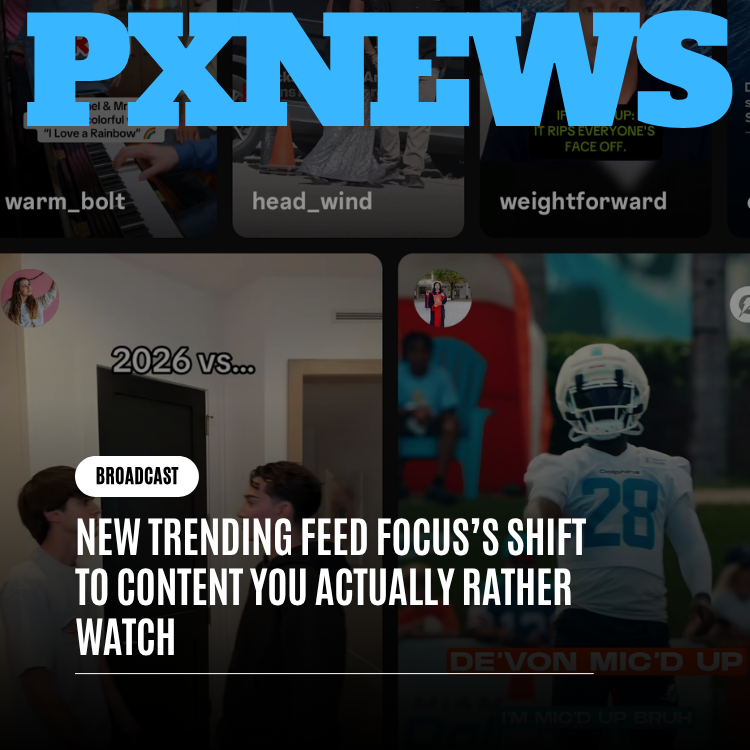
There's a specific feeling most people know without having a name for it: you open a trending feed, three seconds of something loud grabs you, you watch, and then you feel nothing. Not annoyed exactly, not satisfied either — just mildly emptier than before you tapped. Whistlr's Trending tab has spent the last several months being rebuilt against that exact feeling. The philosophy behind what surfaces there is shifting in a specific, deliberate way: away from treating a big first-second reaction as the whole story, and toward noticing what people actually stay for, finish, and come back to a second time.
This isn't a rename or a redesign. It's a change in what "doing well" looks like on the Trending tab, and it shows up in something you can feel the moment you open the app: the content sitting at the top of Trending is, more and more, content that holds your attention all the way through — not content that's engineered to win the first three seconds and then lose you.
The Complaint Everyone Has Had About Every Trending Feed
Ask almost anyone what's wrong with the "what's hot" tab on their social apps and you'll hear some version of the same complaint, phrased a dozen different ways. The clips at the top are loud. They're often confusing, out of context, or engineered around a single startling frame. You watch a few seconds, feel a flicker of something — surprise, confusion, mild offense, a laugh you didn't mean to give — and then you scroll away and can't remember what you just saw an hour later. The feed did its job, technically. You watched. You reacted. And yet almost nobody would call that experience satisfying.
That gap — between "got a reaction" and "was actually worth watching" — is the real subject of this piece. It's a complaint that spans the entire industry, not any one platform, and it's become common enough that people now describe it with a kind of tired shorthand: "trending is just noise," "I don't even know why that's popular," "I watched three seconds and closed the app." Whistlr's team has heard versions of this complaint constantly, both from users directly and in the broader conversation about what's gone wrong with discovery feeds generally. The new approach to Trending is a direct response to it.
"We kept hearing the same sentence in different words: 'trending never has anything I actually want to watch.' That's a real signal, and it's one we'd been under-weighting. A feed can be technically accurate — this is what got the most reaction — and still be wrong about what people wanted. Our job with Trending is to close that gap, not manage it."
— AJ, Founder & CEO, ETAPX
What Actually Changed: From "Got a Reaction" to "Earned a Watch"
The simplest way to describe the shift is this: Whistlr's Trending feed now factors in how people actually watch content, not just whether they clicked, tapped, or paused on it for a beat. A video that gets watched to the end, watched more than once, or actively sought back out after someone scrolled past it once is treated as a meaningfully different kind of "popular" than a video that gets a flood of quick taps and an equally fast exit. Both used to look similar in a purely reaction-driven view of trending. They don't anymore.
You'll notice this without anyone having to explain it to you. Open the Trending tab today and the clips near the top tend to be the kind you watch through without your thumb twitching toward the next thing. They resolve. They have a point, a punchline, a payoff, an ending that makes the three seconds before it worth having sat through. Content built purely to interrupt your scroll — the visual equivalent of a startled shout — still exists on the platform, of course. It just doesn't automatically get escorted to the top of Trending the way it used to.
- Watch-through matters, not just watch-start. Content people stay with from beginning to end is treated as meaningfully different from content people bail on seconds in, even if both technically racked up a lot of initial views.
- Re-watching is a strong signal of genuine value. When people go back and watch something a second or third time — or scroll back up to catch it again — that's treated as one of the clearest signs that content actually delivered on its promise.
- Seeking something back out counts. If someone scrolls past a piece of content, keeps thinking about it, and comes back to find it again later, that return trip is a meaningfully different kind of interest than a passive first glance.
- A fast bail is treated as real information. When people watch a beat or two and immediately move on, that tells the feed something — the same way it always has — but now it's weighed against whether the people who stayed actually got something out of staying.
- Being loud is not disqualifying, but it's no longer sufficient on its own. Attention-grabbing content can absolutely still trend. It just has to also hold up once it's got your attention, rather than coasting on the grab alone.
Why This Wasn't Always How It Worked
It's worth being honest about why trending feeds — Whistlr's earlier version included — leaned so heavily on immediate reaction in the first place. Immediate reaction is easy to measure. It happens fast, it's unambiguous, and it produces clean numbers a feed can rank on within seconds of content going live. Genuine satisfaction, on the other hand, takes time to show itself. You don't know whether someone actually valued a piece of content until well after they've watched it — until you see whether they finished it, whether they came back, whether it stuck.
That timing mismatch is a big part of why "attention-grabbing" and "actually good" drifted apart across the industry to begin with. Ranking systems that need an answer immediately will always lean on the signal that's available immediately, and the signal that's available immediately is reaction, not satisfaction. Content creators, being smart and responsive to incentives, noticed what got rewarded and made more of it. The result, across the whole industry, was a slow drift toward content optimized for the opening moment at the expense of everything after it.
Whistlr's answer isn't to pretend that trade-off doesn't exist. It's to be more patient. Trending content on Whistlr is now allowed to prove itself over a slightly longer window before it's crowned, so that watch-through and re-watch behavior — the signals that actually take time to show up — have a real chance to weigh in before the feed locks in a verdict. A clip can still climb fast. It just has to actually earn the climb from people who watched it, not only from people who glanced at it.
What This Looks Like When You Open the App
Describing a philosophy is one thing; noticing it in your own scrolling is another. Here's what's different in the actual experience of using Trending now, compared to before.
The first thing people tend to notice is fewer dead ends. A "dead end" here means exactly what it sounds like — content that grabs you, resolves nothing, and leaves you with no reason to have watched it. Those clips haven't vanished from the platform, but they're no longer disproportionately clustered at the top of Trending the way pure-reaction ranking used to put them. What replaces them is content with an actual shape: a beginning that earns your attention, a middle that keeps it honestly, and an end that makes the whole thing worth the time.
The second thing people notice is that trending content feels more re-watchable, because it increasingly is. Content that survives this kind of filtering tends to be the kind that rewards a second look — a joke that lands better the second time, a moment you want to show a friend, a clip you go back to because you want to see it again rather than because an algorithm dangled it in front of you again. That's not an accident. Re-watch behavior is now one of the things the feed is actually listening for, so content that produces it naturally rises.
The third thing — and this one's more subtle — is that Trending starts to feel less like a slot machine and more like a curated shelf. A slot machine rewards you unpredictably and keeps you pulling the lever. A shelf shows you things worth picking up. Whistlr is aiming squarely for the second feeling, and shifting the weight toward watch-through and re-watch is one of the clearest ways to get there, because it means the shelf is stocked with things that already proved they were worth someone's time, rather than things that merely proved they could interrupt someone's scroll.
"I used to open Trending, watch like four things for two seconds each, and close the app feeling kind of gross. Now half the stuff up there I actually watch all the way through, and I've caught myself replaying a couple of clips just because I wanted to. That's a completely different feeling from before."
— Whistlr user, iOS
Friend-First Discovery and Watch-Through Are the Same Instinct
Longtime readers of this blog will recognize the underlying instinct here, because it's the same one behind Whistlr's friend-first approach to discovery more broadly. The through-line across everything Whistlr has built into its discovery surfaces is a rejection of the idea that the most efficient way to capture attention is automatically the most valuable way to spend it. Friend-first discovery says a recommendation from someone you actually know is worth more than an algorithm's best guess about a stranger. Watch-through-and-re-watch weighting says the same thing in a different register: what people actually finish and return to is worth more than what merely makes them flinch and tap.
Both are ways of asking the feed to slow down and check its work. Both push back on the same industry-wide default, which optimizes for the interruption rather than the experience. And both come from the same place inside the company — a conviction that a social platform's job is to leave people better off for having used it, not just more engaged with it in the moment.
"Friend-first discovery and this shift in Trending are really the same value expressed twice. One says: trust what the people you actually know found worthwhile. The other says: trust what people demonstrably stuck with and came back to. Neither one trusts the loudest three seconds by default anymore, and that's very much on purpose."
— Renata Osei, VP of Product, ETAPX
What This Means for Creators
Any change to what trends is, understandably, the first thing creators want to understand, because reach is livelihood. The honest framing here is that this shift changes what pays off, and it changes it in a direction most creators who care about their craft should welcome.
Content built purely to jolt someone into watching the first second — a shock cut, a misleading thumbnail moment, a cheap cliffhanger with no payoff — loses some of the advantage it used to have. It can still get attention, but attention alone no longer carries it to the top of Trending the way it once might have. Content that's actually made with care — a real joke, a satisfying edit, a story that resolves, a moment genuinely worth a second watch — gains ground it didn't reliably have before, because the feed is now built to notice when people stick around and come back.
That's a better deal for creators who've been making patient, well-crafted content and watching it get outrun by cheaper attention-bait. It asks a little more of everyone, in the sense that a clip now has to hold up rather than just land a hook. But holding up is a bar most thoughtful creators already clear naturally — it's the bar they were trying to clear all along, before the incentives of a pure-reaction feed nudged the whole industry toward the hook instead.
- Payoff matters again. A video that resolves and satisfies has a real, structural advantage over one that only interrupts.
- Craft compounds. Content people willingly re-watch keeps earning credit over time, rather than spending its entire value in the first hour after posting.
- Cheap hooks alone stop being a strategy. A strong opening still helps get someone to press play — it just isn't enough by itself to carry a clip all the way up Trending anymore.
- Consistency is rewarded, not just spikes. A creator who reliably makes things people finish and return to builds a track record the feed can recognize, rather than chasing one viral instant at a time.
What This Doesn't Mean
It's worth being precise about the limits of this shift, because a philosophy stated too broadly invites the wrong expectations. This isn't a claim that only slow, meditative, or "serious" content can trend now — plenty of what rises on Whistlr's Trending tab is funny, fast, and immediately engaging, and that's exactly as it should be. A great joke can be three seconds long and still be something people watch twice. The distinction was never about pace or tone; it's about whether content earns the attention it gets or just seizes it and lets go.
This also isn't a guarantee that every disappointing three-second clip has been eliminated from Trending forever. Human taste is varied, discovery is inherently a little unpredictable, and no set of priorities produces a perfect feed every single day. What's changed is the underlying bias — what gets a structural advantage when the feed is deciding what belongs near the top — not a promise of a flawless outcome on every scroll.
And it isn't a technical claim about exactly how any of this is calculated behind the scenes. What matters to a Whistlr user, and what this article focuses on, is the experience: what shows up, what it feels like to watch it, and whether it was worth the time. That's the part users actually live in, and it's the part that's genuinely different now.
Where This Fits Into the Bigger Picture — and What's Next
This shift in Trending doesn't exist by itself. It sits alongside the rest of what Whistlr has been building toward across Minis, Circuits and SubCircuits, Waves, Stories, and Creator Studio — a platform-wide instinct that treats a person's time as something to be earned rather than captured. Trending has always been one of the most visible places that instinct shows up, because it's the surface most directly shaped by what a wide audience seems to want in the moment. Making it reward genuine watch-through and re-watch behavior, rather than just the loudest opening beat, is a natural next step in a direction Whistlr has been walking for a while.
It also reflects something about where the broader industry conversation is heading. The complaint that trending feeds are full of content that grabs and doesn't deliver isn't a niche gripe anymore — it's close to a consensus observation about social media as a whole. Whistlr's bet is that platforms willing to actually act on that complaint, rather than just acknowledging it, will be the ones people keep choosing to open.
"Every platform will tell you they care about quality. The test is whether your trending surface — the place that sets expectations for what 'popular' even means on your app — actually reflects that. We wanted people to open Trending on Whistlr and trust that what's there was actually worth their time, not just successful at stopping their thumb."
— John Ridge, CTO, ETAPX
This is a direction, not a finish line. The team expects to keep refining how watch-through and re-watch behavior get weighed against other forms of interest, and to keep listening to users about where Trending still surfaces something that grabs but doesn't deliver. The goal stays the same even as the specifics get tuned: a Trending tab where getting someone's attention is only the opening move, and actually being worth that attention is what determines whether something belongs near the top.
For users, the practical upshot is simple. Trending should increasingly feel like a place stocked with things worth your time, rather than a gauntlet of things fighting for your first three seconds. For creators, the practical upshot is just as simple: making something people finish, remember, and come back to is no longer a nice bonus on top of getting noticed — it's becoming the more reliable way to get noticed in the first place.
Frequently Asked Questions
What exactly changed about the Whistlr Trending feed?
The Trending feed now factors in how people actually watch content — whether they watch it through to the end, whether they watch it more than once, and whether they come back to find it again after scrolling past — rather than relying mainly on how many people reacted to or briefly engaged with it in the first moment. Content that genuinely holds people's attention has a stronger path to the top than content that only grabs attention briefly.
Does this mean short, fast, or funny content can't trend anymore?
No. Pace and tone were never the point. A quick, punchy clip that people watch through and re-watch can absolutely trend — the distinction is between content that earns the attention it gets versus content that merely interrupts a scroll and delivers nothing once it has you. Fast and satisfying isn't a contradiction.
Why is Whistlr making this change now?
It's a direct response to a complaint that's become common across social media generally: trending feeds full of content that's attention-grabbing for a few seconds but not actually satisfying to have watched. Whistlr's team heard that sentiment repeatedly from its own users and saw it echoed across the wider conversation about discovery feeds, and built this shift as a deliberate answer to it.
Is this related to Whistlr's friend-first discovery philosophy?
Yes, they come from the same underlying value. Friend-first discovery says a recommendation from someone you actually know is worth more than a stranger-optimized algorithmic guess. Weighing watch-through and re-watch behavior says something similar: what people genuinely finish and return to is worth more than what merely produces a fast, fleeting reaction. Both push discovery toward what actually serves people.
What should creators do differently because of this?
Nothing drastic — mainly, lean into what already makes content genuinely satisfying to watch: a real payoff, a clean resolution, something worth a second look. A strong opening still helps get someone to press play, but it's no longer enough on its own to carry a clip to the top of Trending. Content that people finish and come back to now has a more direct path to visibility than it used to.
Trending was always meant to be a shortcut to what's worth your time — this shift is Whistlr making good on that promise a little more honestly, one watch-through at a time.