
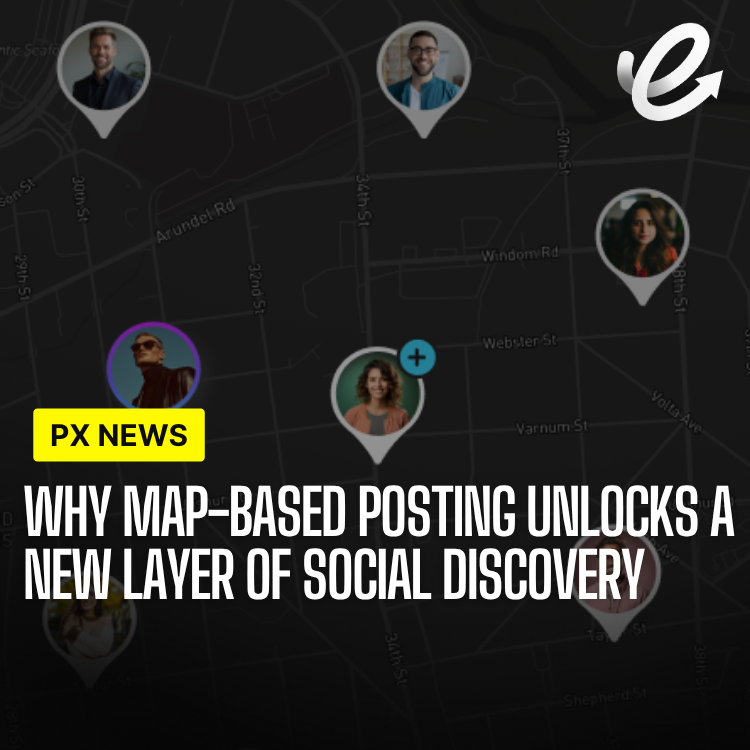
Location has always been context, but in most social platforms it's treated as metadata—a simple tag attached to content rather than a fundamental organizing principle. Whistlr's Radar feature reimagines location as the primary lens for content discovery, creating opportunities for community connection that transcend traditional social graph limitations. When place becomes the way you browse rather than an afterthought you append, an entirely new layer of social discovery opens up.
Map-based posting represents a paradigm shift from follower-centric social networking to place-centric community building. When users can discover content and connections based on shared physical spaces, new forms of social interaction emerge that blend digital and physical community engagement.
"Location isn't just where you are—it's a shared experience with everyone who has been there. Map-based discovery turns every place into a potential community hub where stories, recommendations, and connections naturally emerge."
— Carlos Rodriguez, Product Manager for Location Services, ETAPX
Beyond Check-ins and Tags
Traditional location sharing focuses on broadcasting where you are at a specific moment. Map-based posting creates persistent connections between content and places, allowing users to discover stories, reviews, and community discussions tied to specific locations long after the original posts were created.
This persistence transforms locations into dynamic content hubs. A coffee shop becomes a repository of customer experiences, local events, and community discussions. Users visiting or considering visiting can access this collective knowledge, making more informed decisions and connecting with local communities.
How Map-Based Discovery Works
At its simplest, Radar flips the usual question. Instead of asking "what are the people I follow posting?" it asks "what's happening here?"—where "here" can be your immediate surroundings, a neighborhood you're curious about, or a destination you're planning to visit. Content is anchored to coordinates, and the map itself becomes the interface for exploration.
Opening the map reveals layers of activity tied to real places: posts pinned to a park, a thread of recommendations attached to a restaurant, a cluster of conversation around a venue hosting an event tonight. Because that content persists, the map doubles as both a live snapshot of the present and an accumulated record of a place over time. You're not just seeing who's there now—you're seeing what the place has meant to everyone who's passed through.
- Place-anchored content: Posts and discussions attach to specific coordinates rather than disappearing into a global feed.
- Map-first browsing: The map becomes the primary way to explore, surfacing what's relevant to a location instead of a follower list.
- Persistent local memory: Content accumulates at a place, building a living history visitors can tap into.
- Proximity discovery: Nearby activity surfaces naturally, connecting people who share physical space.
Privacy-First Location Sharing
ETAPX's implementation prioritizes user privacy through innovative technical solutions. Location data is processed locally on devices, with only necessary spatial information shared with servers. Users maintain granular control over location visibility, with options ranging from exact coordinates to general neighborhoods or complete privacy.
The system includes temporal privacy controls, allowing users to share location-based content with delayed publication or retroactive sharing. This enables participation in location-based communities without real-time location tracking concerns.
"Privacy and location services aren't mutually exclusive. Our differential privacy implementation allows rich location-based features while protecting individual user movements and patterns."
— Dr. Lisa Park, Privacy Engineering Lead, ETAPX
Local Discovery and Serendipity
Map-based discovery enables serendipitous connections impossible through traditional social graphs. Users discover content from people they don't follow but who share physical spaces or experiences. This breaks down social bubbles and introduces diversity into content consumption.
Local businesses benefit significantly from map-based posting. Customer experiences and recommendations remain discoverable to future visitors, creating persistent marketing value. Small businesses can build community relationships without expensive advertising, relying instead on authentic customer experiences.
Community Formation Around Places
Places become natural community hubs when content persists and accumulates over time. Neighborhoods develop digital layers of shared knowledge, local events, and community discussions. Regular visitors become local guides, sharing insights and building relationships with others who frequent the same areas.
This community formation extends beyond commercial locations to public spaces, trails, landmarks, and events. Any place where people gather can become a community hub, fostering connections between individuals who share physical experiences.
Who Benefits From Map-Based Discovery
The appeal of place-first discovery is that it serves people the traditional social graph tends to overlook. You don't need a big following to be useful when your knowledge is tied to a place you know well. A regular at a neighborhood spot, a newcomer trying to find their footing in a city, a small shop owner—each gains something distinct from anchoring social activity to geography.
- Newcomers and travelers: Tap into a place's accumulated local knowledge before ever setting foot there.
- Local residents: Discover what's happening nearby and connect with neighbors who share the same spaces.
- Small businesses: Build a discoverable reputation through authentic customer experiences rather than ad spend.
- Event organizers: Turn a venue into a live gathering point where attendees find each other and the moment.
Technical Innovation in Spatial Computing
Implementing effective map-based social features requires sophisticated spatial computing capabilities. ETAPX developed clustering algorithms that group related content while respecting privacy boundaries and user preferences for location precision.
The system handles edge cases like indoor locations, moving venues, and temporary events through dynamic spatial indexing that adapts to changing physical and social contexts. Machine learning helps identify spam and maintain content quality in location-based feeds.
Frequently Asked Questions
Does Radar track my location in real time?
Only to the degree you allow. Location data is processed locally on your device, and you control visibility—from exact coordinates down to a general neighborhood, or full privacy. Temporal controls even let you share content with delayed or retroactive timing, so participation never requires live tracking.
Can I see content from a place I'm not currently at?
Yes. The map lets you explore any location, whether you're standing in it or planning a future visit. Because content persists at a place, you can tap into its accumulated stories, reviews, and discussions from anywhere.
How is this different from checking in or geotagging a post?
Check-ins and tags are momentary—they broadcast where you are and then fade. Map-based posting anchors content to a place permanently, turning each location into a living hub of knowledge that grows over time rather than a one-off label.
Will I be exposed to strangers near me?
Map-based discovery surfaces content, not your identity or precise position. You choose what you share and how precisely, so you can benefit from local discovery while keeping your personal movements private.
How do local businesses use map-based discovery?
Businesses benefit when genuine customer experiences accumulate at their location, creating persistent, discoverable value for future visitors. It's a way to build community reputation through authenticity rather than paid advertising.
Map-based posting represents the evolution of social media from digital-only experiences to hybrid digital-physical community platforms. As users seek more authentic connections to their physical communities, location-based discovery provides the bridge between online interaction and real-world relationships.