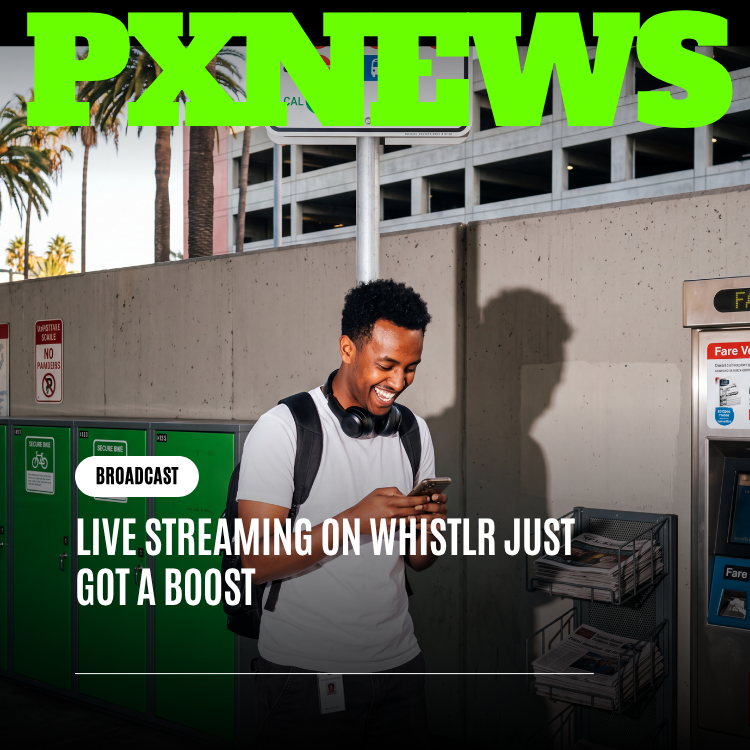
Live streaming on Whistlr just got a serious boost — not to what happens once you're live, but to everything that happens right before it. Going live used to feel like its own small production: find the right moment, dig through a setup screen, confirm a handful of details, and only then hit start. That gap between wanting to go live and actually being live is exactly what shrinks with this update. Whether you're waiting on a coffee order, walking out of a show, or catching a sunset that's too good not to share, getting live on Whistlr now takes about as long as it takes to have the idea. Nothing about broadcasting changed — everything about starting one did.
If you read Whistlr's last live streaming update, you already know it was entirely about the other side of the screen — smoother playback, faster chat, sharper discovery, all built for the people watching. This one flips the camera around. It has nothing to do with Creator Studio's deeper production tools or how a stream looks once it's running, and everything to do with the moments before you go live: how you get there, how much you have to think through first, and how few reasons you now have left to just... not. Because the biggest threat to live streaming has never really been quality. It's hesitation.
Why Going Live Faster Actually Matters
Ask any creator when their best live moments happened, and it's rarely the ones they planned three days in advance. It's the stream that started because something was already funny, already happening, already worth sharing — not because it was sitting on a calendar. But for a long time, going live on Whistlr quietly rewarded planning over instinct. You needed a minute to find the right screen, a minute to settle on a title, a minute to double-check your camera and mic, and by the time all of that was done, the moment that made you want to go live in the first place had usually already passed.
That's the real cost of friction — it doesn't just slow creators down, it filters out every stream that wasn't worth the setup. Big, scheduled broadcasts survived that filter because they were worth planning for: a product drop, a WildDraw tournament, a Live Shopping event with real stakes behind it. Everything smaller — a five-minute check-in, a reaction to something that just happened, a stream with no agenda beyond "hey, I'm here" — lost out to the effort required to start it. Lowering that barrier doesn't make the big moments less important. It just means the small ones finally get a fair shot at happening at all.
The Streams That Never Happened
The easiest way to see the cost of the old flow isn't in the streams that happened — it's in the ones that didn't. Every creator has a version of this: something worth sharing happened, the thought "I should go live" crossed your mind, and then real life kept moving while you were still getting set up. You lost the light, the conversation ended, the moment passed while you were still on a details screen. None of those missed streams ever show up anywhere, because a stream that never starts doesn't leave a trace. It just quietly convinces you, one small inconvenience at a time, that going live wasn't worth it this time either.
From Event to Habit
There's a real difference between streaming being an event you build up to and streaming being a habit you fall into. Events are rare by nature — they take energy, planning, and a reason big enough to justify the setup. Habits are frequent precisely because they don't ask much of you. This update pushes live streaming on Whistlr firmly toward the habit side of that line, without taking anything away from creators who still want to treat a stream like an event. The scheduled, produced, promoted broadcast is still there whenever it's called for. It's just no longer the only shape a stream is allowed to take.
From Impulse to Live: How Whistlr's Live Streaming Boost Works
None of this required reinventing what a Whistlr stream is. It required looking honestly at everything standing between the thought "I should go live right now" and an actual live stream, and clearing out as much of it as possible. Here's what specifically got easier.
One Tap, Not a Checklist
The biggest shift is how few decisions you have to make before you're live. Where going live used to mean stepping through a small sequence of setup screens — one for details, one for settings, one for a final confirmation — it now collapses into a single tap from the moment you decide to do it. You're not filling out a form before you're allowed to stream. You're just going live, with everything else handled quietly in the background so you can get to the part that actually matters: being on.
Go Live From Wherever You Already Are
Just as important as fewer steps is where those steps start. Going live no longer means hunting through a menu to find the one screen that lets you do it. The option to go live now lives right where you already are — from your profile, from the same place you'd post anything else, from the parts of the app you're already moving through during a normal scroll. You don't have to stop what you're doing to go find a "start a stream" button buried three taps deep. It's simply always within reach, which matters most in the exact moment you decide something is worth going live for.
Built for the Phone in Your Hand
This boost is felt most on mobile, because that's where the impulse to go live actually happens. Nobody feels the urge to stream while sitting at a desk with everything already set up — it hits while you're out, phone already in hand, in the middle of doing something else entirely. So the fewer taps, the smarter defaults, and the always-nearby entry point were all built around that exact scenario: one thumb, one hand, and a moment that isn't going to wait for you to find somewhere quieter to set up. If you can go live without breaking stride on a sidewalk or looking up from what you're already holding, the update is doing exactly what it's supposed to.
Defaults That Remember You
The setup that's still there — a title, a category, who gets notified — now leans on what you did last time instead of asking you to rebuild it from nothing every single time. If you tend to stream under the same kind of title, or to the same crowd, Whistlr carries that forward and lets you adjust it rather than start from a blank screen. Your camera preview loads already framed, mic already checked, so the one screen you do see is a quick confirmation of what your audience is about to see, not a checklist standing between you and going live.
- One-tap go live: Starting a stream is now a single action from the moment you decide to do it, not a sequence of setup screens.
- Go live from anywhere in the app: The option to start a stream lives wherever you already are, not buried behind a separate menu.
- Defaults that carry over: Titles, categories, and notification settings remember your last stream instead of resetting to blank every time.
- One clean preview, not a checklist: Camera and mic are already checked before you open the go-live screen, so what's left is a confirmation, not a setup task.
A Spontaneous Stream Still Has Full Earning Power
Speed only matters if it doesn't cost you anything once you're actually live, and it doesn't. A stream you start on a whim carries the exact same earning potential as one you planned for a week. WTC Gems still land the moment your audience wants to show support. Storefronts and Live Shopping are still one tap away from the stream itself if a moment calls for selling something mid-broadcast. WildDraw is still right there if the energy in your stream turns into the kind of moment a spontaneous battle fits. Going live faster was never about doing less with the stream — it was about clearing out everything that stood between you and getting to do any of it.
That matters because some of the best earning moments on Whistlr aren't the ones anyone saw coming. A casual stream that unexpectedly picks up energy, a quick check-in that turns into an impromptu WildDraw because your audience starts egging you on, a five-minute appearance that ends in a wave of Gems because people are just glad you showed up — none of that works if getting to "live" is the hard part. Now the hard part is gone, and what's left is just you, your audience, and everything Whistlr's creator economy already does well.
It also carries over to how far a stream reaches. If you already stream to platforms like Kick or Twitch alongside Whistlr through Flow, that multi-platform setup doesn't force you back into a slower way of starting a broadcast. The same fast, low-friction path to going live still reaches every platform you've connected — spontaneity and multi-platform reach were never supposed to be a trade-off, and now they aren't one.
There's also a timing advantage that's easy to miss. The earliest minutes of any stream tend to set its momentum — how it feels, how it's received, whether it picks up energy or fizzles out. A faster path to going live means you arrive at those first minutes with less of your energy spent on setup screens and more of it spent on the stream itself. You show up already present instead of already a little worn out from getting there, and that difference tends to show on camera.
What This Looks Like in Practice
It's easiest to feel the difference by picturing an ordinary moment instead of a big one. You're walking back from getting coffee and something ridiculous happens — a dog steals someone's sandwich, a street performer finally nails a trick on the fortieth try, whatever it is, it's the kind of thing you'd normally just tell people about later. Instead, you pull out your phone, and instead of a screen that asks you a handful of questions before it lets you do anything, you're live before the moment even finishes happening.
The people who follow you find out because a notification just told them you're live right now — not because they happened to check at the right time. A couple of them tap in within the first minute, and now there's a real, small audience sharing the exact moment you are, before you've had time to overthink it. That's the entire shift in one scene: not a new kind of stream, just a lot less standing between the impulse and the audience that would have loved to see it.
Multiply that one scene by every creator on Whistlr, across every ordinary moment that used to not be worth the setup, and the shape of live streaming on the platform starts to change. Fewer streams that only happen because they were scheduled weeks out. More that happen because something worth sharing is happening right now, and going live is no longer a bigger decision than the moment itself deserves.
Streaming as a Reflex, Not Just an Event
Zoom out far enough and this update isn't really about a faster setup screen. It's about what kind of behavior Whistlr makes easy, and therefore what kind of behavior becomes common. When going live requires real effort, only the moments worth that effort get streamed, and most of life doesn't clear that bar. When going live requires almost none, the bar drops to something much closer to "this is happening and I want to share it" — a far bigger, far more human set of moments than most creators were ever streaming before.
That shift benefits creators most directly. More frequent live moments mean more chances to be found, more chances for a follower to catch you at exactly the right time, and more chances for an ordinary afternoon to turn into a stream that does something none of your planned ones did. But it also benefits Whistlr as a whole, because a platform where live streaming happens constantly, casually, and everywhere feels fundamentally different from one where it happens occasionally and by appointment. One feels alive. The other just has a live tab.
It also fits squarely into what Whistlr has always tried to be — a place built around real friends and real moments, not performances scheduled for an audience. A stream that happens because something funny just occurred fits that spirit a lot better than a stream that had to be planned like a small production. Making it easier to go live spontaneously isn't a departure from what Whistlr is about. It's removing one of the last places where the app was accidentally getting in its own way.
"I used to treat going live like it needed a reason — a plan, a topic, twenty minutes to get ready. Now if something happens while I'm out and it feels worth sharing, I just go live from wherever I am. I've streamed more in the last few weeks than I did the entire quarter before that, and honestly those quick, unplanned ones are where my audience shows up hardest."
— Talia Reyes, Whistlr creator
"We didn't want creators to have to choose between a big, produced broadcast and just being live in the moment. Those are both real, valuable things, and they shouldn't require the same amount of setup. This update is about making the spontaneous version as easy as it should have always been, so going live becomes something you reach for constantly, not something you schedule around."
— AJ, Founder & CEO, ETAPX
None of this replaces Creator Studio's deeper broadcasting tools, and it isn't meant to. When a moment calls for the full production — a launch, a tournament, a Live Shopping event you've been building toward — that toolset is exactly where it's always been, unchanged. This update just makes sure the other, far more common kind of live moment — spontaneous, unscheduled, and easy to talk yourself out of — finally has just as easy a way to happen.
Frequently Asked Questions
What's different about live streaming on Whistlr with this update?
This update is entirely about how quickly and easily you can start a stream — fewer steps, smarter defaults, and the option to go live from wherever you already are in the app. It doesn't change what happens once you're live, and it doesn't touch Creator Studio's broadcasting tools; it just clears away the friction that used to sit between wanting to go live and actually doing it.
Do I need to schedule a stream ahead of time to go live on Whistlr?
No — that's the entire point of this boost. You can still plan and promote a stream in advance if a moment calls for it, but nothing about going live requires scheduling anymore. If you want to stream right now, you can.
Does starting a stream faster change what I can earn from it?
No. A stream you start spontaneously has the same access to WTC Gems, Storefronts and Live Shopping, and WildDraw battles as one you planned for days. Lowering the friction to start a stream doesn't lower what that stream is capable of once it's actually running.
Can I still use Creator Studio for a bigger, more produced stream?
Yes. Creator Studio's full broadcasting toolset is still there for streams that deserve real setup, like a product launch or a scheduled tournament. This update adds a fast, low-friction path for everyday, spontaneous streams alongside it — it doesn't replace the option to go bigger when the moment calls for it.
Does this affect multi-platform streaming through Flow?
No — if you already stream to platforms like Kick or Twitch alongside Whistlr through Flow, that connection carries over automatically. The same faster path to going live still reaches every platform you've connected, so multi-platform creators get the same boost as everyone else.
Live streaming on Whistlr was always going to grow through big moments and small ones alike. This update just makes sure the small ones don't need an appointment. The next time something happens that's worth going live for, you won't need to plan around it — you'll just be live.