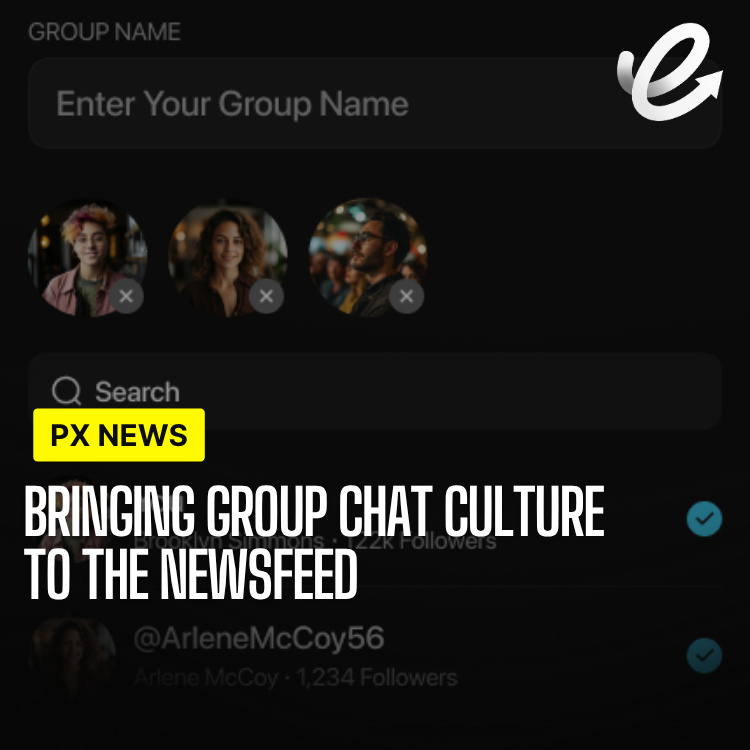
The intimate, conversational dynamics of group chats create more meaningful social interactions than traditional newsfeed structures. ETAPX integrates group chat cultural norms—immediate responses, ongoing conversations, and shared context—into broader social content sharing to create more engaging and personal community experiences across Whistlr.
Group chats succeed because they create intimate spaces for ongoing conversation among trusted participants. These conversations build shared context, inside jokes, and strong relationship bonds that traditional newsfeeds struggle to replicate at scale.
"Group chat culture proves that smaller, more intimate social interactions create stronger bonds than broadcast-style sharing. We're bringing that intimacy to larger social contexts without losing the personal connection."
— Dr. Sarah Kim, Social Interaction Designer, ETAPX
Why the Broadcast Feed Started Feeling Empty
For more than a decade, the dominant shape of social media was the broadcast feed: one person posts, an audience reacts, and the conversation rarely deepens beyond a scattering of likes. That model rewarded performance over participation. It made posting feel like publishing, and publishing carries pressure — the quiet anxiety of putting something polished in front of an audience and waiting to be judged.
Group chats never had that problem. Inside a group thread, no one is performing; everyone is just talking. The stakes are low, the replies are fast, and the running history of the conversation gives every message context. ETAPX's bet is that the warmth people feel in those small threads is not an accident of scale but a set of design principles that can be brought to larger spaces — if the platform is built to protect intimacy rather than dilute it.
Conversational Content Threading
ETAPX implements conversation threading that maintains context across multiple interactions, allowing community discussions to develop depth and continuity like group chat conversations. Users can follow ongoing discussions and contribute to evolving conversations rather than isolated interactions.
This threading system preserves conversation context while remaining accessible to new participants, bridging the gap between intimate group chats and open community discussions.
Shared Context and Community Memory
Community spaces develop shared context and collective memory similar to group chats, where members reference previous conversations, shared experiences, and ongoing community narratives. This shared context strengthens community bonds and creates insider knowledge that builds belonging.
The platform helps communities maintain and access their shared context through conversation history, reference linking, and community timeline features that preserve important moments and discussions.
"Shared context is what transforms groups of individuals into cohesive communities. Our systems help communities build and maintain the collective memory that creates strong social bonds."
— Kevin Park, Community Systems Engineer, ETAPX
The Mechanics of Group Chat Culture
What exactly makes a group chat feel different from a comment section? It comes down to a handful of subtle dynamics that, taken together, change how people behave. ETAPX has studied these patterns closely in order to translate them into the newsfeed without flattening them into generic features.
- Persistent presence: A group chat is always there, picking up where it left off, so participation feels continuous rather than transactional.
- Low-stakes contribution: Short, casual messages are welcome, which lowers the bar for jumping in and keeps conversation flowing.
- Reciprocal attention: People expect responses, and giving them is normal, so members feel seen rather than ignored.
- Accumulated history: The thread remembers, turning past exchanges into shared reference points and inside jokes.
- Trusted membership: A known set of participants creates safety, which encourages honesty over performance.
Immediate Response Culture
Group chat culture emphasizes immediate, informal responses that show engagement and acknowledgment. ETAPX brings this responsiveness to community interactions through quick reaction options, instant notifications, and low-friction response mechanisms.
This immediate response culture creates more dynamic, engaging community interactions where members feel heard and acknowledged, leading to stronger participation and community attachment.
Informal Communication Norms
The platform encourages informal, authentic communication styles characteristic of group chats rather than polished, performative posting. Community spaces feel conversational and accessible rather than competitive or judgmental.
These informal norms reduce barriers to participation while encouraging authentic self-expression and genuine community engagement. Users feel comfortable contributing to conversations without pressure for perfect presentation.
Small Group Dynamics at Scale
ETAPX creates small group dynamics within larger communities through features like conversation rooms, topic-specific discussions, and member clustering that maintain intimate interaction patterns while enabling community growth.
This approach allows communities to scale while preserving the personal connection and meaningful interaction that characterizes successful group chats.
The Challenge of Scaling Intimacy
There is an inherent paradox in growing something that draws its value from being small. Add too many people to a group chat and the warmth evaporates; conversations fragment, replies pile up faster than anyone can read, and the sense of a shared room dissolves into noise. The instinctive fix — simply capping group size — protects intimacy but caps community.
ETAPX's answer is to nest small spaces inside larger ones rather than choosing between them. A broad community can hold many smaller conversation rooms, each retaining the feel of a tight group while still belonging to the whole. Members move fluidly between the intimate and the open, getting the closeness of a small circle and the reach of a wider community without having to trade one for the other.
Real-World Use Cases
Group chat dynamics in the newsfeed are not an abstract design philosophy; they change how specific kinds of communities operate day to day.
- Hobby communities: Enthusiasts can carry on a running conversation about a shared interest, complete with the inside references that make a group feel like home.
- Local groups: Neighbors coordinating events or sharing updates get the immediacy of a chat with the discoverability of a community space.
- Creator audiences: A creator's most engaged followers can talk among themselves and with the creator, turning a passive audience into an active community.
- Support circles: People navigating a shared experience find a low-pressure space where short, honest messages are the norm rather than the exception.
Community Moderation and Safety
Group chat cultural norms include self-moderation and peer accountability that ETAPX adapts for larger community contexts. Members take responsibility for maintaining positive community culture while platform tools support conflict resolution and safety enforcement.
This community-driven moderation approach creates healthier social environments where members feel invested in maintaining positive interaction norms.
What This Means for the Future of Social
The migration of group chat culture into the open feed reflects a broader shift in what people want from social platforms. The era of chasing the largest possible audience is giving way to a desire for spaces that feel personal, responsive, and genuinely social. People are tired of shouting into a void; they want to be part of a conversation.
For ETAPX, that shift is a guidepost rather than a trend to chase. By treating intimacy as a first-class design goal — not a feature bolted onto a broadcast machine — the platform is building toward social experiences that reward connection over reach. The newsfeed of the future may look less like a stage and more like a room full of friends still talking.
"The metric that matters isn't how many people see a post—it's whether anyone felt like talking back. When the feed starts to feel like a conversation, people stop performing and start belonging."
— Dr. Sarah Kim, Social Interaction Designer, ETAPX
Frequently Asked Questions
How is group chat culture different from a normal comment section?
A comment section treats each response as a reaction to a post, while group chat culture treats the conversation itself as the point. ETAPX's threading, shared history, and immediate-response design make discussions feel continuous and personal rather than like isolated replies stacked under an announcement.
Can intimate conversations really work in a large community?
Yes, because ETAPX nests small spaces inside larger ones. A big community can contain many smaller conversation rooms that each preserve the closeness of a tight group, so members get intimacy and reach at the same time rather than having to choose between them.
Does bringing group chat dynamics to the feed make it noisier?
It is designed to do the opposite. Conversation threading keeps side discussions grouped, member clustering keeps rooms appropriately sized, and informal-but-structured norms help discussions stay legible as they grow, so participation feels lively rather than overwhelming.
How does moderation work in these more conversational spaces?
ETAPX leans on the same peer accountability that keeps healthy group chats healthy, supported by platform tools for conflict resolution and safety. Members are encouraged to take ownership of their community's culture, while the platform provides the controls needed to handle problems when they arise.