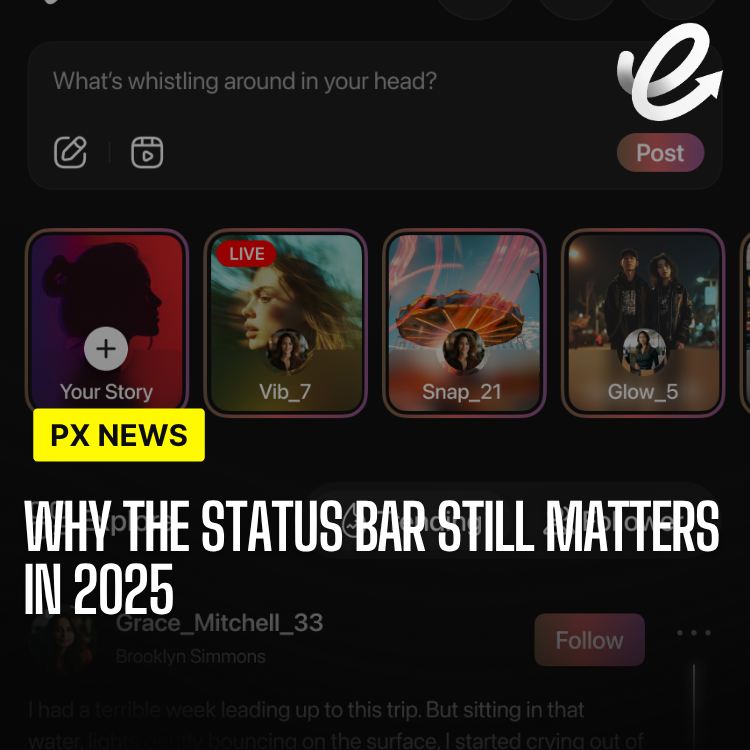
While the tech industry continues to embrace minimalism and clean interfaces, one element has quietly maintained its critical role in user experience: the status bar. As we navigate an increasingly complex digital landscape in 2025, these small but powerful indicators have become more important than ever for user confidence and platform transparency.
Status indicators serve as the digital equivalent of vital signs in medicine—small, often overlooked signals that communicate essential information about system health, connectivity, and user state. In social platforms like Whistlr, where real-time interaction is paramount, these indicators bridge the gap between user action and system response.
"Status bars are psychological anchors in our digital experiences. They provide the reassurance users need to trust that their actions are being processed, their connections are stable, and their content is being delivered."
— Maria Chen, Head of UX Research, ETAPX
The Psychology Of Status Communication
Research conducted by ETAPX's user experience team reveals that status indicators reduce user anxiety by 73% during content upload processes. When users share moments on Whistlr, the progression from "uploading" to "processing" to "live" creates a narrative of completion that transforms potential frustration into confidence.
The modern status bar extends beyond simple progress indicators. It now encompasses connection quality, battery optimization warnings, data usage alerts, and privacy mode confirmations. Each element serves as a micro-interaction that reinforces user control and system transparency.
Why Uncertainty Is The Real Enemy
Most of the frustration users feel with software is not caused by waiting; it is caused by not knowing. A three-second upload with a clear progress indicator feels fine, while a one-second upload with no feedback at all can feel broken. The human brain tolerates delay far better than ambiguity. When an action disappears into silence, people fill the void with worst-case assumptions: it failed, it froze, my post is gone.
The status bar exists to close that gap of uncertainty. By narrating what the system is doing, even in the smallest way, it converts a moment of doubt into a moment of confidence. This is why a well-designed status system can make an app feel faster than a competitor that is technically quicker but says nothing. Perceived performance is shaped as much by communication as by raw speed, and status indicators are the platform's primary voice in that conversation.
What A Modern Status Bar Communicates
The humble status bar now carries a surprising amount of information, each signal answering a question the user would otherwise have to wonder about.
- Action progress: The journey from uploading to processing to live, so users know their content is on its way.
- Connection quality: A real-time read on whether the network is stable, weak, or dropping, setting expectations before something fails.
- Data usage awareness: Alerts that help users on limited plans stay in control of how much bandwidth an action will consume.
- Battery considerations: Optimization warnings that flag when a heavy operation might drain the device.
- Privacy confirmations: Clear signals that a privacy mode or visibility setting is active, reinforcing user control.
Technical Implementation Challenges
Building effective status systems requires sophisticated backend architecture. ETAPX's implementation involves real-time WebSocket connections that provide millisecond-accurate updates across distributed server networks. The challenge lies in maintaining consistency while minimizing battery drain and data usage.
Our engineering team developed a smart batching system that consolidates status updates, reducing network calls by 85% while maintaining the real-time feel users expect. This innovation allows Whistlr to provide immediate feedback without compromising device performance.
"The most elegant status systems are invisible when working correctly but instantly noticeable when something goes wrong. That balance requires obsessive attention to edge cases and failure modes."
— David Park, Principal Engineer, ETAPX
Designing Status Indicators Well
Good status design is deceptively hard because the goal is to inform without intruding. A status system that shouts is as bad as one that stays silent. ETAPX's design team works from a handful of principles that keep indicators helpful rather than noisy.
- Be honest about failure: When something goes wrong, say so clearly and offer a path forward instead of a spinner that never resolves.
- Tell a story of completion: Break long operations into understandable stages so progress feels like movement toward a finish.
- Stay quiet when all is well: Reserve attention-grabbing signals for moments that genuinely need them, fading into the background otherwise.
- Adapt to context: Adjust the level of detail based on the user's device, connection, and history rather than treating every situation the same.
- Respect performance: Deliver real-time feedback without draining the battery or burning through data, because the indicator should never cost more than the action.
Future-Proofing Status Design
As we look toward emerging technologies, status indicators are evolving to accommodate new interaction paradigms. Voice interfaces require audio status cues, AR environments need spatial status visualization, and AI-assisted features demand transparent algorithm state communication.
ETAPX is pioneering adaptive status systems that adjust their communication style based on user context, device capabilities, and interaction history. This personalized approach ensures that status information enhances rather than clutters the user experience.
The future status bar will integrate seamlessly with ambient computing environments, providing contextual awareness without demanding focused attention. This evolution represents the maturation of interface design from attention-grabbing to ambient assistance.
Status Communication In An AI-Driven Interface
The rise of AI-assisted features adds a new and urgent reason for clear status communication. When an algorithm is working on a user's behalf, deciding what to surface, generating a suggestion, moderating a comment, the user is even more in the dark than during a simple upload. They cannot see the work happening, and without a signal they may not even realize it is happening at all. Transparent status becomes the bridge between an opaque system and a user who deserves to understand it.
This is why ETAPX treats algorithm state as something to be communicated rather than hidden. Showing when an AI feature is processing, what it is doing, and when it has finished turns a black box into a transparent collaborator. As more of the interface becomes intelligent, the status bar's role expands from reporting on the network to reporting on the machine's reasoning itself, keeping users informed and in control even as the underlying systems grow more sophisticated.
Frequently Asked Questions
Why does the status bar still matter when interfaces are getting simpler?
Because minimalism removes visual clutter but not the user's need to know what the system is doing. Status indicators reduce uncertainty, which is the real source of most frustration. Even in a clean interface, they remain the platform's primary way of reassuring users that their actions are working.
How do status indicators reduce user anxiety?
By replacing ambiguity with information. ETAPX research found that status indicators reduce user anxiety by a significant margin during uploads, because the progression from uploading to processing to live tells a clear story of completion rather than leaving the user to guess whether something failed.
Doesn't real-time status updating hurt battery and data usage?
It can if implemented naively, which is why ETAPX built a smart batching system that consolidates updates and dramatically reduces network calls while preserving the real-time feel. The principle is that an indicator should never cost more than the action it describes.
What information does a modern status bar actually convey?
Far more than a progress spinner. It communicates action progress, connection quality, data usage, battery considerations, and privacy confirmations, each answering a question the user would otherwise have to wonder about.
How are status indicators changing for AI and voice interfaces?
They are expanding to report on more than the network. AI features need transparent communication of algorithm state, voice interfaces need audio cues, and AR environments need spatial visualization. ETAPX is building adaptive status systems that adjust their style to context, device, and interaction history.