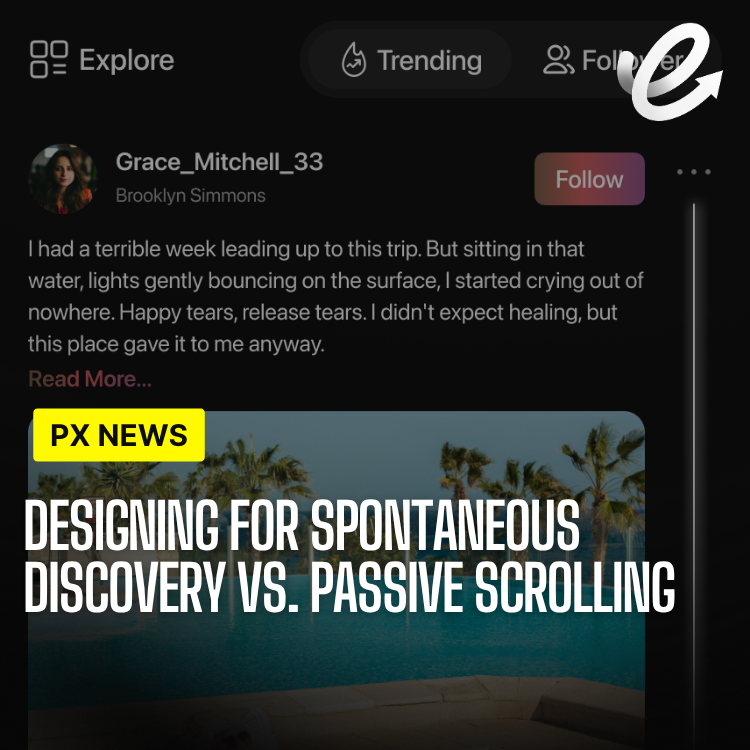
User interface design can either encourage active exploration and meaningful discovery or promote mindless consumption and passive scrolling. ETAPX's design philosophy prioritizes interfaces that inspire curiosity, reward engagement, and create opportunities for serendipitous discovery over addictive infinite scroll mechanisms. The choice between those two paths isn't cosmetic—it determines whether a platform leaves people feeling enriched or merely emptied of an hour they won't get back.
Traditional social media interfaces optimize for time spent through infinite scroll feeds that encourage passive consumption. This design approach can create addictive usage patterns while reducing the quality of user attention and engagement with content.
"Good design makes users active participants in their digital experience rather than passive consumers. When users feel agency and curiosity, they have better experiences and form stronger connections."
— Dr. Maria Chen, Director of User Experience Design, ETAPX
The Hidden Cost of Infinite Scroll
Infinite scroll was one of the most consequential interface decisions in the history of social media, and its genius was also its problem. By removing every natural stopping point, it turned browsing into a frictionless slide that the brain struggles to interrupt. There is always one more item, and the absence of an edge makes "just a little longer" the default rather than a decision.
The result is a peculiar kind of dissatisfaction. Users emerge from long scrolling sessions unable to recall most of what they saw, vaguely aware that the time produced little and connected them to no one. The interface succeeded at its narrow goal—maximizing time on screen—while quietly failing the person using it. Designing for spontaneous discovery begins by treating that outcome as a failure rather than a metric to celebrate.
Breaking the Infinite Scroll Pattern
ETAPX implements deliberate stopping points, content variety, and engagement prompts that interrupt passive scrolling and encourage intentional interaction. Users encounter natural break points that create opportunities for reflection and decision-making about continued engagement.
These design interventions respect user agency while creating more mindful usage patterns. Users report feeling more satisfied with their platform time when interfaces provide natural conclusion points rather than endless content streams.
Curiosity-Driven Interface Elements
Interface design includes elements that spark curiosity and encourage exploration: mystery content previews, interactive discovery tools, and progressive revelation of information that rewards user engagement with deeper insight or exclusive content.
These curiosity-driven elements transform passive consumption into active exploration, creating more engaging and memorable user experiences while reducing the mindless scrolling that characterizes addictive social media usage.
"Every interface element asks: does this encourage thoughtful engagement or mindless consumption? We consistently choose designs that respect user attention and promote intentional interaction."
— Jordan Liu, Senior UX Engineer, ETAPX
How Discovery-First Design Works
Designing for discovery rather than consumption isn't about making a platform harder to use—it's about making it more rewarding to engage with. The mechanics center on giving the user choices and surfacing moments worth stopping for, rather than removing every reason to stop.
- Deliberate stopping points: Natural break moments give users a chance to decide whether to continue rather than sliding past the decision entirely.
- Progressive revelation: Information unfolds in response to engagement, rewarding curiosity with depth instead of dumping everything into a passive scroll.
- Interactive discovery tools: Topic exploration, community browsing, and filters let users steer their own path through content.
- Context-aware surfacing: Content appears when it's actually useful to a user's situation, not just when it's newest or most engaging.
- Quality-forward presentation: Fewer items shown with richer context help users choose intentionally rather than drown in volume.
Contextual Content Organization
Content organization based on user context, interests, and current needs creates more relevant discovery experiences than chronological or purely algorithmic feeds. Users encounter content when it's most useful rather than when it's most recent or engaging.
This contextual approach reduces information overload while increasing the value of discovered content. Users find relevant information and connections when they need them rather than competing for attention in overwhelming content streams.
Interactive Discovery Mechanisms
ETAPX provides interactive tools for content discovery that require user input and choice: topic exploration interfaces, community browsing tools, and filtered discovery options that put users in control of their exploration process.
These interactive mechanisms create more intentional discovery experiences where users actively choose their exploration direction rather than passively consuming algorithmically selected content.
Quality Over Quantity Presentation
Interface design emphasizes content quality over quantity, presenting fewer items with more context, richer preview information, and clear value propositions rather than overwhelming users with extensive content lists.
This quality-focused approach helps users make informed decisions about content engagement while reducing the cognitive load associated with processing large amounts of information during discovery sessions.
Spontaneous Discovery vs. Passive Scrolling
The two models can look superficially similar—both involve moving through content on a screen—but they pull the user in opposite directions. Passive scrolling is something that happens to a person; spontaneous discovery is something a person does.
- Direction of control: Scrolling is steered by the feed; discovery is steered by the user.
- Goal: Scrolling optimizes for time on screen; discovery optimizes for value found.
- Mental state: Scrolling lulls; discovery engages.
- Aftertaste: Scrolling leaves a vague emptiness; discovery leaves something worth remembering.
- Relationship to attention: Scrolling extracts attention; discovery rewards it.
Who Discovery-First Design Is For
Discovery-first design serves the user who has grown suspicious of their own habits—the person who notices they pick up their phone for a reason and put it down forty minutes later having forgotten what it was. It's for people who want their time online to feel chosen rather than captured.
It also serves the broader community and the creators within it. When users explore intentionally, they engage more deeply with what they find, which means thoughtful content and niche communities get a fairer shot than they do in a feed optimized purely for whatever holds eyeballs longest. A platform built for discovery rewards the people making things worth discovering.
"On other apps I'd lose an hour and have nothing to show for it. Here I actually go in looking for something, find it, and put my phone down feeling fine about it. It's the difference between a tool and a trap."
— Theo M., Whistlr user
User Agency and Control Features
The platform provides extensive user control over discovery experiences: customizable interface layouts, discovery algorithm transparency, and preference settings that adapt to changing user needs and interests over time.
This user agency creates ownership and investment in the discovery process, leading to more satisfying experiences and better long-term platform relationships.
Best Practices for Intentional Browsing
A discovery-first platform gives users the controls; getting the most from them is a matter of a few simple habits.
- Enter with intent: Open the app with a sense of what you're looking for, even loosely, rather than out of pure reflex.
- Use the discovery tools: Lean on topic exploration, filters, and community browsing to steer instead of drifting through a default stream.
- Honor the stopping points: Treat natural break moments as genuine decision points about whether to continue.
- Tune your preferences: Adjust settings as your interests change so discovery keeps surfacing what matters to you.
- Engage, don't just consume: Acting on what you find—following, joining, responding—turns browsing into something that builds on itself.
Measuring Discovery Success
ETAPX measures discovery success through user satisfaction, depth of engagement, and meaningful action outcomes rather than time spent or content consumption volume. These metrics align platform success with user value rather than attention extraction.
Success metrics include: follow-up actions taken after discovery, reported satisfaction with discovered content, and long-term relationship formation through discovery experiences. These quality metrics guide continued interface development.
Frequently Asked Questions
What is spontaneous discovery in interface design?
Spontaneous discovery is a design approach that encourages users to actively explore and find content worth their attention, rather than passively consuming an endless feed. It emphasizes curiosity, user choice, and serendipitous, rewarding moments over mindless scrolling.
Why is infinite scroll considered a problem?
Infinite scroll removes natural stopping points, making browsing hard to interrupt and easy to overdo. Users often emerge from long sessions unable to recall what they saw and feeling that the time produced little value or connection.
Does discovery-first design make a platform harder to use?
No. It aims to make the platform more rewarding, not more difficult. By giving users control and surfacing genuinely relevant content, it replaces aimless scrolling with intentional, satisfying exploration.
How does ETAPX measure whether discovery is working?
Rather than tracking raw time on screen, ETAPX measures user satisfaction, depth of engagement, follow-up actions taken after discovery, and long-term relationships formed. These metrics align the platform's success with the user's value.
Can I still browse casually, or do I have to search for something specific?
You can absolutely browse casually. Discovery-first design simply gives that browsing more shape—through interactive tools, context-aware surfacing, and natural break points—so even casual exploration tends to feel chosen rather than compulsive.
Designing for spontaneous discovery creates more engaging, satisfying, and valuable user experiences than passive scrolling optimization. Interfaces that respect user agency and encourage active exploration build stronger, more sustainable platform relationships.