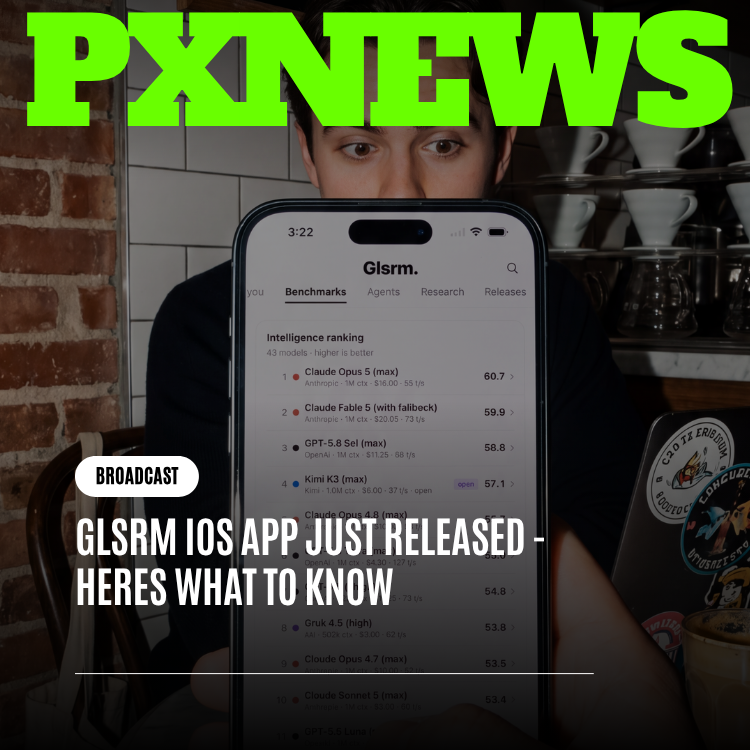
GLSRM has a native iOS app, and it's live today — the first time ETAPX's "front page of AI" has ever left the browser. GLSRM was built as a web-only product from day one: a live newsfeed for the AI industry, Data Pulse stats, cinematic Releases coverage, model Benchmarks, Watch, and Circuits, all tied together into one place people go to understand what's happening in AI right now. That worked well as a website. It works even better as something that lives on your home screen, buzzes when something you're tracking actually happens, and opens in under a second when you just want to check what you missed. This is the story of why the GLSRM iOS app got released now, what it actually lets you do, and how to get the most out of it starting today.
Why GLSRM Needed to Get Off the Browser Tab
AI news doesn't wait for you to be at your laptop. A frontier lab drops a new model at 6:47 a.m. A benchmark leaderboard reshuffles mid-afternoon while you're in back-to-back meetings. A creator you follow in Circuits posts a take on a release that's still developing. None of that respects the shape of a workday, and none of it waits for you to remember which of your forty open browser tabs has GLSRM pinned to it. That mismatch — a product covering an industry that moves by the hour, built for a device you only use at a desk — was the core problem the GLSRM iOS app was built to solve.
GLSRM was designed from the start to be fast-moving: a live feed, not a static page you check once a week. But "live" only means something if you're actually there to see it. A browser tab, however well built, is passive. It waits for you to open it. It doesn't tap you on the shoulder when a model you're watching gets a new release, and it definitely doesn't survive you closing your laptop, switching networks, or just walking away from your desk for the afternoon. The GLSRM iOS app flips that relationship. Instead of you remembering to check GLSRM, GLSRM can now reach you — a real push notification on your phone the moment something you're following actually happens.
That shift matters more for GLSRM than it would for almost any other kind of product, precisely because of what GLSRM covers. Nobody needs a real-time alert the moment their grocery list updates. People absolutely want to know the instant a benchmark leaderboard changes, or a lab they follow ships something new, or a Circuit they're part of lights up with discussion about a release that's still unfolding. GLSRM's entire value proposition is currency — being the place where you're not behind on AI. An app that lives in your pocket and can notify you the second something changes is simply a more honest way to deliver on that promise than a website ever could be.
It's also worth being clear about what wasn't required to make this possible: no new backend, no rearchitecting of how GLSRM tracks the industry, none of that is the story here. The story is entirely about where GLSRM lives and how it reaches you. The same live feed, the same coverage, the same Circuits communities — just no longer boxed into a browser window that has to be open and in focus for any of it to reach you in the moment it happens.
What's Actually Released Today
The GLSRM iOS app is live now on the App Store, and it isn't a stripped-down mobile viewer bolted onto the existing web product. It's the complete GLSRM experience, rebuilt to feel native on a phone — every section that exists on the web is here, tuned for a screen you hold in one hand and check in short bursts throughout the day.
- Live newsfeed: The same scrolling, constantly updating feed of AI industry news that anchors GLSRM on the web, now reachable in a single tap from your home screen instead of a bookmark you have to hunt for.
- Data Pulse: GLSRM's at-a-glance industry stats, redesigned for a phone screen so you can scan the numbers that matter in the time it takes to wait for a coffee order.
- Releases: GLSRM's cinematic coverage of new model and product releases, built to actually feel like an event when something significant ships — not a headline buried in a scroll.
- Benchmarks: The model leaderboards GLSRM tracks, now something you can pull up and compare in the middle of a conversation about which model to use for a task, instead of something you look up later.
- Watch: GLSRM's video and clip coverage, ready to play the moment you have a spare minute, wherever you happen to be.
- Circuits: The community layer of GLSRM — the conversations, takes, and discussion happening around what's moving in AI — now something you can drop into and out of between other things, the way you'd check any other app you actually care about.
- Native push notifications: Follow a model, a lab, a Circuit, or a topic, and the app will tell you the moment something changes, instead of leaving you to remember to go check.
- One account, fully synced: Sign in with the same account you already use for GLSRM on the web, and everything you follow, save, and read carries over instantly — pick up on your phone exactly where you left off on your laptop.
Built Around How People Actually Check AI News
None of that list was assembled from a whiteboard exercise about what a mobile app "should" have. It came from watching how people were already using GLSRM on the web, in ways the browser was never quite built to support. People pulling up GLSRM on their phone's mobile browser anyway, squinting at a layout designed for a wider screen. People checking Benchmarks mid-conversation to settle an argument about which model was actually ahead that week. People wanting to glance at Releases the second they heard something dropped, rather than waiting until they were back at a desk. The web product was never unwilling to do any of that — it just wasn't built for a phone, and it showed. The iOS app exists specifically to stop making people work around that gap.
"GLSRM was always meant to be the place you go to know what's happening in AI, not the place you go to catch up on what already happened. Those are two very different products, even if they sound similar. A website is fundamentally a catch-up device — you go to it when you remember to. A phone app with real notifications is a right-now device — it can come to you. We built GLSRM to be a live feed from day one, and until today, it was living in the one place that couldn't actually deliver on that promise in real time. That's what changes with this release."
— AJ, Founder & CEO, ETAPX
That distinction — a catch-up device versus a right-now device — is really the whole thesis behind releasing a native iOS app for GLSRM in the first place. The web app isn't going away, and it isn't getting worse. It's still the fullest, widest-screen way to dig into GLSRM's coverage. But for the specific job of not missing something the moment it happens, a phone in your pocket beats a laptop in your bag every single time, and GLSRM's iOS app is built entirely around that specific job.
How GLSRM's iOS App Is Different From Influxx's Native Apps
ETAPX shipped native macOS and iOS apps for Influxx, its flagship agentic environment, earlier this year. It's worth being clear about how the GLSRM iOS app relates to that release, because the two products are solving genuinely different problems even though they now share a similar milestone. Influxx's native apps exist so that agentic work — tasks you've handed off, check-ins that need your input — keeps running and reaches you whether or not a browser tab is open. GLSRM's iOS app exists so that a live newsfeed for the AI industry can actually behave like a live newsfeed, reaching you the moment something changes instead of waiting for you to remember to look.
Put simply: Influxx's native apps are about work that's already in motion needing you at the right moment. GLSRM's iOS app is about an entire industry moving constantly and you wanting to stay caught up on it without being chained to a desk. Different products, different jobs, same underlying idea — that living exclusively inside a browser tab was always going to be a ceiling, not a permanent home, for anything that needs to reach people in real time.
What to Know: Getting the Most Out of the GLSRM iOS App
Downloading the app and opening it once will get you the newsfeed, Data Pulse, Releases, Benchmarks, Watch, and Circuits immediately — none of that requires any setup. But the feature that actually changes how you use GLSRM day to day is notifications, and it's worth spending two minutes getting that part right the first time you open the app.
Set Up What You Actually Follow
The default experience is already useful, but GLSRM's iOS app is built to be personal. Follow the specific models, labs, and topics you actually care about, and follow the Circuits where the conversations you want to be part of are happening. The app's notifications are only as good as what you tell it to watch — someone tracking frontier model releases and someone tracking open-source tooling should end up with two very different phones buzzing at two very different moments, and that's by design.
Turn Notifications On Deliberately, Not Broadly
It's tempting to enable every notification category on first launch just to see what happens. Resist that for a day. Start with Releases and Benchmarks notifications for whatever you're personally following, see how that feels for a day or two, and then layer in Circuits notifications once you've found the communities that are actually worth a real-time nudge. An app that respects your attention is more useful long-term than one that shouts at you constantly, and GLSRM's notification settings are granular enough to let you tune that balance yourself.
Use It the Way It's Actually Built For
The GLSRM iOS app isn't trying to replace a long, focused reading session on a laptop — the web app is still the better tool for that. What it's built for is the in-between moments: the elevator ride, the five minutes before a meeting starts, the walk to get coffee. Check the newsfeed there. Glance at Data Pulse there. Let a Releases notification pull you in the moment it lands. Then, if something genuinely deserves a longer look, pick it back up on the web later — your account, your follows, and your read history are all synced, so nothing is lost by moving between the two.
Let Circuits and Watch Fill the Small Moments
The newsfeed and notifications will likely be what pulls most people into the GLSRM iOS app first, but it's worth deliberately spending time in Circuits and Watch once you've settled in. Circuits is where the actual discussion around a release happens — the disagreements, the early hands-on impressions, the context that a headline alone never captures — and it reads differently on a phone, where dropping in for two minutes between other things feels natural in a way that opening a laptop specifically to check a community feed rarely does. Watch works the same way: a short clip queued up and ready the moment you have a spare minute is a much lower bar to clear than remembering to sit down and watch something later, and most people never do.
"I work in a job where I genuinely cannot be on my laptop most of the day, so I used to just accept that I'd find out about a model release six or eight hours after everyone else already had. The morning after I installed the GLSRM iOS app, a release notification hit my phone during a meeting I couldn't step out of, and I still knew about it before three separate group chats mentioned it later that afternoon. That's the whole reason I wanted this app, and it delivered on exactly that within a day."
— Marcus Feldman, GLSRM user since the iOS release
Why This Matters for Anyone Trying to Keep Up With AI
The AI industry doesn't operate on a predictable news cycle. There's no evening broadcast, no weekly digest that captures everything that matters. Releases happen at odd hours across time zones. Benchmark results get published, get disputed, and get revised, sometimes within the same day. Communities form opinions in real time in places like Circuits, and being part of that conversation as it's happening is a genuinely different experience than reading a summary of it after the fact. For anyone whose job, curiosity, or career depends on not falling behind in AI — and at this point that's a very large and growing group of people — the cost of finding things out late isn't hypothetical. It's the difference between being part of a conversation and catching up on one that's already moved on.
A native iOS app addresses that in a way a website structurally cannot, no matter how well the website is built. Websites require you to remember to visit them. Even a great one, bookmarked and pinned, is still something you have to think to open. An app on your home screen with real push notifications inverts that entirely — GLSRM can now be the one doing the remembering. You don't have to build a habit of checking AI news throughout the day. The app can simply tell you when there's something worth checking, and let you get back to whatever you were doing the rest of the time.
There's also a simpler, less philosophical reason this matters: friction. Every extra step between "something happened in AI" and "I know about it" is a chance for you to find out later, secondhand, from somewhere else — a group chat, a colleague, a headline days after the fact. Removing steps compounds. A phone that's already in your hand, an app that opens instantly, a notification that arrives without you asking for it — each of those shaves off a little bit of the delay between an event happening and you knowing about it. Stack enough of that removed friction together and the difference isn't small. It's the difference between being current and being behind, and GLSRM's iOS app exists specifically to put you on the right side of that line.
What's Next for GLSRM on Mobile
Today's release is GLSRM's first native app, not its last update. The team's near-term focus is on tightening what's already live — sharper notification controls so people can dial in exactly what reaches their phone and when, deeper personalization of the newsfeed based on what someone actually follows and reads, and continued investment in making Benchmarks and Releases feel as immediate on a phone screen as they do on the web. An Android version isn't part of today's announcement, and ETAPX isn't pretending otherwise — the priority was getting iOS right first rather than splitting effort across platforms before either was solid. What's said publicly about additional platforms will wait until there's something real to say.
What won't change is the underlying idea this release is built on: GLSRM is a live feed for an industry that never really stops moving, and a live feed only earns that name if it can actually reach people the moment something happens. A website could describe itself that way. A phone in your pocket, with a notification landing at the right second, is what actually proves it.
Frequently Asked Questions
Is the GLSRM iOS app available now?
Yes. The GLSRM iOS app has officially released and is live on the App Store today, available to download on any iPhone. This is GLSRM's first native app — until this release, GLSRM was a web-only product.
Do I need a new account to use the GLSRM iOS app?
No. Sign in with the same ETAPX account you already use for GLSRM on the web, and everything carries over immediately — the models, labs, and topics you follow, your Circuits activity, and your reading history all sync automatically between the web app and the iOS app.
What can I actually do in the GLSRM iOS app that I couldn't do before?
Everything GLSRM offers on the web is in the iOS app — the live newsfeed, Data Pulse stats, Releases coverage, Benchmarks leaderboards, Watch, and Circuits — plus one thing the web app structurally couldn't do: native push notifications that reach you the moment something you follow actually happens, rather than requiring you to remember to check a browser tab.
Does the GLSRM iOS app replace the website?
No. The GLSRM website isn't going anywhere and remains the best option for longer, more focused reading sessions on a bigger screen. The iOS app is built for a different job — quick checks and real-time notifications throughout the day — and the two are meant to be used together, fully synced through one account.
Is a GLSRM Android app coming?
Nothing is being announced today. ETAPX has said the priority with this release was getting the iOS app right first, and that decisions about additional platforms will be shared when there's something concrete to announce.
GLSRM's iOS app is released, live, and free to download today — the first time the front page of AI has ever fit in a pocket instead of a browser tab, and, based on how quickly early users have started leaning on it, likely not the last mobile milestone GLSRM has this year.