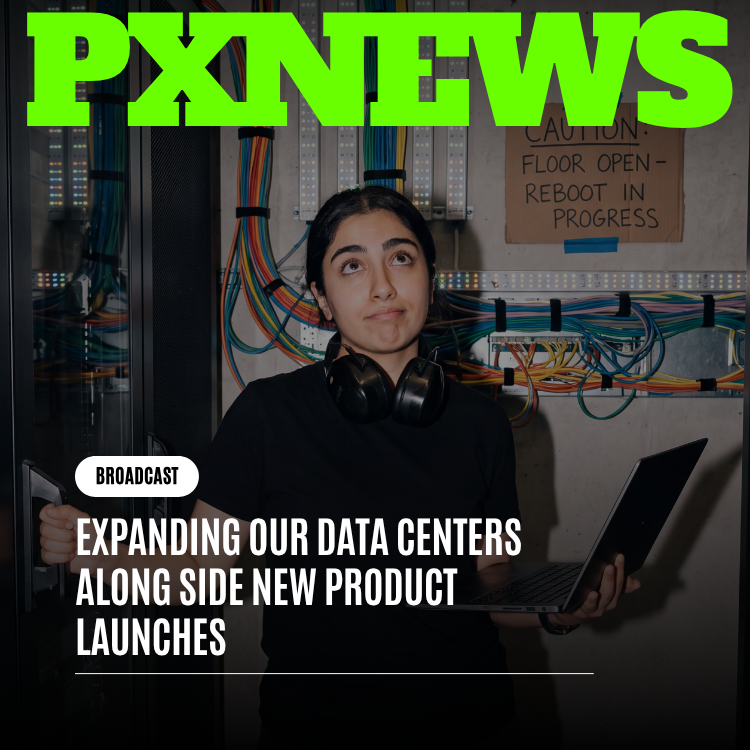
ETAPX is expanding its data centers to keep pace with a company that is now building and scaling four products at once. As Whistlr, GLSRM, Ocsidian, and Influxx each grow their audiences and ship more ambitious releases, the systems running underneath all four need more room to work with — not eventually, but now, and on an ongoing basis from here forward. This investment is deliberately front-loaded: rather than waiting until growth strains what already exists, ETAPX is adding capacity ahead of the new product launches already on the calendar. The goal is straightforward and, we'd argue, refreshingly unglamorous — every product should feel just as fast and dependable on a record-breaking day as it does on a quiet one, no matter how many people show up or how much any single product asks of the systems behind it.
Why We're Expanding Our Data Centers Now
There's a simple business reality behind this announcement: ETAPX has more users, more products, and more usage than it did a year ago, and the trend line points the same direction for the year ahead. Whistlr continues to add new members and communities. GLSRM has grown from a new idea into a daily habit for a meaningfully larger audience. Ocsidian keeps attracting creators building projects that used to require a full studio. And Influxx, our flagship agentic environment, is asking more of the systems behind it every time someone hands it a bigger task. Individually, any one of those growth curves would be reason enough to invest in more capacity. Arriving together, at the same time, they make expansion a necessity rather than an option.
Timing matters here as much as the decision itself. ETAPX doesn't have one product launch on the horizon — it has several, spread across four different products, each with its own audience and its own usage pattern. Expanding our data centers now is how the company makes sure those new product launches arrive on top of a foundation that's already sized for what they'll need, instead of a foundation that finds out the hard way once real usage shows up. It's the difference between renting a bigger space before the move-in date and signing the lease the week the boxes arrive.
This is also consistent with how ETAPX has approached growth from the beginning. The company has never treated "more users" as a problem to solve after it happens. Growth is something ETAPX plans for the way any disciplined business plans for growth: by looking at where the lines are heading and making sure the foundation is ready before demand actually gets there, not after.
Four Products, One Shared Foundation
Whistlr, GLSRM, Ocsidian, and Influxx are four distinct products built for four different reasons, but they don't run on four separate promises to their users. Whoever opens Whistlr to check a group chat, GLSRM to see what's happening in AI, Ocsidian to keep building a game, or Influxx to hand off a task expects the same basic thing: it works, it's fast, and it's there when they need it. Expanding data center capacity is how ETAPX keeps that promise consistent across a portfolio that's growing in four directions simultaneously, rather than one.
That shared foundation is also why this investment isn't a one-time reaction to a single product's success. If only one product were growing, the calculus might be simpler — size up, ship, move on. But ETAPX is in the unusual position of having four products growing together, each adding its own demand on top of the others at the same time. Planning capacity for that kind of combined growth takes a wider lens than planning for any single launch, and it's exactly the kind of planning a company should be doing quietly, well before anyone using the products ever needs to notice it.
Influxx and the Weight of Always-On Agents
Influxx is the clearest example of why this generation of products asks something different of the systems behind them. A traditional app mostly waits for a person to do something — open it, tap something, scroll. Influxx is built around agents that keep working on a task after someone hands it off, which means the underlying demand doesn't fully go quiet just because a person closed the tab. As more people rely on Influxx for heavier, longer-running work, that pattern adds up differently than a typical spike in app opens. It's less like more people walking into a store and more like more people leaving something running in the back room — steady, ongoing, and cumulative in a way that rewards planning ahead rather than reacting in the moment.
GLSRM and a Feed That Never Really Idles
GLSRM carries a similar dynamic from a different angle. It's built to track a fast-moving industry continuously, which means it's doing meaningful work around the clock regardless of how many people happen to be looking at it in any given moment — and that baseline only grows heavier as its audience and its coverage both expand. Layer a growing readership on top of that always-on foundation, and the combination compounds in a way a slower-moving, browse-and-close product simply wouldn't. Between Influxx's agentic workloads and GLSRM's always-on nature, ETAPX is supporting two products whose demand looks meaningfully different from a typical app — which is exactly why capacity planning has to look ahead rather than react to last month's numbers.
The Discipline of Planning Capacity Ahead of Growth
Expanding capacity ahead of demand is a discipline, not a reflex. It would be easy, and cheaper in the short term, to wait until a product's growth actually strains what's already in place, and only then invest in more room. Plenty of companies operate that way, and plenty of companies pay for it in the exact moments when they can least afford to: a launch day, a viral moment, the week a new feature lands and everyone wants to try it at once. ETAPX has chosen the harder, less flashy path instead — building out data center capacity before it's strictly needed, on the theory that the cost of being early is almost always smaller than the cost of being late.
That theory shapes how the company actually approaches the decision, in practice, on an ongoing basis:
- Forecast before the need arrives: Capacity decisions are made by looking at where Whistlr, GLSRM, Ocsidian, and Influxx are heading over the coming months, not by watching a dashboard until it turns red.
- Headroom is the point, not the byproduct: ETAPX plans for more than the expected case, on purpose, so that a stronger-than-expected launch is a good problem rather than an emergency.
- Growth is reviewed as a portfolio: Because four products are growing at once, capacity planning looks at combined demand across the whole company, not just one product's forecast in isolation.
- Investment lands ahead of the announcement: The capacity behind a new product launch is put in place before that launch goes public, not assembled in a hurry after the fact.
- Reliability is treated as a feature: Staying fast and available through growth is planned with the same seriousness as anything on the product roadmap, because to the people using the product, it effectively is one.
Why Reactive Scaling Is a Trap
Reactive scaling looks fine for a while and then fails at the worst possible time — precisely when a product is having its best moment. A new feature travels further than expected, a launch gets more attention than the team projected, a quiet product suddenly isn't quiet anymore, and if the underlying capacity was sized for yesterday's usage, the first thing users notice about a company's big moment is that it couldn't quite handle it. That's an expensive way to learn a lesson that capacity planning is designed to teach in advance instead. ETAPX would rather spend on room it grows into over several months than spend on a scramble it has to explain after the fact.
"The easiest infrastructure mistake to make is a quiet one: you wait to invest until the numbers tell you that you have to. By then you're not planning anymore, you're recovering. We'd rather be a step ahead of our own growth than a step behind it — that's the whole philosophy behind expanding now instead of waiting for four products' worth of demand to arrive at once and ask us to explain ourselves."
— John Ridge, CTO, ETAPX
What Expanded Capacity Means for the People Using Our Products
None of this is meant to be a story users have to think about, and that's by design. The entire point of expanding our data centers now is so that the people using Whistlr, GLSRM, Ocsidian, and Influxx never have a reason to notice it happened. In practice, that shows up as an absence rather than a presence: the absence of slowdowns during a busy evening, the absence of a sluggish feed the day a new feature ships, the absence of a task in Influxx that stalls because the system behind it is stretched thinner than it should be.
- Consistency during growth: The experience on an ordinary Tuesday and the experience on a record-breaking day should feel the same.
- Room for heavier workloads: As Influxx takes on longer, more complex agentic tasks, the foundation underneath it is sized to keep up rather than fall behind.
- Stability during launches: New product launches and feature releases land on a foundation that was already prepared for extra attention, not one hoping it holds.
- Fewer surprises, not just faster products: The measure of success here is less "did it get faster" and more "did it stay steady," even as far more people and far more products lean on it.
That's the real deliverable of this investment. Speed matters, but consistency matters more — a product that's occasionally very fast and occasionally struggling is a worse experience than one that's reliably good every time. Expanding capacity ahead of growth is how ETAPX protects the second kind of experience as the default, across all four products, as more people arrive and as each product asks more of the systems behind it.
The Business Case for Investing Ahead of Demand
There's a straightforward business argument underneath the reliability argument, and it's worth stating plainly: trust is the hardest thing ETAPX has built across Whistlr, GLSRM, Ocsidian, and Influxx, and it's disproportionately easy to spend down. A person who has a rough experience during a product's biggest moment doesn't file that away as an isolated hiccup — they file it away as a reason to expect less next time. Capacity invested ahead of growth is, in that sense, a direct investment in the thing that took years to build and would take far longer to rebuild.
There's also a simpler capital-allocation argument. Building capacity ahead of need costs money on a predictable schedule the company controls. Building it reactively costs more, on a schedule set by whichever product happens to be having its best week, with far less room to plan around it. Treating this as planned investment rather than emergency spending is, in the most literal business sense, the cheaper way to grow — even though it requires spending earlier than strictly necessary, which is exactly the kind of decision that looks unremarkable when it works and looks obviously correct in hindsight on the day it doesn't.
"Every dollar we put into capacity before we strictly need it is a dollar spent on not having an emergency later. That trade is almost always worth making. We've got four products growing at the same time and more launches ahead of all of them — the boring, disciplined move is to make sure the foundation is ready before the growth shows up, not after."
— AJ, Founder & CEO, ETAPX
None of this is framed internally as glamorous, and it isn't meant to be. It's framed as maintenance of the thing that actually matters most across the portfolio — the confidence that whatever ETAPX ships next will land on solid ground.
How This Sets Up What's Next
This expansion isn't tied to a single launch, and that's intentional. It's meant to underwrite a period where Whistlr, GLSRM, Ocsidian, and Influxx are each shipping meaningfully more often than they used to, to meaningfully larger audiences. The company isn't sizing capacity for the next release; it's sizing it for a stretch of new product launches across four products at once, because that's a more accurate picture of what's actually ahead.
That's also why this is being announced as a business decision rather than folded quietly into a product changelog. Expanding data center capacity doesn't ship a new button or a new screen, but it's just as load-bearing as any feature launch this year — arguably more so, since it's what makes every other launch land the way it's supposed to. Treating it with the same visibility as a product announcement is a small signal of how seriously ETAPX takes the foundation everything else depends on.
Looking ahead, this is a pattern ETAPX intends to keep, not a one-time correction. As Whistlr, GLSRM, Ocsidian, and Influxx keep growing — individually and as a connected ecosystem — capacity planning will keep running ahead of that growth on a rolling basis, reassessed regularly rather than revisited only when something forces the question. Expansion, in other words, isn't a single project with an end date. It's a standing commitment that scales alongside everything else the company builds.
Frequently Asked Questions
Why is ETAPX expanding its data centers right now?
Because growth across Whistlr, GLSRM, Ocsidian, and Influxx has reached a point where all four products need more room at the same time, and because several new product launches are already planned across those products in the months ahead. Expanding now means that capacity is ready before those launches arrive, rather than being addressed after usage has already outgrown what's in place.
Is this expansion in response to an outage or a specific problem?
No. This is a proactive investment tied to growth and to upcoming new product launches, not a reaction to an incident. The entire premise of planning capacity ahead of demand is to make sure ETAPX never has to have this conversation as a response to something going wrong.
Will Influxx and GLSRM be affected differently than Whistlr and Ocsidian?
The four products place different kinds of demand on the systems behind them. Influxx's agentic workloads and GLSRM's always-on, AI-native coverage tend to run more continuously than a typical app, so they factor heavily into how ETAPX plans ahead. The expanded capacity is sized with all four products in mind, including the heavier, steadier demand that Influxx and GLSRM create as they grow.
Will users notice any changes because of this expansion?
Ideally, the only thing users notice is that nothing changes — that Whistlr, GLSRM, Ocsidian, and Influxx stay just as fast and reliable as more people join and as each product ships more often. Success here looks like consistency rather than a new visible feature.
How does this fit into ETAPX's broader growth plans?
It's the foundation underneath them. As ETAPX continues to grow its user base and ship new product launches across Whistlr, GLSRM, Ocsidian, and Influxx, capacity planning will keep running ahead of that growth on an ongoing basis, so reliability never becomes something the company has to catch up on later.
Expanding our data centers isn't a headline most companies get excited to write, and that's fine — it isn't supposed to be exciting. It's supposed to be dependable, the same way Whistlr, GLSRM, Ocsidian, and Influxx are supposed to be dependable for the people who use them every day. As ETAPX keeps growing and keeps shipping new product launches across all four, this is the quiet work that makes sure the exciting parts get to stay exciting, without anyone ever having to think about what's running underneath them.