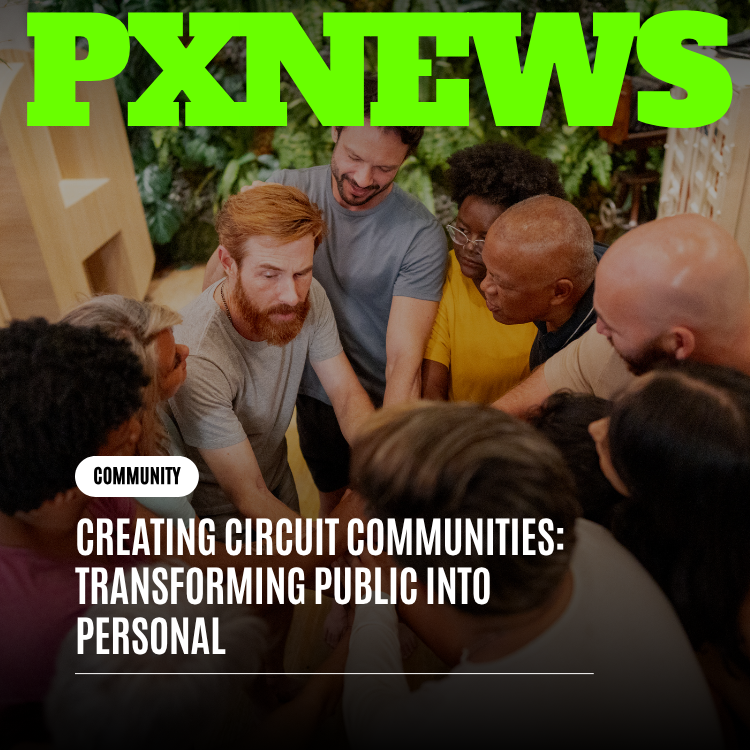
Every broad interest online eventually turns into a crowd, and every crowd eventually stops feeling like anywhere in particular. Circuits, Whistlr's home for interest-based communities, exists to reverse that math: it takes a topic millions of people technically share and breaks it into SubCircuits — small, self-contained communities where the same interest feels personal again. Here's how that public-to-personal transformation actually works, why it's a deliberate design choice rather than an accident of growth, and how to find or start the SubCircuit where your own broad interest becomes a real community.
The Trouble With Public
Say you care about basketball, or houseplants, or true crime. On most platforms, that interest routes you into the biggest possible bucket: a hashtag, a general feed, a topic page shared with millions of people who technically like the same thing. It feels efficient. In practice, it's closer to shouting into a stadium and hoping someone specific hears you back — public, at that scale, isn't a room, it's a broadcast, and broadcasts don't have conversations. They have audiences.
That's what happens to any shared interest once it gets big enough that no one can hold the whole community in their head: you stop recognizing names, stop remembering who replied last week, and the room becomes too large to be a place — just a category with a member count attached. Circuits is built on a different assumption: a public interest and a personal community are not the same thing, and treating them as if they were is why so many online communities feel hollow at scale. Whistlr communities aren't designed to be one enormous room per topic. They're designed to be many small ones.
How Circuits Turns Public Interest Into Personal Community
Circuits is Whistlr's layer for interest-based communities, but the layer itself isn't where people gather — that happens one level down, inside SubCircuits: individual, self-contained communities addressable at a clean handle, c/<name>, the same way a profile reads as u/<username>. A SubCircuit is the actual unit of "personal" inside Circuits, with its own banner, description, rules, members, and feed of threads belonging to that group alone.
The mechanism is subdivision. Instead of one giant SubCircuit standing in for "basketball" on behalf of everyone who has ever cared about the sport, Circuits lets that interest fracture along the lines people actually organize around: a team's die-hards, pickup-game logistics in a city, the analytics crowd arguing about shot charts. Each is small enough to have a memory, with members whose usernames look familiar after a week. A broad public interest goes in; a personal community comes out. The topic doesn't shrink — the distance between the people talking about it does.
"A topic doesn't get more personal because more people care about it. It gets more personal by having fewer people in the room at once, showing up again and again until they recognize each other. That's just how belonging has always worked. Circuits is built to get out of the way of that, not replace it with an algorithm's guess."
— Marcus Whitfield, Head of Product at ETAPX
Why Smaller Rooms Build Real Belonging
Isn't a bigger community just a better one? Not necessarily — the design behind Circuits leans on an old piece of social reasoning: people can only meaningfully track a limited number of relationships and conversations before a place stops feeling like one they know. Past that point, more people doesn't mean more community. It means more noise. A few structural choices are what keep a SubCircuit a community instead of sliding back into a category:
- Bounded membership: A SubCircuit has an actual roster, not an audience size — over time you recognize its regulars, like at a place you visit often.
- A permanent address: Living at c/<name> makes a SubCircuit somewhere you return to on purpose, not a hashtag you scroll past — permanence turns a topic into a place.
- Self-definition: A banner, description, and rules written by its own members mean a SubCircuit says what it is, not an algorithm's guess.
- Threads with a memory: Nested, threaded replies keep a discussion intact instead of scattering it into a flat pile, so a good conversation from weeks ago is still legible.
- Moderation built into the structure: A "Best" sort surfaces thoughtful replies over loud ones, so quality doesn't depend on a moderator catching every bad post.
Put those together and you get what a massive public feed cannot produce: a discussion where showing up matters. In a crowd of millions, one voice is a rounding error. In a SubCircuit of a few hundred, one thoughtful reply can shape what the whole community thinks — and everyone there can tell who wrote it.
"I used to follow a general food tag with half the internet in it. Never once felt like anyone was talking to me. I joined a SubCircuit for home bakers who only do sourdough — maybe four hundred people — and within two weeks people were replying to my posts by name. Same hobby. It just finally feels like mine."
— Renata Souza, ETAPX community member
Finding the SubCircuit Where Your Interest Actually Lives
The practical question, once the philosophy makes sense, is simple: how do you get from "I have a broad interest" to "I'm in a personal community about it"? The path runs through specificity, not through joining the biggest thing you can find. Start narrower than feels natural — search for the niche you actually care about, whether that's a sub-genre, a specific game, a particular city, or a narrow technique. Circuits organizes its interest-based communities so browsing by category surfaces the smaller SubCircuits nested under the broad entry points, meaning the room you want is usually one or two clicks past the obvious one.
- An active feed, not a large member count: A smaller roster with daily threads beats a huge number and a stale front page.
- Rules that describe a real place: Specific, clearly written rules usually mean someone is actually tending the community, not just holding a name.
- Threads you'd actually reply to: If a few threads make you want to jump in, that's the clearest signal a SubCircuit fits.
If nothing quite fits, starting a SubCircuit isn't a large undertaking: name it precisely, describe who it's for, set a few rules, and post the first handful of threads yourself — usually enough to turn an interest with no home into one that finally has an address.
Moderation That Scales Down, Not Just Up
Most discussion of moderation assumes the problem is scale: how do you keep order across millions of people? Circuits asks a quieter version: how do you keep a few hundred people talking productively, without a heavy hand? The answer is mostly structural. Threaded replies keep disagreement contained to the branch where it started instead of derailing the whole discussion. The Best sort rewards the reply that actually answers the question, not the one posted first or loudest. And rules exist per SubCircuit because what fits a debate community fits no support community — one global rulebook can't hold both.
The result is that moderation, at personal scale, looks less like enforcement and more like tending: a space small enough that the people running it can actually read what's happening in it. That becomes impossible once a community is sized in the millions instead of the hundreds.
The Same Interest, a Different Feeling
None of this requires caring less broadly about your interests. Whistlr still has a general feed, Waves for music, and other feeds across the wider Whistlr Network app, all built for reach at scale. Circuits sits alongside that, cutting across whatever feed you found the interest on, and doing what a feed structurally can't: turning a shared topic into a room small enough to know by name. The public interest is why people show up. The SubCircuit is why they stay.
Frequently Asked Questions
What is a SubCircuit on Whistlr?
A SubCircuit is an individual, self-contained community inside Whistlr's Circuits layer, addressable at a clean handle like c/<name>, the same way a profile reads as u/<username>. Each has its own banner, description, rules, members, and feed of threads with nested replies.
What's the difference between Circuits and a SubCircuit?
Circuits is the overall layer for interest-based communities on Whistlr — the system organizing discussion by shared topic. A SubCircuit is one specific community living inside that layer, focused on one narrow interest. You don't join "Circuits" directly; you join individual SubCircuits.
How do I find a SubCircuit for my specific interest?
Search or browse by category and go narrower than your first instinct — look for the specific sub-genre, technique, team, or angle you care about. An active feed with recent threads and clear rules is usually a better sign than a large member count alone.
How do I start my own SubCircuit community?
Pick a focused topic rather than a broad category, choose a clean c/<name> handle, describe who the community is for, set a small number of clear rules, and post the first several threads yourself so the space doesn't look empty to the first people who find it.
Why are smaller communities better than one big public feed for discussion?
Once a shared interest grows past the point where members recognize each other, it stops functioning as a community and starts functioning as a category. Smaller, bounded SubCircuits keep membership legible and let structural tools like nested replies and a "Best" sort reward thoughtful contributions over loud ones.
Can a SubCircuit be private, or are all Whistlr communities public?
SubCircuits can be public or private depending on what the community needs. Public SubCircuits are open for anyone to find and join, which is how a broad interest scales into a personal space in the first place; private ones restrict membership from the start.
The internet already proved a shared interest can reach millions of people. Circuits is ETAPX's answer to the harder question: how does that same interest turn back into somewhere you belong? Find the SubCircuit that fits, or start the one that doesn't exist yet — either way, the room is built to feel like yours.