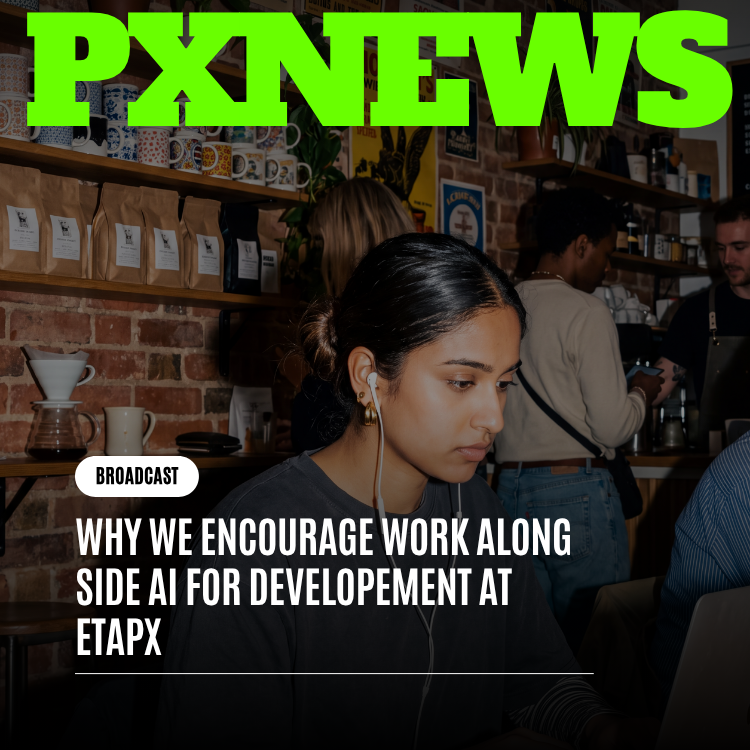
Walk through ETAPX on any given afternoon and you'll see something that would have looked strange five years ago: a product designer talking through three variations of an onboarding flow with an AI collaborator before ever opening a design file, a support writer refining the tone of a help article with a model that's read the whole knowledge base, an engineer narrating a half-formed idea out loud to see it sketched back as a starting point. None of it looks like replacement. It looks like a company that has decided, deliberately and out loud, that working alongside AI is simply how good work gets made now — and that the decision says as much about ETAPX's values as any feature on the roadmap.
This is not a story about tools. It's a story about a mindset shift that took hold across ETAPX over the past several years, one that shows up in how the company hires, how teams structure their days, and how leadership talks about the future of work. The short version: AI doesn't replace the people at ETAPX. It amplifies them. The longer version is worth telling, because it explains why the company builds the products it builds, and why "working alongside AI" has become something closer to a cultural value than an operational policy.
From "Replace" to "Amplify": A Mindset, Not a Mandate
The easiest and laziest story anyone can tell about AI in the workplace is the replacement story — that machines are coming for jobs, that headcount will shrink, that the human role in creative and technical work is a temporary inconvenience on the way to full automation. It's a story that gets clicks and it's a story that misunderstands what actually happens when capable people get access to capable tools.
At ETAPX, the operating belief is the opposite: AI amplifies people. It doesn't substitute for judgment, taste, product sense, or care — it removes friction from the parts of the job that were never where the value lived in the first place. The tedious first draft. The fifteenth variation of a layout. The research summary nobody wanted to write but everybody needed to read. AI absorbs the friction so people can spend more of their attention where it actually counts.
This distinction matters because it changes what you optimize for as a company. A "replace" mindset treats headcount as a cost to be minimized and treats AI adoption as a way to do the same work with fewer people. An "amplify" mindset treats AI adoption as a way to do more ambitious work with the same people — to raise the ceiling on what a small, focused team can attempt rather than lower the floor on how many people you need. ETAPX has consistently chosen the second framing, and it shows in how the company has grown its product surface — Whistlr, GLSRM, Ocsidian, and Influxx — without treating each new initiative as a headcount problem to be solved by cutting corners elsewhere.
"I've never once told a team 'go figure out how to do this with fewer people because AI will cover the gap.' That's not the conversation. The conversation is 'you now have room to be more ambitious than you were eighteen months ago — what would you build if the boring 60% of the job took a tenth of the time?' That question changes what people say yes to. It changes what they think is possible on a small team. That's the whole point."
— AJ, Founder & CEO, ETAPX
What AI Actually Buys You: Time and Attention
It's tempting to talk about AI collaboration in the workplace purely in terms of speed, and speed is real — work that used to take days can often take hours. But speed alone is the least interesting part of the story, and treating it as the headline undersells what's actually happening. The more meaningful currency AI collaboration trades in is attention. Every hour a person doesn't spend wrestling with a first draft, formatting a document, transcribing research notes, or hunting down a stray bug is an hour that becomes available for something a machine genuinely cannot do: deciding what matters.
ETAPX teams talk about this in terms of where the "expensive" thinking happens. Drafting is cheap. Iterating is cheap. What's expensive — what has always been expensive, long before AI entered the picture — is knowing which draft is actually right, understanding why a design decision will or won't serve the people using it, and having enough taste to recognize the difference between something that's technically finished and something that's actually good. AI collaboration doesn't touch that expensive layer. It clears everything underneath it so more hours in a person's week land on that layer instead of getting consumed by the scaffolding around it.
This plays out differently depending on the discipline, but the shape is consistent:
- Design: AI collaboration handles rapid exploration of layout and interaction variations, freeing designers to spend their time on the judgment calls — hierarchy, emotional tone, and whether an experience actually feels right — that no amount of exploration substitutes for.
- Writing: First-pass structure and research synthesis move faster, so writers spend more of their time sharpening voice, cutting what doesn't earn its place, and making sure the piece actually says something true.
- Product: AI-assisted prototyping shortens the distance between an idea and something people can react to, which means more ideas get tested against reality before anyone commits real engineering time to them.
- Engineering: Repetitive, well-understood implementation work moves faster, leaving more attention for architecture, edge cases, and the kind of judgment that determines whether a system holds up under real use.
- Everyone: The unglamorous administrative layer of any job — summarizing, organizing, formatting, searching — shrinks, and that time reliably migrates toward the work each person was actually hired to do.
None of this is about doing the same work faster for its own sake. It's about widening the space where human attention lands, so that space is filled with decisions that deserve a person's full focus rather than tasks that never needed one.
Why "Amplify" Beats "Replace" as a Business Philosophy
There's a practical reason ETAPX has settled on the amplify framing beyond it simply being the more humane one: it's also the more effective one. Products built by people who have more time to think carefully are, on average, better products. Copy written by someone who spent their reclaimed hours on nuance instead of a second unrelated task reads better. Interfaces designed by someone who used the time AI collaboration bought them to sit with a hard problem instead of rushing to the next ticket feel more considered. Quality is not a fixed cost that AI adoption lets you spend less on — quality is a variable that goes up when the people responsible for it have more room to exercise judgment.
There's also a talent argument here that ETAPX takes seriously. The people the company wants to hire and keep — designers with real point of view, writers who care about precision, engineers who think in systems, product people with sharp instincts for what users actually need — are exactly the people who get restless doing repetitive work and exactly the people who get energized when a tool clears that work out of their way. A culture that treats AI as a threat to be managed tends to attract people who are anxious about their own relevance. A culture that treats AI as a collaborator to be trusted with the right things tends to attract people who are confident enough in their own judgment to want more room to use it. ETAPX has deliberately built toward the second group.
This is also why the company has never framed AI adoption as a cost-cutting initiative internally. Cost-cutting framing sends a signal — it tells a team that management sees their function as fundamentally a budget line, one that AI exists to shrink. Amplification framing sends a different signal entirely: that the company sees the team's judgment as the actual asset, and everything else, AI included, exists in service of protecting more of that judgment's time.
What Stays Fundamentally Human
None of this works if "amplify" quietly becomes "replace" through the back door, and ETAPX is careful about the line. There is a category of work at the company that AI collaboration touches only at the margins, because it was never a throughput problem to begin with. It's a judgment problem, a taste problem, a care problem — and those don't scale the way drafting speed scales.
- Product vision: Deciding what to build and, just as importantly, what not to build remains a human call, grounded in a read of what people actually need rather than what's merely technically possible.
- Creative direction: The point of view that makes something feel like it belongs to ETAPX — a tone, a visual language, a sense of what's tasteful and what's noise — comes from people who've internalized what the brand stands for, not from a process that can be automated end to end.
- Quality bar: Someone has to decide when something is actually done versus merely finished on paper. That bar is set by people who care enough to notice the difference, and it stays a human responsibility at every stage of shipping.
- Care for users: Empathy for the person on the other end of a feature, a support ticket, or a piece of writing is not a task to be delegated. It's the reason the task exists in the first place.
- Accountability: When something ships, a person stands behind it. That ownership doesn't transfer to a tool, no matter how much of the groundwork the tool helped lay.
This is the part of the philosophy that keeps the whole thing honest. It would be easy for a company to talk about "amplification" while quietly hollowing out the judgment-heavy parts of a role and calling it efficiency. ETAPX's approach is closer to the opposite: the more capable the AI collaboration gets at the scaffolding, the more deliberately the company protects the judgment-heavy parts as things a person does, on purpose, with the extra time and attention that scaffolding freed up.
Practicing What ETAPX Builds
There's a reason this philosophy feels lived-in rather than aspirational at ETAPX, and it traces back to the company's own product lineup. GLSRM was built around the idea of AI as a front page — a place where people go to understand and engage with AI as a genuine part of daily life, not a novelty bolted onto something else. Ocsidian lets people direct agentic collaborators to help build entire games, treating creative direction as the human's job and execution as a partnership. Influxx, the company's flagship agentic environment, was built by a team that spends its own working life inside the exact question this article is about: what should a human decide, and what should an intelligent collaborator carry from there.
That's not a coincidence. A company that builds products meant to help other people work alongside AI has an obligation to actually live that way internally — otherwise the products are theory rather than practice. ETAPX's internal culture and its product philosophy grew up together, each one testing and informing the other. When the team debates how much autonomy an agentic feature in Influxx should have before a human needs to step in, that's the same conversation happening in parallel about how a writer should collaborate with AI on a first draft, or how a designer should use it to explore a layout. The company isn't building tools for a way of working it doesn't practice. It's building tools for the way it already works, refined enough to hand to everyone else.
"I used to dread the first two hours of any big writing project — just staring at a blank page, trying to find the shape of the thing before I could even start being picky about it. Now that part takes a fraction of the time, and honestly the work I'm proudest of this year happened in the hours that used to get eaten by that dread. I didn't get replaced. I got the boring part of my own job taken off my plate so I could actually do the part I was hired for."
— Priya Sathe, ETAPX employee
How Teams Actually Practice This Day to Day
Philosophy only matters if it changes behavior, and at ETAPX it shows up in small, consistent habits rather than a single sweeping policy. New collaborators are encouraged, from their first week, to treat AI as a thinking partner rather than a vending machine — to bring it a half-formed idea and push back on what comes out, rather than accepting a first pass at face value. Reviewing and refining what AI produces is treated as a real skill, one that gets better with practice, not an afterthought tacked onto the end of a task.
Teams are also encouraged to be honest about where AI collaboration genuinely helps and where it doesn't. Not every task benefits from it — some work is better done slowly, by hand, with full human attention from the first minute, and ETAPX doesn't treat "use AI" as a mandate that applies uniformly to everything. The judgment about when to reach for AI collaboration and when to set it aside is itself one of the human skills the company values, and it's treated with the same seriousness as any other craft decision.
Perhaps most importantly, the company avoids treating AI fluency as a purely technical skill reserved for engineers. Designers, writers, marketers, and product people are all expected to develop their own working relationship with AI collaboration, shaped by what their discipline actually needs. A writer's use of it looks nothing like an engineer's use of it, and that's by design — the goal was never uniformity, it was giving every discipline room to figure out its own version of amplification.
The Long View: Why This Is a Values Question, Not a Tools Question
It would be simple to write this off as a company being enthusiastic about efficient tooling, but that undersells what's actually at stake. How a company talks about AI internally is a reasonably good proxy for how it thinks about its people generally. A company that frames AI purely as a way to reduce headcount is, whether it says so out loud or not, communicating that it sees its people as replaceable inputs. A company that frames AI as a way to give its people more room for judgment, creativity, and care is communicating something very different — that the people are the point, and everything else, AI included, exists to protect their ability to do their best work.
ETAPX has chosen the second framing deliberately, and it has stayed with it through every stage of the company's growth, from the early days of Whistlr through the expansion into GLSRM, Ocsidian, and Influxx. It's a bet that in a world where AI capability keeps compounding, the companies that thrive won't be the ones that used AI to need fewer people — they'll be the ones that used AI to let their people do more of what only people can do. That's not a slogan at ETAPX. It's the operating assumption behind how teams are structured, how new collaborators are onboarded, and how the company's own products get built.
Frequently Asked Questions
Does ETAPX use AI to reduce its workforce?
No. ETAPX's internal philosophy treats AI as a way to expand what a given team can attempt, not as a mechanism for reducing headcount. The company's growth across Whistlr, GLSRM, Ocsidian, and Influxx has consistently paired new initiatives with real investment in people rather than treating AI adoption as a substitute for hiring.
Which teams at ETAPX work alongside AI — just engineering, or more broadly?
It spans the company. Design, writing, product, marketing, and engineering all incorporate AI collaboration into their work in ways suited to each discipline. The company deliberately avoids treating AI fluency as an engineering-only skill; every function is encouraged to develop its own working relationship with AI as a collaborator.
What parts of the work does ETAPX keep strictly human?
Product vision, creative direction, the quality bar for what ships, genuine care for users, and accountability for outcomes all remain human responsibilities. AI collaboration accelerates the surrounding scaffolding — drafting, iteration, research, exploration — but the judgment calls that define whether something is actually good stay with people.
Is this philosophy connected to ETAPX's own products, like GLSRM, Ocsidian, and Influxx?
Yes. ETAPX's internal culture of working alongside AI grew up alongside its product philosophy, not separately from it. Products like GLSRM, Ocsidian, and Influxx are all built around the idea of AI as a genuine collaborator rather than a replacement for human direction, and that same principle shapes how ETAPX's own teams work day to day.
How does ETAPX decide when AI collaboration is or isn't the right approach for a task?
That judgment is left to the people doing the work rather than dictated by a blanket policy. Teams are encouraged to be honest about where AI genuinely removes friction and where a task is better served by slow, fully human attention from the start — recognizing that judgment itself as a skill worth taking seriously, not an afterthought.
At its core, ETAPX's approach to AI isn't a technology policy — it's a statement about what the company believes its people are for. Clear the friction, protect the judgment, and trust that the humans in the room are the reason any of it is worth building in the first place.