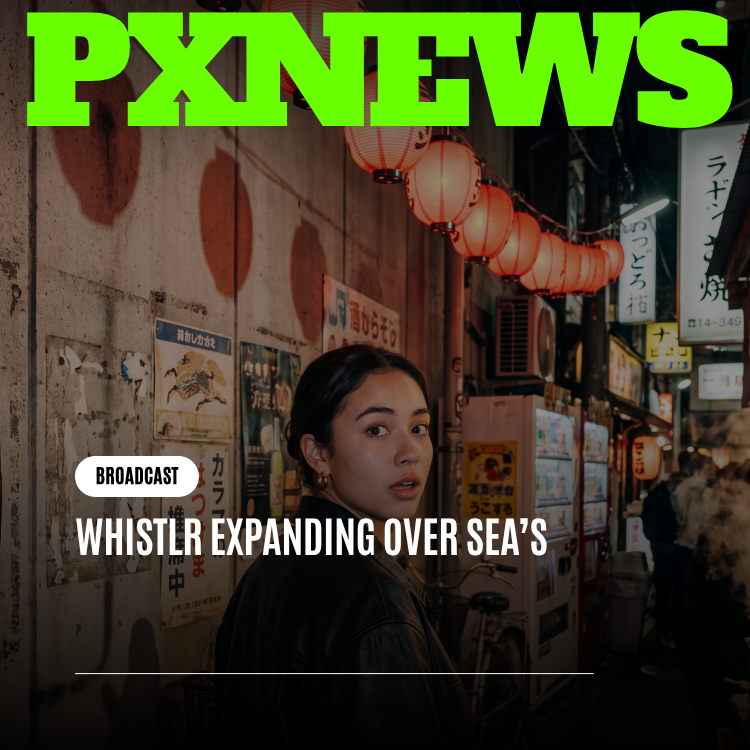
Starting today, Whistlr is open for new sign-ups across the United Kingdom, Ireland, Australia, New Zealand, Brazil, Mexico, and the broader European Union, with in-app language support landing alongside the rollout rather than trailing behind it. This isn't a soft, waitlist-gated test in a handful of cities — it's a full international expansion of the app people already know, with Circuits, Waves, Minis, Storefronts, and every other corner of the platform available to new users the moment they download it. For a platform that spent its first stretch of life proving itself in one market, this is the point where "come see what we built" turns into "come build it with us, wherever you are."
Why Now
The honest answer is that the timing wasn't driven by a calendar — it was driven by demand that showed up long before ETAPX had made any formal move to invite it. Over the past several months, a growing share of new Whistlr accounts, Circuit activity, and Waves listening sessions has been coming from outside the regions the app originally launched in, arriving organically through shared links, creator cross-posts, and word of mouth rather than any deliberate marketing push. People were already finding their way in. The company's job was to stop treating that as an edge case and start treating it as the next chapter.
There's also a simpler, less strategic reason: it was time. A social platform that only feels complete inside one country's borders is, by definition, a smaller version of what it's trying to be. Circuits work best when the conversation inside them is wide enough to be interesting. Waves gets richer when the playlists crossing through it reflect more than one country's charts. Minis becomes a better mirror of culture the moment the culture being reflected isn't just one culture. None of that happens by staying put.
The Signal the Team Couldn't Keep Ignoring
Internally, the turning point wasn't a single dashboard or a single meeting — it was a pattern that kept repeating across nearly every part of the product. Circuit moderators started flagging conversations happening partly in Portuguese or Spanish, with members translating for each other manually rather than waiting for the app to catch up. Waves playlists began circulating with track selections that clearly weren't sourced from a single country's listening habits. Storefront creators fielded direct messages from followers overseas asking, in essence, "can you ship this to me, and can I actually pay for it." None of that was a campaign. It was a community quietly outgrowing the boundary the product had drawn around itself, and it made the decision to expand feel less like a strategic bet and more like catching up to something that had already started without ETAPX's help.
That pattern also shaped how the company thought about sequencing. Rather than picking regions off a map based on market size alone, the international team weighted early planning toward the places where organic activity was already the strongest — which is part of why the United Kingdom, Ireland, Australia, and New Zealand were included in this first wave alongside Brazil, Mexico, and the EU. In several cases, the app was already being used more than internal projections assumed, just without any of the language, payment, or support infrastructure that would make the experience feel complete rather than improvised.
Where Whistlr Is Now Available
As of today, new and existing users can access the full Whistlr app — no region lock, no feature gating — in the following markets:
- United Kingdom & Ireland: Full platform access with English-language localization already in place from Whistlr's original build, plus region-specific Circuit recommendations and Storefront support for local creators.
- Australia & New Zealand: Complete access across all core features, with timezone-aware Live discovery so trending streams surface at hours that actually make sense locally instead of defaulting to a distant primary market's peak times.
- Brazil: Full Portuguese-language support at launch, along with in-region payment methods for Storefronts and WTC Gems purchases, built specifically around how Brazilian users already prefer to pay online.
- Mexico & the broader Latin American region: Spanish-language support, localized customer support coverage, and Storefront shipping and checkout options built for the region rather than adapted after the fact.
- The European Union: Availability across EU member states with rolling language support (starting with French, German, Spanish, Italian, and Dutch, with more on the way), plus region-appropriate account and privacy controls built to match each market's expectations.
This list is a starting point, not a ceiling. ETAPX has been clear internally that international expansion is a continuous process rather than a single event, and the regions above represent where the app is landing first — not where it stops.
What's Actually Different for International Users
Language Support That Goes Deeper Than Translation
A lot of "international launches" in this industry amount to running the interface through a translation layer and calling it localization. Whistlr's approach has been slower and, the team would argue, more honest: language support was built feature by feature, so that a Circuit conversation, a Storefront product description, and a Waves lyric sync all read like they were written for the language they're in, not converted into it. Idioms, casing, and even emoji conventions vary by region, and the localization pass accounted for that rather than papering over it with a generic string replacement.
That work isn't finished everywhere at once, and ETAPX isn't pretending otherwise. English, Portuguese, and Spanish support is complete at launch. The additional EU languages are rolling out on a staggered schedule over the coming weeks, prioritized by where the earliest international sign-ups are actually concentrated, so the languages with the most active new users get full coverage first.
Reviewed by the People Who Actually Speak the Language
The process behind that localization work matters as much as the result. Rather than relying solely on automated translation and calling it finished, the team built a review layer of native-speaking community members and creators already active in each target region, who read through the localized product before it shipped and flagged anything that sounded stiff, formal in the wrong way, or simply off. A phrase that's warm and casual in English can land as cold or overly corporate when translated literally, and the reverse is just as true — so the goal was never a perfect word-for-word match, it was a version of Whistlr that feels like it was written by someone who actually talks the way its new users talk. That review pass is also why the additional EU languages are rolling out on a staggered timeline rather than all at once: getting it right for one language at a time, with real native-speaker review, was judged to be worth more than shipping five languages simultaneously at a lower bar.
Payment and Support, Built for Where People Actually Are
Nothing kills a global product's credibility faster than asking someone to use a payment method they don't have or don't trust. Whistlr's international expansion includes in-region payment options for Storefronts, Live Shopping, and WTC Gems purchases, matched to what's actually common in each market rather than assuming one global default works everywhere. Customer support is following the same logic — response coverage in local languages, during local hours, instead of routing every ticket through a single time zone and hoping the wait feels reasonable.
Timezone-Aware Features, Not Just a Clock in the Corner
A platform built around live moments — Live streaming, Flow's multi-platform broadcasting, Circuit events — has to actually understand time zones, not just display them. Whistlr's Live discovery now weights what's trending by a user's local time rather than a single global clock, so someone opening the app in Sydney at 8pm sees streams that are actually live and relevant at 8pm Sydney time, not the tail end of a feed tuned for a different hemisphere. Scheduling tools across Circuits and Storefronts carry the same logic — an event scheduled by a creator in São Paulo shows up correctly converted for a follower in Manchester, without either of them doing the math themselves.
What Stays Exactly the Same
Expansion this size tends to invite a specific worry from existing users: does this dilute what made the platform feel like itself in the first place? The answer the product team has committed to is no, on every count that matters.
- Core features, unchanged: Circuits and SubCircuits, Waves with Apple Music integration, Minis and Whistlr Studio, WTC Gems, Storefronts and Live Shopping, Creator Studio, Flow, Moods and Blips, relationship status, group chats, Thoughts, and Stories all ship identically to every market — nothing gets a stripped-down version.
- Creator monetization, consistent: The tools creators already rely on for monetization work the same way for a creator in Berlin as they do for one in the platform's original home market, with payout paths matched to local norms rather than a one-size-fits-all model bolted on top.
- Moderation standards, uniform: Community guidelines and moderation apply consistently across every region Whistlr now serves, with no lighter or heavier version of the rules depending on where a user happens to be located.
- Design and feel, untouched: The floating bottom nav, the visual language of Circuits, the way Minis feels to scroll through — none of it was redesigned for this. The product a new international user opens is the same product a longtime user already knows, just reachable from more places.
The Community and Cultural Angle
Numbers and feature lists tell part of the story, but the more interesting part is cultural, and it's the part ETAPX leadership keeps coming back to internally. Whistlr started as a platform built around a specific place and a specific community's way of talking to each other — and it grew into something with its own tone, its own inside references, its own sense of what a Circuit or a Mini is supposed to feel like. The question this expansion raises isn't whether that tone survives contact with new cultures. It's whether it gets more interesting because of them.
Early signs suggest it does. Circuits that started as regional or niche interest groups have already begun absorbing international members organically, and the conversations inside them haven't flattened out — they've picked up new references, new music, new humor, without losing whatever made them worth joining in the first place. That's the outcome the team was hoping for rather than the one it was worried about.
"We built Whistlr around a very specific feeling — the sense that you're part of something with its own culture, not just scrolling through a generic feed. The question we asked ourselves before this expansion wasn't 'can we support more languages,' because that part was always going to be solvable with enough time and care. The real question was whether that feeling would survive getting bigger. What we've seen in the early rollout tells us it doesn't just survive — it gets richer. A Circuit with people from four countries in it isn't a diluted version of a Circuit. It's a better one, because everyone in it is bringing something the others didn't already have."
— AJ, Founder & CEO, ETAPX
That belief shaped a lot of the sequencing decisions behind this launch — why localization work happened before marketing did, why in-region payment support shipped alongside language support instead of after it, and why the team resisted rushing a wider rollout before the experience actually matched what existing users had come to expect.
"International expansion sounds like an infrastructure story from the outside, but for us it was mostly a patience story. We could have opened sign-ups everywhere a year ago and called it done. We didn't, because showing up in a new market with half-finished language support or no local payment options isn't really showing up — it's just being visible there. We wanted the first thing someone in São Paulo or Manchester experiences to feel considered, not adapted. That took longer. I think it was worth it."
— Priya Nadarajah, VP of International, ETAPX
Early Community Reaction
The response since the rollout began trickling out to early access users has been, by the team's own account, more enthusiastic than anticipated — not just from new users in the newly opened regions, but from existing users who've spent months watching international friends and collaborators ask when they'd finally be able to join properly.
"I've been on Whistlr for a while now, mostly through a Circuit built around music production, and half my favorite people in it were always in Europe or Latin America, joining through workarounds because the app technically wasn't 'available' where they were. Watching it open up properly — with actual language support, not just a translated button here and there — feels like the community finally catching up to what it already was. My Circuit didn't get bigger this week. It got more honest about who was already in it."
— Devon Marsh, Circuit creator
"I downloaded Whistlr the day it became available in Brazil and the thing that actually surprised me wasn't the app itself, it was how normal everything felt in Portuguese. I've used plenty of apps that technically 'support' my language and still feel like they were built for somewhere else. This didn't feel like that. Storefronts checkout worked with a payment method I actually use. That's a small thing until you realize how rarely it happens."
— Camila Duarte, new user, São Paulo
What's Next
This expansion is described internally as a first wave rather than a finish line. The regions above represent where localization, payments, and support were ready to ship at a standard the team was willing to put its name on — not the full list of where Whistlr intends to go. Additional EU languages continue rolling out over the coming weeks, and the international product team has said openly that further regional expansion is already in active planning, sequenced the same deliberate way this wave was: language and local support before marketing, not after.
There's also a feedback loop built into this rollout that didn't exist for the platform's original launch. Because Whistlr already has an established community and years of product maturity behind it, the international team can watch what new users in each region actually do with the app from day one — which Circuits they gravitate toward, which Waves genres take off locally, where Minis trends diverge from the platform's original home market — and use that to shape what comes next, rather than guessing in advance. Expansion, in other words, isn't a single announcement. It's the start of an ongoing conversation with a much larger set of people than the platform has had before.
Regions Already in Planning
ETAPX hasn't published a fixed timeline for what comes after this first wave, and the international team has said plainly that it would rather under-promise on dates than repeat the mistake of opening a market before the language and support work actually matches it. That said, the shape of what's next isn't a mystery. Canada and additional Latin American markets beyond Mexico are already part of active planning conversations, alongside early groundwork in parts of Southeast Asia where organic activity has started to show the same kind of pattern that preceded this wave — creators and Circuit members finding their way in ahead of any formal invitation. Whether any of those specific regions make up the next wave, or whether the data points somewhere else entirely once the team looks closer, is genuinely still being decided rather than already settled and simply unannounced.
Frequently Asked Questions
Which countries can now access Whistlr?
As of this rollout, Whistlr is fully available in the United Kingdom, Ireland, Australia, New Zealand, Brazil, Mexico and the broader Latin American region, and across European Union member states. This is described as the first wave of a continuous international expansion, with additional regions in active planning.
Will Whistlr feel different for users outside the original launch market?
No. Every core feature — Circuits and SubCircuits, Waves, Minis and Whistlr Studio, WTC Gems, Storefronts and Live Shopping, Creator Studio, Flow, Moods and Blips, relationship status, group chats, Thoughts, and Stories — ships identically across every region. What changes is language support, in-region payment options, localized customer support, and timezone-aware discovery, not the product itself.
What languages does Whistlr support at launch?
English, Portuguese, and Spanish are fully supported at launch. Additional European languages — starting with French, German, Italian, and Dutch — are rolling out on a staggered schedule over the coming weeks, prioritized by where new international sign-ups are most concentrated.
How does Whistlr handle payments and support for international users?
Storefronts, Live Shopping, and WTC Gems purchases now support in-region payment methods matched to what's commonly used in each new market, rather than a single global default. Customer support coverage is also expanding to local languages and local hours in the newly opened regions.
Does this expansion change how Circuits, moderation, or creator monetization work?
No. Community guidelines and moderation standards apply consistently across every region Whistlr now serves, and the monetization tools creators already use work the same way internationally, with payout paths adjusted to match local norms rather than the underlying system being changed.
Whistlr didn't set out to be a platform that stayed in one place — it just needed to earn the right to grow before growing for its own sake. This expansion is ETAPX treating that seriously: language support built rather than bolted on, payment methods that match how people actually pay, timezone-aware features that respect where someone actually is, and a community the company is betting gets richer, not thinner, the more of the world it includes. The United Kingdom, Ireland, Australia, New Zealand, Brazil, Mexico, and the European Union are the first stop. They won't be the last.