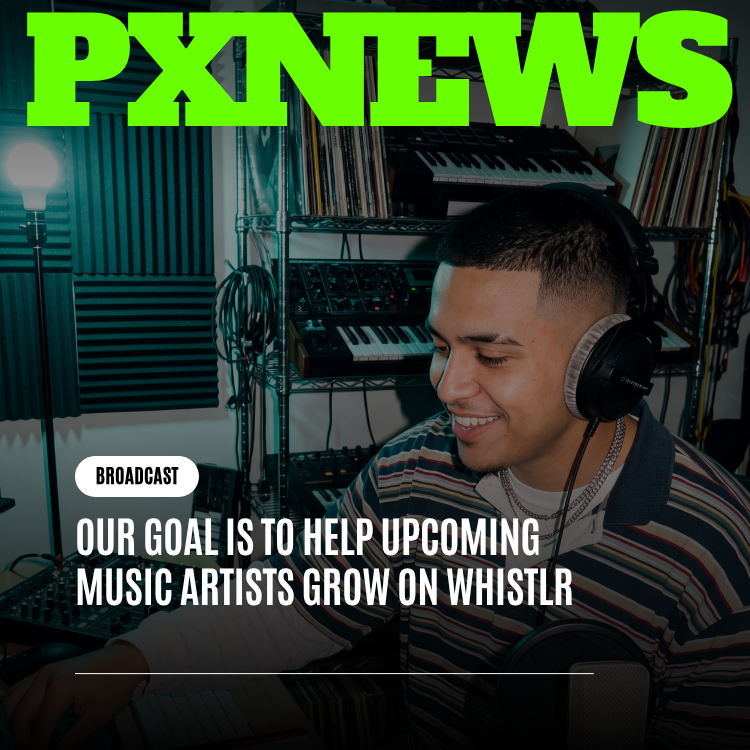
Our goal is to help upcoming music artists grow on Whistlr. Not as a slogan, not as a feature we shipped and moved on from, but as a standing commitment that shapes how ETAPX makes decisions about the music side of this platform. Most talented musicians never get discovered — not because the music isn't good enough, but because the traditional industry was never built to notice them in the first place. It was built to notice whoever the gatekeepers had already decided to bet on. We think that's a broken way to decide whose art the world gets to hear, and we think a platform built around real community, rather than around who a curator picked this week, can be a genuinely different path forward for musicians specifically. This piece is about why that belief sits at the center of what Whistlr is trying to be, and what we're committing to as we keep building toward it.
The Gatekeeping Problem We Started Whistlr to Push Back Against
For most of the last century, the music industry has run on a simple and mostly unquestioned assumption: somewhere between an artist finishing a song and an audience hearing it, someone with authority has to say yes. A label had to sign the artist. A radio programmer had to add the single to rotation. A magazine editor had to decide the act was worth a feature. Later, a playlist curator had to decide a track belonged on a list with a few hundred thousand followers. At every stage, the number of people who could actually hear new music was a rounding error compared to the number of people making it, and the difference between those two numbers was filled entirely by gatekeepers exercising judgment on behalf of an audience that never got a vote.
That system produced real stars, and it produced some genuinely great records. It also, quietly and consistently, produced a much longer list of artists who never got a chance to find out whether an audience existed for them, because nobody with the keys to distribution ever gave them the opportunity to try. Streaming was supposed to be the correction. In practice, it mostly replaced human gatekeepers with automated ones — an algorithm deciding what gets surfaced is still a gatekeeper, it just doesn't return your emails and it optimizes for different things than a person would. An artist can spend years building a catalog that never gets a fair look, not because a machine made a moral judgment about the music, but because the machine was never built to notice music the way a human fan notices it — through a friend's recommendation, a live set that stops you mid-scroll, a song shared inside a group chat because someone couldn't keep it to themselves.
We started Whistlr's music features with that history in mind, and we keep coming back to it whenever we make decisions about where the platform goes next. The problem was never that the music industry lacked talented people. It has always had more talented people than it had room to promote. The problem was a structure that treated discovery as a scarce resource to be rationed out by a small number of decision-makers, instead of something a large, engaged community could do for itself if it had the right tools. Helping upcoming music artists grow starts with rejecting that scarcity as a given. It doesn't have to be true. It was only ever a byproduct of infrastructure built before anyone had a better option.
Why Upcoming Music Artists, Specifically
Whistlr supports creators of every kind, and we take that mission seriously across the board. But music holds a specific place in why ETAPX exists, and it's worth explaining rather than assuming it's obvious. Music is one of the few art forms that turns strangers into a community almost on contact. A comedian's fans laugh at the same jokes. A musician's fans build identities around a sound, show up in the same physical rooms to hear it live, put it on at the exact moment in their lives when it means the most, and carry it forward for years in a way that very little other content does. When a platform gets music right, it isn't just distributing songs — it's giving people a reason to gather around something they genuinely love, and that kind of gathering is the raw material every healthy community is built from.
Upcoming artists carry an additional weight that established ones don't. A musician with a label deal, a booking agent, and a marketing budget has options if one platform doesn't serve them well — they have people whose job is finding another way. An artist writing, recording, and performing without any of that infrastructure usually has exactly one option: whatever they can build themselves, with whatever tools are actually available to them. That asymmetry is precisely why we think ETAPX's effort matters more here than almost anywhere else it could be spent. A large platform choosing to build genuinely for artists without a team behind them isn't a neutral act — it's a deliberate redistribution of a kind of leverage that used to belong almost exclusively to labels and curators. We'd rather spend that leverage on the artist still working a day job and writing songs at night than on acts who already have every advantage the old system could offer.
There's also a simple, almost old-fashioned belief underneath all of this: most genuinely talented musicians are undiscovered, not because talent is rare, but because the old machinery for finding it was never built at the scale the internet made possible. We think there are more great songwriters, more compelling live performers, and more artists worth caring about right now than any single label roster, radio format, or curated playlist could ever represent. If that's true — and we believe it is — then the biggest opportunity in music today isn't finding the next act the industry would have found anyway. It's building the infrastructure that lets the artists the old system was never going to find get heard on their own terms.
What "Grow" Means to Us, and Why We Chose That Word Deliberately
We didn't title this "discover upcoming music artists" or "promote upcoming music artists," and that wasn't an accident. Discovery implies a moment — someone gets found, or they don't. Promotion implies something being done to an artist from outside, a push they're on the receiving end of. Growth is different. Growth is a process an artist is actively part of, one that compounds over time rather than resolving in a single lucky break. It's slower to talk about and harder to put in a headline, but it's the only version of this that actually matches how careers in music have ever really been built — not by a single moment of being chosen, but by a following that gets a little bigger, a little more devoted, a little more resilient, month after month.
That distinction changes what we hold ourselves accountable to. If our goal were discovery, we could point to a handful of breakout artists and call it a success story, regardless of what happened to everyone else. Growth as a goal is a much less forgiving standard, because it asks a harder question about every artist on the platform, not just the ones who happened to break through: is the person who joined Whistlr with forty listeners in a meaningfully better position a year later than the person who joined a platform that only rewards artists who were already popular enough to be rewarded? We think that's the right question to hold ourselves to, even though it's a much harder one to answer cleanly.
"I don't want Whistlr to be a platform that's good for musicians who already made it. Anyone can build that — it's not hard to serve people who arrived with an audience. I want us to be the platform that's good for the artist who has forty real listeners and needs forty more, then four hundred more, then four thousand more, without ever having to go through someone else's permission to get there. That's a much harder thing to build, and it's the only version of this I actually care about. Helping upcoming music artists grow isn't a feature on our roadmap. It's the reason the music side of Whistlr exists at all."
— AJ, Founder & CEO, ETAPX
Growth as a North Star for Product Decisions
Treating growth as a mission rather than a feature changes how decisions actually get made inside ETAPX. When the team debates a change to how music gets surfaced, the operative question isn't "does this look impressive in a keynote" — it's closer to "does this make it more or less likely that an artist with a small, genuine following can turn it into a slightly bigger one." That's a quieter standard than chasing whatever trend is dominating the broader creator economy in a given month, and it means saying no to things that would generate short-term buzz at the expense of long-term fairness to the artists who joined early and stayed. We'd rather build slowly toward something durable than fast toward something that only works for whoever happens to already be popular.
Why This Has to Be a Long-Term Commitment, Not a Launch
We're intentionally not framing this as something we finished. A company can ship a feature, announce it, and move its attention elsewhere. A company cannot ship a commitment to a category of creator and consider the job done, because the industry problem that made this commitment necessary in the first place — a small number of gatekeepers controlling access to a large, distributed audience — doesn't disappear because one platform built better tools. It requires sustained attention: revisiting whether our tools are actually working for the artist with the smallest following as often as we revisit whether they're working for the one with the largest, and being honest with ourselves when the answer says we still have work to do. That's the posture we're taking. This is a goal we're working toward for as long as ETAPX exists, not a milestone we're checking off.
What We Believe About the Music Industry's Gatekeepers
We want to be precise about this, because it would be easy to overstate it into something it isn't. We don't think labels, playlist curators, or radio programmers are acting in bad faith. Most of them are music people who got into the business because they love it, working inside a structure that predates the internet and was never designed for a world where millions of artists could theoretically reach an audience directly. Our disagreement isn't with the people doing that work. It's with the structural reality that puts so much power over who gets heard in the hands of so few decision-makers, and with the assumption — often unstated, rarely examined — that this is simply how music discovery has to work.
Here's what we actually believe, stated plainly:
- Talent is far more common than opportunity: The number of musicians worth hearing has never been the bottleneck. Access to an audience has.
- Gatekeeping optimizes for safety, not quality: A curator with a reputation to protect and a limited number of slots to fill will often choose the safe, familiar bet over the unproven one, even when the unproven artist is genuinely better.
- Real community outperforms curated placement: A hundred fans who found an artist through a friend, a live set, or a shared playlist are worth more, long-term, than a single algorithmic placement that disappears the moment the algorithm changes its mind.
- Upcoming artists deserve tools built for their reality, not scaled-down versions of tools built for established acts: An artist without a team needs different things than an artist with one, and treating both the same isn't neutrality — it quietly favors whoever already had the advantage.
- Growth should be earned through connection, not bought through spend: An artist who can't afford advertising shouldn't be structurally disadvantaged against one who can. What should matter is whether the music actually resonates with the people who hear it.
None of this is a claim that Whistlr has solved music discovery. It's a statement of what we're building toward, and a standard we're comfortable being held to as we keep building.
Real Community as the Alternative to Gatekeeping
If gatekeeping is the problem, the natural question is what actually replaces it — because "no gatekeepers at all" isn't a real alternative on its own; a feed with no filtering mechanism whatsoever just becomes noise, and noise doesn't help an upcoming artist any more than a closed door does. Our answer is that community, when it's built well, is a better filter than a curator ever was — not because it's more accurate in any single instance, but because it's distributed, it's honest, and it compounds. A curator's judgment is one person's taste, applied at scale to millions of listeners who never asked for that particular filter. A community's judgment is thousands of individual, low-stakes decisions — one friend telling another about a song, one listener adding a track to a playlist they actually use, one person staying for an entire live set instead of clicking away — aggregating into something that reflects what people actually respond to, rather than what one gatekeeper predicted they would.
This is also why we've resisted building Whistlr's music tools around chasing whatever trend or format is generating attention in a given month. It would be easy to redesign the whole music experience around whatever short-form format is having a moment, because that's usually the fastest way to post an impressive growth number in an investor update. We've chosen a slower path instead — investing in the mechanics of real community, the parts of the platform that let genuine fans find each other and organize around an artist they care about — because that's the part of this we actually believe compounds into something durable. Trend-chasing produces a spike. Community produces a career.
"I spent years assuming that if my music was good enough, someone would eventually find it — a blog, a curator, somebody. Nobody did, and I don't think that was about the songs. What actually changed things wasn't getting picked by anyone. It was a handful of people who found my music on Whistlr and told their friends, who told their friends. Nobody gave me permission to have an audience. I just built one, slowly, out of people who actually wanted to be there. That's the first time in years I've felt like growing as an artist was actually in my hands."
— Renata Solis, independent musician on Whistlr
What This Commitment Looks Like Day to Day, Without Turning Into a Feature List
We've written elsewhere, in detail, about the specific tools upcoming artists use on Whistlr to share new music, turn a song into something shareable, perform live, and build a dedicated community around their work — that's practical, how-to territory, and it deserves its own space rather than getting compressed into a paragraph here. What we want to say in this piece is narrower and, we think, more important: those tools exist in the shape they do because of the mission described above, not the other way around. We didn't build a general-purpose creator platform and then look for ways to bolt music onto it. We built toward a specific belief — that upcoming artists deserve a direct, unmediated relationship with the people who'd love their music if they heard it — and let that belief determine what the tools needed to do.
That ordering matters more than it might seem to from the outside. A feature built to solve a belief tends to keep serving that belief even as it evolves. A feature built first and justified with a mission statement afterward tends to drift toward whatever's easiest to build or easiest to market, because there was never a real commitment underneath it in the first place. Every time our team revisits how music works on Whistlr, the test is still the one AJ describes: does this make it easier for someone with forty real listeners to earn forty more, honestly, without needing anyone's permission first. We expect that test to still be the one we're applying five years from now, even as the specific tools built around it change.
The Economics of Attention, and Why We Think They Should Change
A quieter part of this mission is about money, and we don't think it should stay quiet. For most of music history, the economics of discovery favored whoever could afford to buy attention — the label with a marketing budget, the artist who could pay for placement, the act whose management could afford a publicist with the right relationships. An upcoming artist without capital behind them wasn't just competing on the strength of their music; they were competing against budgets they had no access to, in a system where spend often mattered more than substance.
We think that's backwards, and we think it's fixable. A platform that rewards genuine engagement — a fan who actually stays for a live set, a listener who adds a song to a playlist they'll keep coming back to, a community that organizes itself around an artist because the music earned it — creates a version of growth that isn't for sale. It can still be slow. It can still require real effort and real talent and, frankly, real luck. But it doesn't require capital an upcoming artist doesn't have, and we think that single change matters more to the future of independent music than almost anything else a platform could build. Helping upcoming music artists grow, to us, partly means making sure growth is something an artist can earn through connection with real people, not something that quietly requires a budget they don't have.
Where We Go From Here
We're not going to pretend this mission is finished, because it isn't, and framing it that way would betray the entire point of committing to it as a long-term goal rather than a launch. There are upcoming artists on Whistlr right now whose tools we'll improve because we learn, from watching them actually try to grow, where the gaps still are. There are parts of the music industry's old gatekeeping structure that still shape how audiences discover new artists everywhere else, and Whistlr being different in this one corner of the internet doesn't undo that on its own — it just means we've chosen a place to plant a flag and keep building outward from it. What we can commit to is the direction: every decision about how music works on Whistlr gets measured against whether it makes life better for the artist who hasn't broken through yet, not just the one who already has. That's the standard. We intend to keep being held to it.
Frequently Asked Questions
Why does ETAPX focus specifically on upcoming music artists rather than musicians in general?
Because upcoming artists carry the biggest gap between talent and opportunity. An established musician usually has a team, a budget, and options if one platform doesn't serve them well. An upcoming artist working without any of that infrastructure typically has far fewer alternatives, which is exactly why we think a platform genuinely committed to helping upcoming music artists grow matters most for that group. It's also where we believe the traditional industry's gatekeeping does the most damage — turning away artists who were never given a fair chance to find an audience in the first place.
What does "helping artists grow" actually mean if it isn't a specific feature?
It means every product decision about music on Whistlr gets evaluated against one question: does this make it easier for an artist with a small, genuine following to build a slightly larger one, honestly and without needing anyone's permission. That standard shapes how tools get built and refined over time, rather than describing one single feature that, once shipped, completes the mission. Growth is ongoing by definition, so our commitment to it has to be ongoing too.
Is this commitment to upcoming music artists a permanent part of Whistlr, or a temporary campaign?
It's permanent, by design. We deliberately didn't frame this as a launch or a campaign with an end date, because the industry problem behind it — a small number of gatekeepers controlling who gets heard — doesn't go away on a schedule. It's a long-term goal we expect ETAPX to keep being measured against for as long as Whistlr exists, revisited continually rather than declared finished.
How is Whistlr's approach actually different from the traditional gatekeepers in the music industry?
Traditional gatekeepers — labels, playlist curators, radio programmers — decide on an audience's behalf who gets heard, usually based on a narrow set of relationships or a limited number of available slots. Whistlr's approach is built around letting real community do that work instead: friends sharing music with friends, fans organizing around an artist they genuinely care about, listeners staying for a live set because it's actually good. We believe that produces a fairer, more honest picture of what resonates than any curator's individual judgment can.
Does an upcoming artist need money, industry connections, or an existing following to grow on Whistlr?
No, and that's central to the mission described here. We've deliberately built toward a version of growth that rewards genuine connection with real listeners rather than advertising spend or industry relationships. An artist without capital or connections isn't structurally behind an artist who has both — the goal is for the music and the community it builds to be what actually determines whether an upcoming artist grows.
This is a mission we expect to be working on for a long time, because the problem it responds to was decades in the making and won't be undone in a single product cycle. What we can promise is the direction we're committed to: helping upcoming music artists grow on Whistlr, deliberately and continually, for as long as we're building this platform.