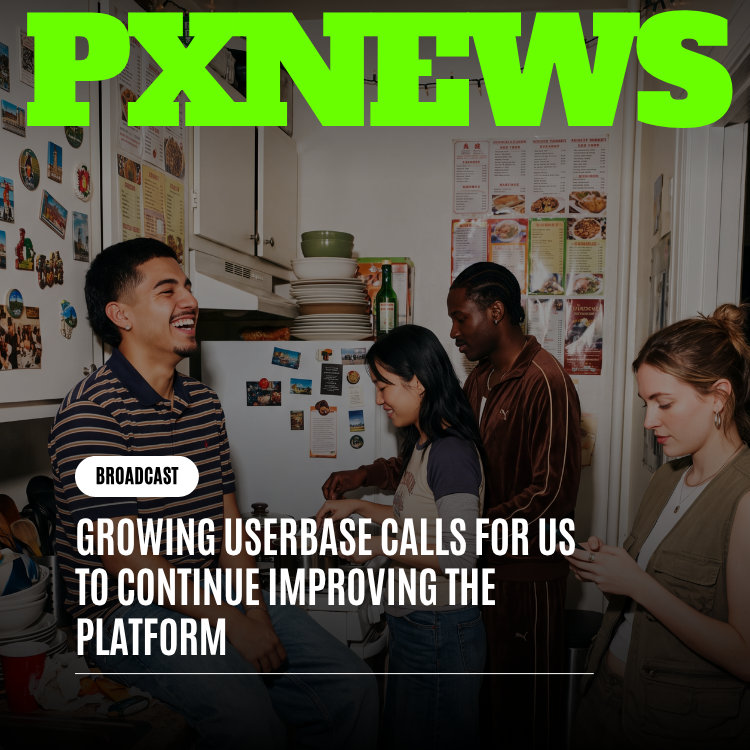
Whistlr is bigger than it was a year ago, bigger than it was six months ago, and bigger than it was last week. More people are joining every week, more Circles are forming, more Waves are getting shared, more Minis are getting posted, and more relationships, friendships, and communities are finding a home on the platform. That growth is something we're genuinely proud of, but it's not something we treat as a finish line. A growing userbase doesn't mean we can ease off — it means the opposite. It means more people are trusting us with more of their daily lives, and that trust is exactly what calls us to keep improving the platform, not just maintain it.
The Growth We've Seen, and Why We Don't Take It for Granted
When we talk about growth at ETAPX, we're not talking about a single spike or a lucky viral moment. We're talking about a steady, compounding pattern of people joining Whistlr, sticking around, and bringing other people with them. New Circles form every day. New Storefronts open. New creators discover Creator Studio and start building an audience around Minis, Waves, and Live Shopping. New couples, co-founders, and close friends confirm relationships on the platform because they trust it enough to be honest there. Every one of those actions represents a person who chose Whistlr over the alternatives, and a rapidly growing community like ours doesn't happen by accident — it happens because people keep finding reasons to stay.
We say this not to boast, but to set up the actual point of this piece: growth is a responsibility before it's a milestone. Every new person who joins Whistlr arrives with expectations shaped by the version of the platform they found — and every existing user who's been here since the early days has expectations shaped by watching the platform evolve. Both groups deserve a product that keeps getting better, not one that coasts on its current feature set because the userbase happened to get bigger. That's the philosophy behind everything in this piece: growth raises the bar. It doesn't lower it.
It's worth being honest about what growth actually feels like from the inside. It's not a straight line, and it's not always comfortable. More users means more feedback, more feature requests, more edge cases, more opinions about what Whistlr should become next. We've come to see that as a gift rather than a burden. A platform that isn't hearing from its community is either too small to matter or too quiet to be trusted. We'd rather have a loud, engaged, occasionally demanding community than a silent one — because the loud, engaged community is the one that's actually invested in what we're building.
"Every time our numbers go up, I feel the weight of it before I feel the excitement of it. A bigger community isn't a scoreboard win — it's more people who are counting on us to keep listening, keep shipping, and keep taking their feedback seriously. Growth is the reason we work harder on this platform, not the reward for having worked hard enough already."
— AJ, Founder & CEO, ETAPX
Why a Bigger Community Raises the Bar Instead of Lowering It
There's a tempting but wrong way to think about growth: the idea that once a platform reaches a certain size, it can relax into its current form and coast on momentum. We reject that framing completely. A bigger Whistlr community means a wider range of people relying on the platform for different things — some for staying close with a small Circle of friends, some for building a following through Creator Studio, some for running a Storefront, some for discovering new music through Waves, some for expressing themselves through Minis and Whistlr Studio. Every one of those use cases deserves continued attention, and the more people who depend on each of them, the higher the cost of letting any one of them stagnate.
Think about it from the other direction. If a feature people love went untouched for a year while the userbase around it tripled, that's not stability — that's three times as many people quietly wishing something worked a little better, three times as many people who noticed a rough edge and said nothing, three times as many small frustrations accumulating in the background. Growth doesn't excuse slow iteration. It makes slow iteration more expensive, because more people are living inside whatever we decide not to fix.
We also think about growth in terms of what it does to the range of voices we hear from. A platform with a small, early userbase tends to hear from a narrow slice of people — often the most vocal, sometimes the most similar to each other. As Whistlr's community has grown, the feedback we get has become more varied, more specific, and honestly more useful. Different types of users surface different types of friction. A creator running Live Shopping on their Storefront notices something a casual Circle user never would. A longtime user with years of Thoughts and Stories notices something a brand-new signup never would. That range is a resource, not noise, and it only gets richer as more people join.
So when we say a growing userbase calls for continued improvement, we mean it in a very literal sense: the bigger the community gets, the more perspectives we have access to, the more responsibility we carry for each of those perspectives, and the more damage a stalled roadmap would do. Growth is the argument for staying sharp, not the excuse for going soft.
How Community Feedback Actually Shapes What We Build Next
It's easy for a company to say "we listen to our users." It's harder to explain what that actually looks like in practice, so we'll try to be specific here. Feedback reaches ETAPX through a lot of different channels — comments on our own posts, direct messages to our team accounts, patterns we notice in support conversations, App Store and Play Store reviews, and conversations that happen inside Circles and group chats that get shared back to us. None of that feedback arrives pre-organized. Our job is to actually sit with it, look for patterns, and figure out which requests represent a genuine, recurring need versus a loud but isolated preference.
That distinction matters more than people might expect. Not every piece of feedback becomes a feature, and it shouldn't. If we shipped every individual request exactly as written, Whistlr would turn into a pile of one-off accommodations instead of a coherent product. What we look for instead is the signal underneath the request — the actual problem someone is trying to solve, which is often more useful information than the specific solution they proposed. Someone asking for a very particular notification setting might really be telling us that our notification system feels noisy in general. Someone asking for a tiny profile tweak might really be pointing at a bigger gap in how people express identity on the platform. We try to build for the underlying need, not just the literal ask.
Renata Osei, our VP of Product, has talked about this internally as the difference between "hearing" and "listening." Hearing is collecting requests in a spreadsheet. Listening is doing the work to understand why people are asking for what they're asking for, and then having the discipline to build the version of the solution that actually holds up at scale — not just the version that quiets the loudest voice in the room fastest.
"I've used a lot of apps where 'send feedback' feels like shouting into a void. On Whistlr I've actually seen things I asked about show up months later, sometimes in a better form than what I originally suggested. It's a small thing, but it changes how I use the app — I actually bother to tell them when something bugs me now, because I've seen it matter before."
— Whistlr user, active since early Circles launch
We also try to be transparent about the limits of this process. We can't promise every request gets built, and we can't promise a timeline the moment someone asks for something. What we can promise — and what we try to demonstrate through the actual history of the platform — is that community feedback is a real input into the roadmap, not a suggestion box we quietly ignore. The clearest proof of that isn't anything we say about ourselves. It's the list of things Whistlr has that exist specifically because people asked for them.
Features That Exist Because Our Community Asked For Them
We could describe our feedback process in the abstract forever, but the more convincing version of this story is concrete. Here's a look at some of the improvements that trace directly back to what people told us they wanted, needed, or wished worked differently.
- The profile redesign: longtime users had been telling us for months that profiles felt like a static business card rather than a real reflection of who someone is on the platform. The redesign was built directly around that feedback, giving people more room to express identity beyond a bio and a grid of posts.
- Halo: the ambient presence feature on profile avatars grew out of repeated requests for a lighter, more human way to signal "I'm here" without the all-or-nothing pressure of a traditional online status indicator. People wanted presence without exposure, and Halo was our answer to that specific tension.
- Relationship Status: one of our most requested features for years, built the way our community insisted it had to be built — mutual, consent-based, and audience-controlled — which is exactly why it was able to cross a 10,000-user milestone without a single wave of unwanted tags or complaints.
- Echos and Reactions: users wanted more expressive, lower-friction ways to respond to what they were seeing without writing a full comment every time. Echos and Reactions came directly out of that feedback loop, giving people a faster, more textured way to show up for each other's posts.
- Creator Studio's evolution into its own standalone home: as more creators leaned on Whistlr for Minis, Waves, and Live Shopping, they told us they needed a dedicated space to manage their work that felt built for creators specifically, not bolted onto the general app experience. That feedback is a big part of why Creator Studio grew into its own home at whistlr.studio.
- The floating bottom nav: smaller in scope, but a direct response to users telling us the older navigation felt cluttered and made it harder to move quickly between the parts of the app they used most.
None of these started as our idea in a vacuum. Each one started as a pattern we noticed in what people were telling us, then went through months of internal debate, design iteration, and testing before it became something we felt good shipping to the whole community. We bring these up not to take a victory lap, but to make a point: "we listen to our users" isn't a slogan for us. It's a description of how most of the platform's most-loved features actually came to exist.
Balancing New Features With Polish and Stability
One of the hardest questions we wrestle with internally is how to split our attention between building new things and making existing things better. It would be easy to chase headlines by constantly announcing new features, and it would be equally easy to justify an entire roadmap built around nothing but bug fixes and refinements. Neither extreme serves our community well, and we've learned that the healthiest version of a growing platform holds both priorities at once, on purpose.
New features matter because they're how Whistlr keeps up with what people actually want to do. Waves integrating with Apple Music, Minis getting their own in-app editor in Whistlr Studio, Flow letting creators stream across multiple platforms at once, WTC Gems giving communities a way to recognize each other — these things exist because standing still isn't actually neutral. A platform that never adds anything new slowly falls behind the way people actually want to communicate and create, even if nothing about the existing product gets worse.
But polish and stability matter just as much, arguably more, because they're what determines whether all those new features actually feel good to use once someone's inside them. A new feature that ships fast but feels rough erodes trust faster than a missing feature ever could. We'd rather take a little longer on something and have it feel considered — like Moods and Blips, or the redesigned relationship status flow — than rush it out and spend the next six months apologizing for rough edges. Every new feature we ship also becomes something we're responsible for maintaining and refining going forward, which means every "yes" to something new is also an implicit "yes" to ongoing care for it.
In practice, this means our roadmap always has room set aside for things that will never make an announcement post — the quieter refinements to Thoughts, Stories, group chats, and the general day-to-day experience that don't generate headlines but genuinely improve how the platform feels to use every single day. We think of these as just as important as anything flashier, because most of a person's time on Whistlr isn't spent discovering a brand-new feature. It's spent doing the ordinary things — posting, reacting, chatting, scrolling — and those ordinary moments deserve just as much craft as the big launches.
"People remember the big feature launches, but what actually keeps someone on a platform for years is whether the boring, everyday parts of it keep getting quietly better. We try to give both the spotlight and the plumbing the same level of care, even though only one of them ever gets a headline."
— John Ridge, CTO, ETAPX
What We're Working on Next
We're deliberately not going to lay out a detailed feature list here — partly because plans change as feedback evolves, and partly because we'd rather under-promise and deliver something considered than pre-announce something and box ourselves into shipping it before it's ready. What we can say is the general shape of where our attention is going as the community keeps growing.
We're continuing to look closely at how people express themselves across Circles, Thoughts, Stories, and Minis, and where those experiences could feel more connected to each other rather than like separate tools bolted together. We're paying close attention to how creators are using Creator Studio now that it has its own standalone home, and what the next layer of support for them should look like as more people build real audiences and real income through the platform. We're continuing to refine the newer additions to the platform — Halo, the redesigned profile, relationship status — based on the early feedback that's already coming in now that more people have had time to actually live with them. And we're keeping a steady focus on the unglamorous work: making the everyday parts of Whistlr feel a little smoother, a little more intuitive, and a little more considered every time we touch them.
If there's a common thread across everything currently in motion, it's that none of it is happening in isolation from what the community is telling us. Every item on our internal roadmap has a reason it's there, and more often than not, that reason traces back to something a real user said, either directly to us or through the patterns we've noticed across thousands of conversations. That's not going to change as Whistlr grows. If anything, it becomes more true, because a bigger community gives us a clearer, richer signal to build from.
Our Commitment as the Community Keeps Growing
We started this piece by saying that growth isn't a finish line, and we want to end on the same idea, made as concrete as we can make it. As more people join Whistlr, we're not going to treat the platform as "done" in any of its current forms. We're not going to assume that what worked for our first wave of users is automatically enough for the next wave, or the wave after that. We're going to keep watching how people actually use the platform, keep reading the feedback that comes in through every channel we have, and keep making the case internally for spending real time on the things that matter most to the people who show up every day.
We also want to be honest that this is a standing commitment, not a one-time promise tied to this specific moment in Whistlr's growth. Every milestone we hit — every new wave of users joining, every new Circle forming, every new creator finding their footing on Creator Studio — resets the clock on this same commitment rather than satisfying it. There is no version of "big enough" that lets us stop paying attention. The bigger this community gets, the more seriously we intend to take that responsibility, not less.
To everyone who's sent us feedback, reported a rough edge, requested a feature that later showed up on the platform, or simply kept showing up and using Whistlr the way it was — thank you. You're the reason the roadmap looks the way it does, and you're the reason we keep pushing to make the next version of this platform better than the one you're using today.
Frequently Asked Questions
How does ETAPX decide which community feedback actually becomes a new Whistlr feature?
We look for patterns rather than treating every individual request as a standalone ticket. When similar feedback shows up repeatedly across different channels — comments, support conversations, direct messages, app store reviews — we treat that as a signal worth investigating. From there, our product team tries to understand the underlying need behind the request, not just the literal ask, and designs a solution meant to hold up for the whole community rather than accommodate one specific suggestion.
Does a growing userbase mean Whistlr will add new features faster, even if they're less polished?
No. Growth actually pushes us in the opposite direction. A larger community means more people are affected by every release, so a rough or rushed feature causes more friction than it would have at a smaller scale. We'd rather take the time to get something right than ship it quickly and spend months fixing it while more and more people are relying on it.
Are Halo, the profile redesign, and Relationship Status all things the Whistlr community specifically asked for?
Yes. Each of these came out of recurring feedback we heard from users over an extended period, not from an internal brainstorm disconnected from what people were actually asking for. Halo responded to requests for a lighter way to signal presence, the profile redesign responded to feedback that profiles felt static, and Relationship Status was one of the most consistently requested features we've built, shaped directly by community input on how consent and privacy should work.
How does ETAPX balance shipping new features against improving things that already exist on Whistlr?
We treat both as standing priorities rather than choosing one over the other. New features help Whistlr keep up with how people actually want to create and connect, while ongoing polish and stability work is what makes those features — and the everyday experience of the app — actually feel good to use. Our roadmap always sets aside real time for quieter refinements that never get an announcement post, because most of a person's time on the platform is spent in those ordinary, everyday moments.
Will ETAPX keep improving Whistlr even as the userbase gets much larger?
Yes, and we consider this a standing commitment rather than a promise tied to any single milestone. Every new wave of users joining Whistlr resets our sense of responsibility rather than satisfying it. We don't believe there's a size at which a platform is "done" listening to its community, and we intend to keep building with that mindset for as long as people keep choosing to join and stay.
Growth, for us, will always be the reason to keep improving Whistlr rather than a reason to stop — and that's a commitment we intend to keep earning with every person who joins the community next.