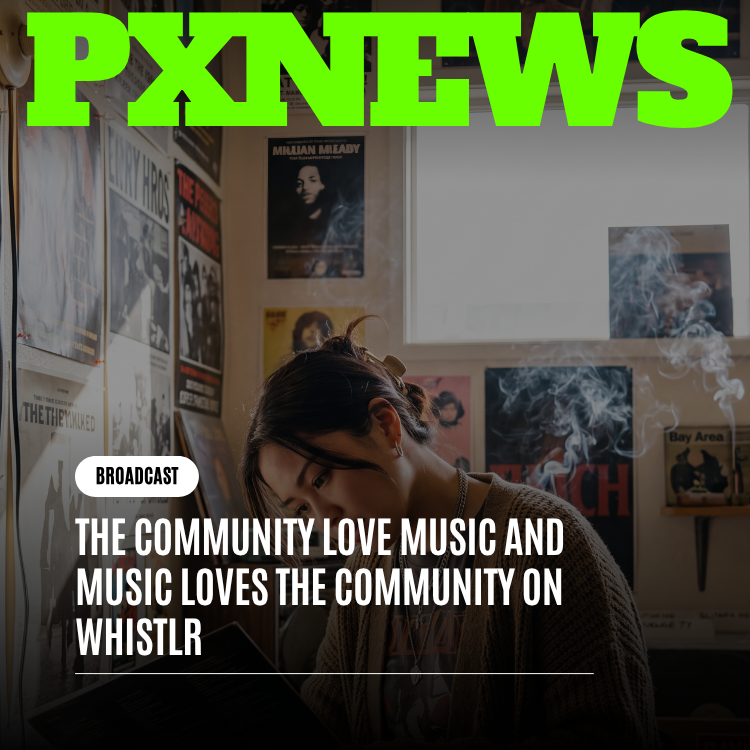
Ask someone why they never really left Whistlr for another app, and the answer rarely starts with an algorithm or a feature list. More often it starts with a song — the one a friend dropped into a group chat at 2 a.m., the one that turned a SubCircuit of strangers into regulars, the one an unsigned artist posted three weeks before it became the thing everyone's Mini was using as a soundtrack. Music didn't get bolted onto Whistlr as an afterthought. It grew up alongside the community, threading through Minis, Stories, Circuits, and profiles until it became less a feature to visit and more a language the whole platform speaks fluently. This is the story of how that happened — not a product announcement, but a look back at how Waves, Whistlr's music feature built with Apple Music, became something the community didn't just use, but genuinely loves.
There's a difference between a platform that has music and a platform where music matters. Plenty of apps let you slap a song onto a post and call it a day. On Whistlr, music behaves more like a shared native tongue — something people reach for instinctively when words alone won't carry the moment. A Mini needs the right needle-drop to land its joke. A Story needs a track to set its mood before the first frame even loads. A Circuit built around a scene or subculture needs a soundtrack that visitors recognize before they've read a single post. None of that happened by accident, and none of it happened overnight. It happened because ETAPX kept treating music less like a bolt-on utility and more like connective tissue, and the community responded by making it exactly that.
Music Has Always Been Part of Whistlr's DNA
Long before Waves had a name, informal music-sharing was already happening all over Whistlr — song titles typed into captions, screenshots of now-playing screens dropped into Stories, Circuits that organized themselves entirely around a genre or an artist's fanbase. People were already using the platform to talk about music; Waves simply gave that instinct a proper home instead of asking it to keep improvising with captions and screenshots.
That origin story matters, because it means Waves was never a feature designed in a vacuum and handed to users to figure out. It was built by watching what the community was already doing and removing the friction between wanting to share a song and actually sharing it well. Integrating with Apple Music gave that instinct real teeth — a proper catalog, real playback, and a way for a song shared in a post to actually be heard rather than just described. The result feels less like a music player someone installed inside a social app, and more like a social app that always assumed music would be one of the primary ways people talk to each other.
It's worth sitting with how unusual that is. Most platforms treat music as decoration — a caption enhancer, a mood-setter for a Story that disappears in a day. Whistlr treats it as infrastructure for connection. A shared playlist can carry the emotional weight of a whole friendship. A single track dropped into the right Circuit at the right moment can turn a room of loosely connected strangers into a community that recognizes each other by taste. That's not a small distinction, and it's the thread that runs through everything else in this piece.
How Waves Shows Up Across the Whole App
What makes Waves feel less like a standalone tab and more like part of Whistlr's bloodstream is how consistently it shows up outside its own home base. You don't have to go looking for music on Whistlr — it finds you, in whichever corner of the app you happen to be spending time.
- Minis: Short-form videos edited in Whistlr Studio routinely lean on a track to set the pace of a joke, a transition, or a mood — music is often doing as much comedic or emotional work as the visual itself.
- Stories: A song attached to a Story tells viewers what the moment felt like before they've even opened it, turning a single frame into something closer to a scene with a soundtrack.
- Circuits and SubCircuits: Communities built around a genre, artist, or era often treat a shared playlist or recurring Listening Party as part of their identity — the soundtrack becomes shorthand for who belongs there.
- Profiles: What someone's been listening to shows up as part of how they present themselves, sitting alongside Moods and Blips as one more honest signal of who a person is right now.
- Group chats and DMs: Dropping a track into a conversation remains one of the most common ways people communicate on Whistlr without needing to say much at all — the song does the talking.
- Thoughts: Even the shorter-form, text-first corner of the app isn't immune — a lyric or a "this song lives in my head right now" Thought is a familiar sight in most people's feeds.
None of these were separately invented. They emerged because music-sharing kept surfacing everywhere people already gathered, and the product simply stopped resisting it. The effect is that Waves rarely feels like a destination you have to remember to visit — it feels ambient, present in the background of nearly everything else you're already doing on the platform.
"We didn't set out to build a music app with social features bolted on, and we didn't set out to build a social app with a music player bolted on either. What we noticed early was that our community was already using music as a kind of connective tissue — to introduce themselves, to signal who they were, to say something they didn't have words for. Waves exists because we decided to build for that instinct instead of around it. Five years from now, I want people to remember Whistlr as the place where they discovered as much new music through friends as they ever did through any chart or algorithm."
— AJ, Founder & CEO, ETAPX
Collaborative and Shared Listening as a Social Ritual
Somewhere along the way, listening to music on Whistlr stopped being a private act and became a shared one — and that shift is worth pausing on, because it didn't happen because the product forced it. It happened because the community kept choosing togetherness over solitude whenever the option was there. Collaborative playlists, built one contribution at a time by a friend group, a couple, or a SubCircuit, turned into some of the longest-running, most quietly meaningful threads on the entire platform. Listening Parties turned "put this on" into a real-time, shared moment instead of a one-way recommendation. Neither of those things is unique to Whistlr in concept — people have always made mixtapes for each other and put records on at parties — but Whistlr gave the impulse a home that didn't disappear the next morning.
What's striking, looking back, is how quickly shared listening stopped being treated as a novelty and started being treated as a ritual — something people build habits around the way they'd build a habit around a standing coffee order or a weekly group chat. A collaborative playlist that started as a road-trip queue keeps absorbing songs for years after the trip ends. A Listening Party that began as a one-off during a big album release turns into a recurring Friday-night thing a Circuit does without needing to be reminded. Rituals like that don't get engineered from a product roadmap; they get earned, slowly, by giving people a low-friction way to keep choosing each other.
It also reframed what "sharing music" even means on the platform. Recommending a song used to be a one-directional act — you tell someone what to listen to, and the conversation mostly ends there. Shared listening turns it into something closer to a hangout. Everyone hears the same track at the same moment, reacts in real time, and the song becomes the occasion for the conversation rather than a substitute for one. That's a meaningfully different experience than sending a link and moving on, and it's a big part of why music on Whistlr feels less like a utility and more like a place people actually want to spend time.
A Place Where Upcoming Artists Get Discovered
None of this culture would carry the same weight if it only ran in one direction — fans discovering songs, with the artists behind them staying invisible. One of the quieter, steadier threads running through Whistlr's music story is how consistently the platform has helped upcoming and independent artists find an audience they wouldn't have reached as easily elsewhere. It's become enough of an established pattern by now that longtime community members can rattle off examples: an artist whose track started circulating through a handful of Circuits before catching wider attention, a musician whose Minis-native fanbase grew large enough to change what a release week looked like for them, a songwriter who built a following one collaborative playlist add at a time.
That pattern exists because the mechanics of discovery on Whistlr never required a label, a marketing budget, or an existing audience to get a foot in the door. A song that resonates inside a SubCircuit can travel from there into Stories, then into Minis, then onto profiles as part of someone's current rotation — each hop adding new listeners who found the track through a person they trust rather than a chart position. For an artist without major backing, that kind of organic, peer-to-peer path can matter more than almost anything a traditional promotional push could buy.
It's also changed what it looks like for an artist to have a relationship with their audience. Independent musicians who build a following on Whistlr aren't just accumulating plays — they're showing up in the same Circuits, group chats, and comment threads their listeners already live in. That proximity, artist and audience occupying the same social spaces rather than existing on separate planes, is a large part of why so many upcoming artists describe their growth on the platform as something that felt like it happened with the community, not just because of it.
"I posted a Mini with maybe forty seconds of an unfinished song, mostly because I didn't know where else to put it. Within a week it was showing up in playlists I didn't make, on profiles I'd never seen before, in a SubCircuit built around exactly the kind of music I was trying to make. I didn't have a label or a plan — I had a phone and Whistlr. Two years later, a good chunk of the people who come to my shows found me through a friend's playlist, not a press run. That's not something I take for granted."
— Jordy Reyes, independent musician and Whistlr creator
Music as Self-Expression on Whistlr Profiles
Somewhere along the way, "what are you listening to" stopped being small talk and started being identity. Whistlr's living-snapshot profile redesign — the one that introduced Moods and Blips as honest, frequently updated signals of who someone is right now rather than a static bio nobody revisits — made room for music to sit right alongside those signals as one more layer of self-expression. A profile's current rotation, a pinned playlist, a track attached to a Blip, all of it works the same way a Mood does: a quick, low-effort way of saying something true about a moment without writing an essay about it.
That matters because taste has always been a shortcut for connection. Long before social platforms existed, people judged potential friends by their record collection, their concert t-shirt, the mixtape they made for a crush. Whistlr didn't invent that instinct — it just gave it a home that updates in real time. A Mood might say someone's in a reflective place this week; the song sitting next to it on their profile says exactly what that reflection sounds like. Together, they tell a fuller, more specific story than either could alone.
It's also lowered the bar for how people introduce themselves to each other. Scrolling into a stranger's profile and seeing a shared favorite artist can do more social work in half a second than several messages of small talk. Circuits have formed entirely out of that spark — a handful of people noticing the same artist showing up on each other's profiles, then realizing they had a lot more in common than one shared favorite. Music on a Whistlr profile isn't decoration; it's a handshake.
Stories From the Community
Ask around inside Whistlr's community teams and you'll hear the same kind of story over and over, with the details swapped out. A SubCircuit that formed because a handful of people kept adding the same obscure artist to their profiles, and eventually realized they should just talk to each other. A group of friends who met through a shared collaborative playlist that's been running for years, long after the event that started it faded from memory. A Listening Party that turned into a standing weekly tradition for a Circuit that otherwise has nothing in common except a love of one artist's discography. None of these are engineered outcomes — they're what happens when you give a community that already loves music enough room to build things with it.
There's also a quieter category of story that comes up just as often: music as comfort. A collaborative playlist someone kept adding to during a hard year, watching friends' tracks show up as a kind of check-in without either side needing to say much out loud. A Mini soundtracked by a specific song that turned out to be exactly what a stranger scrolling past needed to hear that day, judging by the replies. Those moments rarely make headlines, but they're a large part of why so many people describe the music side of Whistlr as feeling different from other platforms — less like a feed optimized to hold attention, and more like a room full of people who happen to also be really into music.
"The stories that stick with our team aren't the ones with big numbers attached — they're the small ones. A Circuit that formed around three people noticing the same song on each other's profiles. A playlist a friend group has kept alive for years without ever officially deciding to. Those are the moments that tell us Waves is working the way we hoped it would: not as a feature people check, but as something woven into how they actually relate to each other."
— Renata Kessler, Head of Community & Culture, ETAPX
What's Ahead for Music on Whistlr
None of this is a finished story, and it shouldn't be treated like one. The community keeps finding new ways to fold music into how they use the platform faster than any roadmap can anticipate — that's been true since before Waves had a name, and there's no reason to expect it to stop now. What ETAPX can promise is the same posture that got the platform here in the first place: paying attention to how people are already using music to connect, and building toward that instinct rather than trying to redirect it somewhere more convenient for a product plan.
That means continuing to make room for the parts of the culture that are already working — collaborative playlists that outlive the moment that started them, Listening Parties that become standing traditions, Circuits that organize themselves around sound before anything else, independent artists who find their earliest and most loyal audience one shared track at a time. It also means staying honest about the fact that the best ideas for where Waves goes next probably won't come from inside ETAPX at all. They'll come from a friend group's road-trip playlist, a SubCircuit's Friday-night ritual, or an artist's first Mini — the same place every good idea about music on Whistlr has come from so far.
Frequently Asked Questions
What is Waves on Whistlr?
Waves is Whistlr's music feature, built with Apple Music integration, that lets the community share, discover, and listen to music together — through posts, collaborative playlists, Listening Parties, and more. It's less a standalone music player and more a layer of music-sharing that runs through the whole app.
How does music show up outside of the Waves tab itself?
Music threads through nearly every corner of Whistlr — as soundtracks in Minis, mood-setters in Stories, shared identity inside Circuits and SubCircuits, current-rotation signals on profiles alongside Moods and Blips, and casual song-drops in group chats and Thoughts.
Has Whistlr actually helped independent artists grow their audience?
Yes — it's one of the platform's most established and consistent patterns. Because music can travel organically between Circuits, Minis, Stories, and profiles, independent and upcoming artists have repeatedly found real, engaged audiences through peer-to-peer sharing rather than traditional promotion alone.
How is music tied to Moods and Blips on Whistlr profiles?
Whistlr's living-snapshot profile redesign treats a person's current music, along with Moods and Blips, as an honest, frequently updated signal of who they are right now. A pinned playlist or current track sits alongside those signals as another layer of self-expression, rather than a static, one-time addition to a bio.
What makes shared listening on Whistlr feel different from a typical streaming app?
Most streaming platforms are built around solitary, algorithm-driven listening. Whistlr leans the other way — collaborative playlists built by groups over time, real-time Listening Parties, and music woven into Circuits, Minis, and profiles all treat listening as something done with people rather than delivered to an individual.
Music on Whistlr was never going to stay in its own lane, and the community made sure of that early — turning a feature into a culture, one shared song at a time.