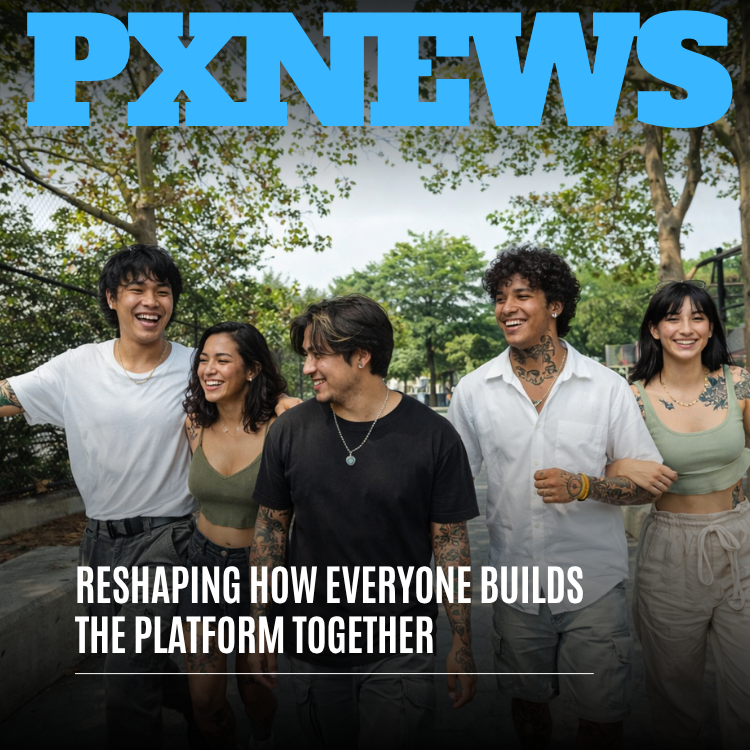
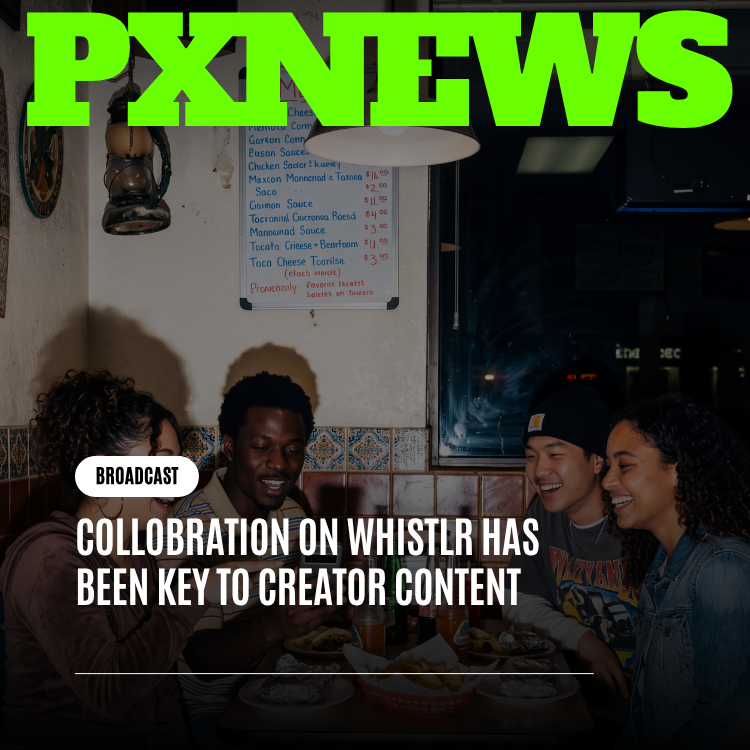
Ask a Whistlr creator what changed their growth trajectory and the answer is almost never "I posted more." It's usually a name: the co-host they went live with on Flow, the friend they duetted a Mini with, the Circuit they built alongside three other moderators, the brand they dropped a joint Storefront collection with. Two years into watching creators build on Whistlr, one pattern has become impossible to ignore — the platform's best content, and its most durable creator careers, are almost never solo productions anymore. Collaboration didn't arrive on Whistlr as a feature. It became the culture.
This is not the story of a single launch. It's a look back at how creators, communities, and small businesses on Whistlr have quietly reorganized around making things together — across live broadcasts, short-form video, communities, music, and commerce — and what that shift says about where the platform is headed next.
The Quiet Shift From Solo Feeds To Shared Ones
Go back far enough and every social platform starts the same way: one account, one feed, one person's face in the thumbnail. Whistlr launched with that same shape. But somewhere in the last year, the center of gravity moved. Scroll through Discovery on any given night now and a meaningful share of what's performing well involves more than one creator — a co-streamed Flow broadcast, a Mini with two names in the credit line, a Storefront drop stamped with two logos instead of one.
That's not an accident of what the algorithm happens to favor. It's downstream of what creators themselves have decided is worth their time. Making something with another person is, on balance, more fun, less risky, and more likely to find an audience than making it alone — and once a critical mass of creators discovered that on Whistlr specifically, it became the default instinct rather than the exception.
It also didn't happen all at once. The earliest collaborations on the platform tended to be one-off novelties — two friends going live together because it seemed like a fun idea for a night, not because either of them had a growth strategy in mind. What's changed is that those novelties stopped being occasional. Creators noticed the pattern in their own numbers, talked about it with each other, and started treating collaboration less like a special occasion and more like a default setting for how they approach a new piece of content.
The interesting part isn't that collaboration exists. Every platform has some version of a duet or a co-host slot. The interesting part is how thoroughly it has spread across every corner of Whistlr — into the live surface, the short-form surface, the community surface, the commerce surface, and the music surface — until it stopped being a feature you reach for and became the water creators swim in.
Where Collaboration Actually Shows Up
It helps to name the specific shapes collaboration takes on Whistlr today, because they're doing genuinely different creative jobs even though they share a common instinct: more than one voice is better than one.
- Co-streams and multi-host broadcasts on Flow: Two or more creators broadcasting the same live moment together, splitting hosting duties, trading the mic, and reaching both of their audiences in one shared room instead of two competing streams.
- Joint Minis: Duet-style and side-by-side short-form videos where two creators build on each other's bit, react to each other in real time, or split a scene between them — the format that most naturally rewards chemistry over polish.
- Shared Storefront drops: Two creators, or a creator and a brand, releasing a joint product or bundled collection under both names, each promoting it to their own following.
- Circuit and SubCircuit collabs: Communities built and moderated by more than one creator, or two Circuits running a joint event, thread, or challenge that pulls both memberships into the same room.
- Group Waves playlists: Informal, ongoing collaborative playlists that friend groups, couples, and SubCircuits build one song at a time — less a music feature than a shared creative object that keeps growing for months or years.
None of these were designed as a single unified "collaboration product." They emerged separately, in different parts of the app, aimed at different creative needs. What's notable is that creators started treating them as one continuous behavior — the same instinct to team up, expressed differently depending on whether the medium was live video, short-form, community, commerce, or music.
"We didn't set out to make collaboration the theme of the year. We set out to build good live tools, good short-form tools, good community tools. What we noticed afterward is that creators used all of them the same way — they kept reaching for a partner. That told us something about what people actually want from making content, not just from watching it."
— AJ, Founder & CEO, ETAPX
Why Collaboration Works So Well On Whistlr Specifically
Plenty of platforms have some version of a collab feature. Not all of them see it become the dominant creative mode the way it has on Whistlr. A few things about the platform's shape seem to explain why collaboration has taken root here rather than staying a novelty.
The first is audience cross-pollination. Whistlr's feed structure means a shared broadcast, a joint Mini, or a co-branded drop genuinely reaches both audiences rather than getting siloed behind one account. A creator with three thousand followers who partners with a creator who has thirty thousand isn't just borrowing reach for a day — they're being introduced to a real, standing audience by someone that audience already trusts. That kind of introduction converts at a rate that a cold algorithmic recommendation rarely matches, because it comes wrapped in an implicit endorsement.
The second is how low the barrier is for a newer creator to team up with an established one. Because collaboration lives inside the same tools creators already use to go live, post a Mini, or list a product, there's no separate negotiation, no external contract, no awkward request to "guest" on someone else's show through a DM and a prayer. A smaller creator can ask a bigger one to co-host a Flow stream or duet a Mini the same casual way they'd ask a friend to hang out — and increasingly, that's exactly how it's framed.
The third is simply that collaborative content is more dynamic than solo content. A creator talking to camera alone has to generate all of the energy in the room themselves. Two creators bouncing off each other generate it for free — disagreement, banter, surprise, the unscripted moment where one person makes the other laugh. Audiences can tell the difference between a performance and a conversation, and on Whistlr, the conversation increasingly wins.
The Patterns ETAPX Has Actually Observed
Watching this play out across thousands of creators over the past year, a few recognizable patterns keep repeating — different creators, same instincts.
The most common is what might be called the standing pair: two creators who aren't a formal duo, but who show up in each other's content often enough that their audiences think of them as a package. They co-stream on Flow every couple of weeks, they'll duet each other's Minis when the mood strikes, and neither one has to ask permission anymore — it's just understood. These pairings tend to start from a single successful collaboration and then calcify into a habit, because both creators noticed their numbers moved when they worked together and neither wanted to let that go.
The second is the community-anchored collab, where the collaboration isn't between two individual creators but between two Circuits or SubCircuits. A cooking SubCircuit and a budgeting SubCircuit running a joint "cook for cheap" week. A gaming Circuit and a music-focused Circuit doing a crossover event. These tend to produce some of the most durable content because the collaboration isn't dependent on two specific people staying friends — it's baked into the communities themselves, and it keeps happening even as individual moderators come and go.
The third is the commerce collab — two creators, or a creator and a small brand, launching a joint Storefront drop timed to a live moment. What's notable here isn't the transaction itself but the trust transfer. A creator's audience buys into a joint drop partly because their favorite creator vouched for it, and partly because seeing two names on the same product signals it wasn't a one-off cash grab — somebody put real thought into it together.
And running quietly underneath all of it is the group Waves playlist — less a growth strategy than a social ritual. Friend groups, couples, and SubCircuits keep a shared playlist running for months, each person adding songs as they think of them. It's rarely framed as "content" at all, but it's one of the clearest examples of the same underlying instinct: build something together, slowly, rather than alone.
"My first real growth moment on Whistlr wasn't a video I made by myself, it was a co-stream I got invited onto almost as a joke. I had maybe eight hundred followers. The creator I streamed with had close to forty thousand. By the end of that one broadcast I'd picked up more new followers than I had in the previous four months combined, and a bunch of them stuck around because we kept doing it. I don't think I'd still be creating if that first collab hadn't happened."
— Malik Torres, Whistlr Creator
What This Means For Newer And Smaller Creators
The most consequential effect of Whistlr's collaboration culture may be on the creators who are just starting out. Every platform tells new creators the same thing: post consistently, be patient, the algorithm will find you eventually. That advice is true but slow, and it asks a lot of someone with no audience and no feedback loop telling them whether they're on the right track.
Collaboration offers a faster, warmer on-ramp. A brand-new creator who lands one co-stream, one joint Mini, or one guest spot in an established Circuit gets something a solo post rarely delivers this early: a real audience, introduced by someone that audience already trusts, all at once. It doesn't guarantee they'll stick, but it gives them a fair first look — which is often the hardest thing to earn from a cold start.
Established creators, for their part, have increasingly leaned into this as a deliberate part of how they operate rather than an occasional favor. Bringing a newer creator onto a stream or into a joint drop costs the established creator very little and does something valuable for the platform as a whole — it keeps the pipeline of new talent moving instead of letting attention concentrate permanently at the top. Several of the creators ETAPX has spoken with describe it almost as a form of mentorship, one collaboration at a time.
"The healthiest creator ecosystems aren't the ones where a handful of huge accounts hoard all the attention. They're the ones where attention keeps circulating — where a bigger creator bringing a smaller one into their stream is just a normal Tuesday. That's what we're seeing on Whistlr, and it's a big part of why the platform feels alive instead of static."
— Renata Osei, VP of Product, ETAPX
What Makes A Collaboration Feel Different From A Solo Post
There's a texture to collaborative content that solo content rarely has, and creators who've done both describe it consistently. Solo content is planned, scripted, and controlled — a creator decides in advance what they're going to say and how they're going to say it, and the audience is watching a performance. Collaborative content is negotiated in real time. Two people on a Flow co-stream don't fully know where the conversation will go. Two creators duetting a Mini are, in a small way, improvising off each other. That unpredictability is exactly what makes it compelling to watch.
It also tends to feel more honest. Audiences have gotten very good at detecting when a creator is performing a persona versus when they're actually reacting to another human being in the room. A joint Storefront drop with genuine back-and-forth between two creators about why they made the product a certain way reads as more credible than either creator promoting it solo, because the audience is watching two people convince each other, not just one person try to convince them.
There's also a practical creative benefit that doesn't get talked about as much: collaboration lowers the cost of a bad idea. A creator working alone has to fully commit to a concept before they know if it will land, and a flop feels entirely like their own. Two creators trying something together can bail on a bit that isn't working mid-take, laugh about it, and pivot — and often that pivot becomes the best part of the video. Working with someone else makes experimentation cheaper, and cheaper experimentation tends to produce better content over time.
Community Reaction: Why Audiences Keep Asking For More
Audience behavior backs this up. Comment sections on collaborative content run differently than on solo posts — viewers show up asking when the two creators will do it again, tagging friends to introduce them to a creator they hadn't followed before, and treating the collaboration itself as an event worth discussing rather than just another upload. Circuits built around a shared interest have started organizing their own informal collab calendars, coordinating joint streams or crossover threads around community milestones without any prompting from ETAPX.
That kind of organic demand is the clearest signal that collaboration isn't a gimmick creators are using to game a feed — it's something audiences on Whistlr have come to actively want, and increasingly expect, from the creators they follow. When a favorite creator goes quiet on collaborations for a stretch, their own community tends to notice and ask about it, which says a great deal about how normalized the expectation has become.
What It Means For Whistlr's Growth And Community Feel Going Forward
Zoom out and the cumulative effect of all this collaborative behavior is a platform that feels less like a collection of individual broadcasts and more like an interconnected community — one where discovering a new favorite creator usually happens through someone you already follow, rather than through a cold algorithmic guess. That has real implications for how Whistlr grows. Every collaboration is, in effect, a small act of distribution that doesn't cost anything beyond two creators deciding to make something together, and it tends to bring in audiences that arrive already primed to trust what they're seeing.
It also shapes the emotional texture of the platform. A network where creators are constantly teaming up, crediting each other, and showing up in each other's content feels warmer and more communal than one where every account is an island competing for the same finite attention. That's not a small thing for a platform whose identity has always leaned toward the social and the friend-first over the purely transactional.
Looking ahead, the expectation inside ETAPX is that this trend keeps compounding rather than plateauing. As more creators experience firsthand what a good collaboration can do for their reach, their creative output, and honestly their enjoyment of making content in the first place, teaming up stops being a strategy they occasionally reach for and becomes simply how they work. The solo post isn't going away — plenty of great content will always start and end with one person and one idea. But on Whistlr, the ceiling increasingly belongs to creators who know how to bring other people along with them.
None of this requires a grand plan from any one team to keep going. It requires the same thing that got it here in the first place: creators noticing that the people around them make their work better, and reaching for a partner the next time they have an idea worth making. If that instinct holds — and everything ETAPX has observed over the past year suggests it will — collaboration won't just remain a big part of Whistlr's creator culture. It will keep becoming a bigger one.
"If you'd asked us at the start what would define the Whistlr creator experience a year or two in, I'm not sure 'collaboration' is the first word we'd have used. But it's the word creators keep using about their own best content. When your users tell you what's working for them that clearly, and that consistently, you build around it."
— John Ridge, CTO, ETAPX
Frequently Asked Questions
Why has collaboration become so central to content on Whistlr?
Because it works better along nearly every dimension creators care about. Collaborative content reaches more people through audience cross-pollination, feels more dynamic and authentic than a solo performance, and lowers the barrier for newer creators to get in front of an established audience. Once enough creators experienced those benefits firsthand, teaming up shifted from an occasional tactic to a default habit across the platform.
What are the main ways creators collaborate on Whistlr?
The most common forms are co-streamed and multi-host broadcasts on Flow, duet-style or joint Minis, shared Storefront drops between two creators or a creator and a brand, joint efforts and crossover events between Circuits or SubCircuits, and collaborative Waves playlists built by friend groups, couples, or communities over time.
Does collaborating actually help smaller or newer creators grow?
Creator accounts and internal observation both point to yes. A single collaboration with an established creator can introduce a newcomer to a real, trusting audience in a way that slow, consistent solo posting takes much longer to achieve. It's not a guarantee of long-term growth, but it consistently gives new creators a fairer first look than starting from zero alone.
Is collaborative content just for big, established creators?
No — if anything, the newer and smaller creators tend to see the most dramatic relative impact, since they have the most room to gain from being introduced to a bigger audience. Established creators benefit too, largely by keeping their content feeling fresh and by playing a role in bringing new talent into their communities.
What does ETAPX see ahead for collaboration on Whistlr?
The expectation is that collaborative behavior keeps growing rather than leveling off, spreading further into how creators plan content from the outset rather than something they add on top of solo work. As more creators experience the reach, creative energy, and community feel that collaboration brings, it's expected to keep shaping the platform's identity as a genuinely social, friend-first place to create.
None of this was engineered from a single feature spec — it's the sum of thousands of creators independently arriving at the same conclusion: making things together, on Flow, in Minis, through Circuits, across Storefront drops, and one song at a time in a shared Waves playlist, simply makes for better content and a better platform. That's the story of Whistlr's creator ecosystem so far, and it's shaping up to be the story of where it goes next.