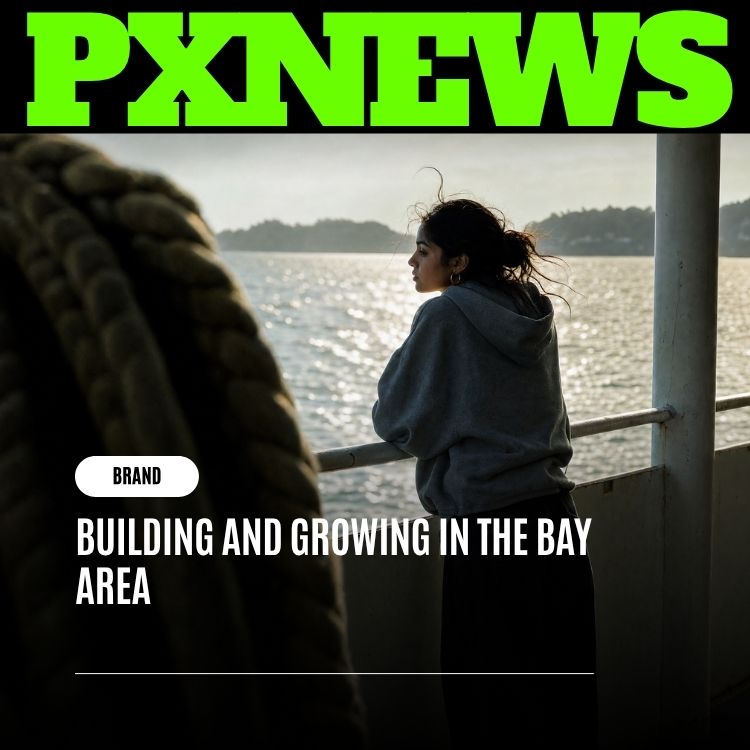
Every company has an address. Not every company has a home, and the difference is bigger than it sounds. ETAPX's home is the Bay Area, a stretch of hills, fog, and crowded city blocks that has spent the better part of a century teaching the people who live here the same lesson on repeat: building and growing aren't two separate chapters of a company's life, they're one continuous habit, practiced daily by whoever's in the room that year. This is a story about that habit — about what it means to build Whistlr, GLSRM, Ocsidian, and now Influxx inside a place that has never once let its builders forget they're standing on other people's shoulders, and about the community that has grown up around all of it.
A Region Built on the Habit of Building Something Next
Long before anyone at ETAPX had written a line of the Whistlr feed or sketched what GLSRM's front page should look like, this region had already reinvented itself several times over. Orchards became defense plants. Defense plants became garages. Garages became the semiconductor floor, then the PC clone shop, then the dot-com loft, then the app studio, then whatever comes after that, on a timeline that never really stops moving. Each wave left behind people who'd learned the same private lesson: the thing you're building right now is not the last thing you'll build, and the region around you expects you to already be thinking about the next one.
That expectation isn't written on a welcome sign anywhere, but it doesn't need to be. It's carried by the people who show up in this region generation after generation — people who left somewhere else specifically because they wanted to be near others who took building seriously, and who then became, without necessarily meaning to, the reason the next wave of arrivals chose to come too. AJ didn't invent that pattern by starting ETAPX here. He inherited it, the same way every founder in this region eventually does, whether they arrived last year or grew up five exits down the freeway.
What's easy to miss, if you only read the region from a distance, is that the habit was never really about any one technology. Semiconductors gave way to software gave way to social platforms gave way to whatever the current wave gets called this year, and the technology changed completely each time. What didn't change is the underlying instinct: build something, watch it get outgrown, and start the next thing before you're finished admiring the last one. ETAPX didn't have to import that instinct from somewhere else. It was already the local dialect, spoken long before this company had a name.
More Industries Than the One Everyone Talks About
Say "Bay Area," or reach for the older shorthand, Silicon Valley, and you'll get one association back almost every time: tech, and lately, AI. That reputation is earned — a meaningful share of the industry GLSRM, ETAPX's front page for AI, covers as a full-time beat is built within a short drive of our office. But treating the whole region as one tech ecosystem and nothing else misses most of what actually makes it feel the way it does day to day, and it misses most of what shapes ETAPX as a company too.
This is also a region of dockworkers and dairy farmers a county over, of two of the country's most influential university towns, of a food culture built by generations of immigrants who arrived with nothing resembling a pitch deck, of muralists and shipbuilders and teachers and nurses, of a live-music scene that predates any of the current tech wave by decades, of small business owners who've spent thirty years perfecting one shop instead of chasing one exit. It's talent-dense, no argument there, but that talent wears more hats than the industry's reputation suggests, and none of it shows up in a "why founders love the Bay Area" listicle.
That texture matters to ETAPX specifically because Whistlr was never built as a platform for one kind of person doing one kind of work. It was built on the belief that everyday creators — the person running a small pop-up, the local musician, the group chat that basically runs a neighborhood's social calendar — deserve the same real tools as anyone with a verified badge and a publicist. A region that has always had far more working artists and small builders in it than it has headline-grabbing founders is, in that sense, a strange kind of proof of concept for the whole idea behind Whistlr, sitting right outside our windows every day.
What Building and Growing in the Bay Area Actually Teaches You
Ask anyone who has spent real time building something here what the region actually gives them, day to day, and you'll get answers that are smaller and more specific than "energy" or "access." They tend to sound something like this:
- Patience gets normalized: Everyone around you has watched a promising idea take years longer than planned to click, so a rough quarter reads as ordinary rather than alarming.
- Craft gets rewarded over noise: In a region this crowded with genuinely serious builders, a polished-but-empty demo gets seen through fast, and a rough-but-real one earns real respect.
- Scale stops being abstract: You can watch, in real time and often in person, what it actually looks like when a small idea turns into something a lot of people rely on, because someone nearby has usually already lived through that exact climb.
- Reinvention loses its stigma: A region that has rebuilt its own core industry every couple of decades doesn't treat a pivot, a relaunch, or a total rethink as a failure story — it treats it as Tuesday.
- Ambition becomes a shared language: Saying out loud that you want to build something a lot of people end up using isn't received here as arrogance. It's just how people here talk.
None of that is unique to any one company, and it isn't something ETAPX can take credit for creating. It's ambient. It's in the coffee shops, the shared workspaces, the night classes people take to learn a skill for what they're building on weekends. ETAPX gets to build inside that atmosphere rather than having to manufacture it internally from scratch, and that's a genuine advantage, quietly compounding, that has very little to do with any single hire or any single funding round.
Growing Alongside a Community That Already Believes in Builders
It would be easy to tell this story only about the people on ETAPX's payroll, but that would leave out the half of it that actually matters more. The region's belief that anyone can decide, on a given weekend, to start building something real is the same belief Whistlr is built around — Circuits and SubCircuits exist so a community can organize itself around a shared interest without waiting for permission from anywhere, and Creator Studio and Gems exist so someone's weekend project can become their actual living without needing a studio deal first. That's not a coincidence of good product instincts. It's the regional habit, translated into software.
Ocsidian carries the same instinct into an entirely different medium. The BlackFrost Engine exists because building a game used to require a team, a publisher, and a multi-year runway that most people with a great idea simply didn't have access to. Ocsidian's bet is that the person who might have otherwise spent years just learning the tools should instead get to spend that time actually building the world they imagined — which is, again, exactly the story this region has told about itself for decades, just pointed at a new craft.
Influxx is the newest resident of that same instinct, and it's worth naming directly because it's the freshest proof the habit hasn't slowed down. It's ETAPX's newest flagship agentic environment, and the premise is disarmingly simple: describe the outcome you're actually after, and let the work of getting there be carried out on your behalf. That's a very Bay Area kind of bet to make — that the gap between having a real idea and actually seeing it built should keep shrinking, generation after generation, rather than staying fixed. Every product ETAPX ships is, in some sense, another argument for that same bet.
The Fog, the Hills, and the Neighborhoods That Shape How We Think
It's tempting to talk about a region entirely in terms of its industries and skip the physical place itself, but the physical place is doing more work than it gets credit for. The fog that rolls in most afternoons and burns off most mornings. The hills that mean two neighborhoods four minutes apart by car can feel like different climates and different decades. The bridges that make "across the water" a real, felt distance instead of a line on a map. People who build here build inside that geography, whether they notice it or not, and it shows up in small ways — a preference for walking a problem out loud instead of just messaging it, a habit of running into the same people often enough that professional relationships slowly turn neighborly.
Small Rooms Before Big Stages
Almost everything that eventually gets described as a regional phenomenon here actually started in a small room: a garage, a dorm lounge, a back booth at a diner that's been open since before any of the current wave of companies existed. That history creates a specific kind of humility that's easy to underestimate. Nobody who has spent real time in this region believes a big outcome starts out looking big. It starts out looking like a handful of people arguing about a detail nobody outside the room would think mattered yet, in a space too small to hold whatever it eventually becomes.
A Region Full of People Who Moved Here to Become Someone
A huge share of the people who make up this region's daily life didn't grow up here. They arrived from somewhere else, often with very little, because this seemed like the place where the version of themselves they wanted to become was most possible. That's true of engineers, and it's just as true of line cooks, muralists, nurses, and small-business owners who never once wrote a line of code. ETAPX's own team includes plenty of people who fit that same description, and the company's instincts have absorbed something from all of them, not just from the ones whose job title happens to match the industry the region is famous for.
Bringing the Neighborhood Into Campus and PX News
None of this stays confined to the physical office, and it isn't meant to. Campus, ETAPX's official Discord, is a global community that spans time zones the actual headquarters never will — but the habits that show up there trace back to the same regional instinct described above: show up, be direct, help the person next to you build the thing they're working on, and don't wait for an official program to give you permission to be useful. A lot of the best moments in Campus look less like customer support and more like the informal version of a regional meetup, just happening in a text channel instead of a coffee shop.
"I moved out here a few years ago with a duffel bag and a laptop, not really knowing anyone. The first place that felt like a real community wasn't a job — it was Campus. It's the first time an app's Discord has actually felt like the neighborhood I was trying to find when I moved here in the first place."
— Yuki Tanabe, Whistlr creator and Campus community member
PX News carries the same instinct into a different format. A local newsroom, at its best, treats its neighborhood's builders, disasters, arguments, and small wins as genuinely worth writing about in detail, not just when they're big enough to go national. That's the standard we try to hold PX News to for ETAPX's own community — writing about a Circuit that grew from a dozen members into a real gathering place, or a Whistlr creator whose Gems income let them go full-time, with the same seriousness a good regional paper gives to any other real, local story. The Campus Store exists in that same spirit: a physical, tangible way for a global community to wear something that says they were part of this specific place and this specific moment, not just a generic fan of an app.
Ambition We Want, Excess We Don't
Living inside a region this ambitious for long enough teaches you its lessons, and not all of those lessons are ones worth repeating. This place has also produced plenty of products built to be as consuming as possible, growth chased well past the point where it served the people generating it, and a few genuinely painful, well-documented lessons about what happens when engagement quietly becomes the only metric that matters. Growing up around that history, even at a distance, is itself a kind of education, and it's one ETAPX has tried to actually learn from rather than just observe from a comfortable distance.
That's part of why creators-first design, non-addictive product decisions, mental-health-conscious pacing, and transparent moderation aren't treated internally as a marketing checklist — they're closer to a direct response to a specific regional history everyone here has watched play out. Whistlr's Moods and Thoughts are built to give people a lightweight way to express something small without turning every feed into a permanent highlight reel. Flow and Stories are paced with an actual end in mind rather than an infinite one. None of that would be a particularly interesting design choice in a region that hadn't already shown, repeatedly, what the alternative tends to cost the people using the product.
"You can't build here for very long without watching a product get too good at holding attention and not good enough at deserving it. We wanted the ambition this region hands you for free. We didn't want the part where growth becomes the only thing a team is allowed to care about."
— Colin Nakashima, Head of Brand at ETAPX
That distinction — wanting the region's ambition without importing its worst habits — is a harder needle to thread than either extreme. It would be simpler to chase growth at any cost, or to reject ambition altogether and call that restraint — the two extremes startup culture usually offers. ETAPX has tried to hold the harder middle position: build with the same seriousness and drive this place has always demanded, while measuring success by whether the community around Whistlr, GLSRM, Ocsidian, and Influxx is actually better off, not just bigger.
Frequently Asked Questions
Why does ETAPX describe itself as a Bay Area company instead of just a tech company?
Because the region has shaped a lot more about ETAPX than its industry classification does. Being here means building alongside a much wider culture of ambition than any one sector, tech included, and that broader culture of building and growing shows up in ETAPX's products and community as much as any specific technology does.
Is this piece about why AJ chose to headquarter ETAPX in person instead of going remote-first?
No — that's a different, more personal story we've told elsewhere on PX News, focused specifically on AJ's own reasoning for building in a shared room. This piece is broader: it's about how the Bay Area's culture and history of building and growing shape ETAPX's identity and community, separate from any single hiring or office decision.
Does this mean ETAPX is primarily an AI company because of its location?
No. ETAPX builds Whistlr, GLSRM, Ocsidian, and Influxx, and while a meaningful share of the AI industry GLSRM covers is genuinely nearby, that's one thread in a much larger regional fabric that includes universities, immigrant communities, working artists, and generations of builders across industries that have nothing to do with AI at all.
How does the Bay Area's culture actually show up in ETAPX's products?
Mostly through instinct rather than direct reference. Whistlr's Circuits, Creator Studio, and Gems are built on the same belief the region has always held about everyday builders deserving real tools; Ocsidian's BlackFrost Engine applies that same belief to game creation; and Influxx extends it further, aiming to shrink the distance between having an idea and actually seeing it built.
Does ETAPX see any downsides to being shaped by this specific region?
Yes, and we'd rather be honest about them than only tell the flattering version. The same regional history that rewards ambition has also produced products built around unhealthy engagement, and ETAPX has deliberately tried to take the region's drive to build and grow without inheriting that particular habit.
An address is just where a company happens to be registered. A home is something a company, and the people who build it, actually absorb — its habits, its history, its mistakes, its stubborn insistence that the next thing is always worth building. ETAPX's home has been the Bay Area from the start, and every product this company has shipped, from Whistlr's first Circuit to Influxx's newest workspace, carries a little of that home inside it. Building and growing were never separate goals here. They were always just the region's name for the same continuous habit — and it's the one ETAPX intends to keep practicing.